


When Berdiansk fell under occupation, the first target of the Russian forces was the TV tower. Along with the signal of Ukrainian television channels, residents lost access to reliable information. Russia began building its own information space, immersing people in propaganda.
It is this information occupation that Locator Media is working against. Their materials show how propaganda becomes a weapon: from imposing Soviet films on children to creating fake “statistical data” about unemployment.
The team participates in our Stronger Together: Transparency and Anti-corruption project, through which it has already prepared and published nine investigations. Several of them focus on the situation in temporarily occupied territories, including materials about vocational education under occupation and about who and how helps Russia spread propaganda in the occupied territories.
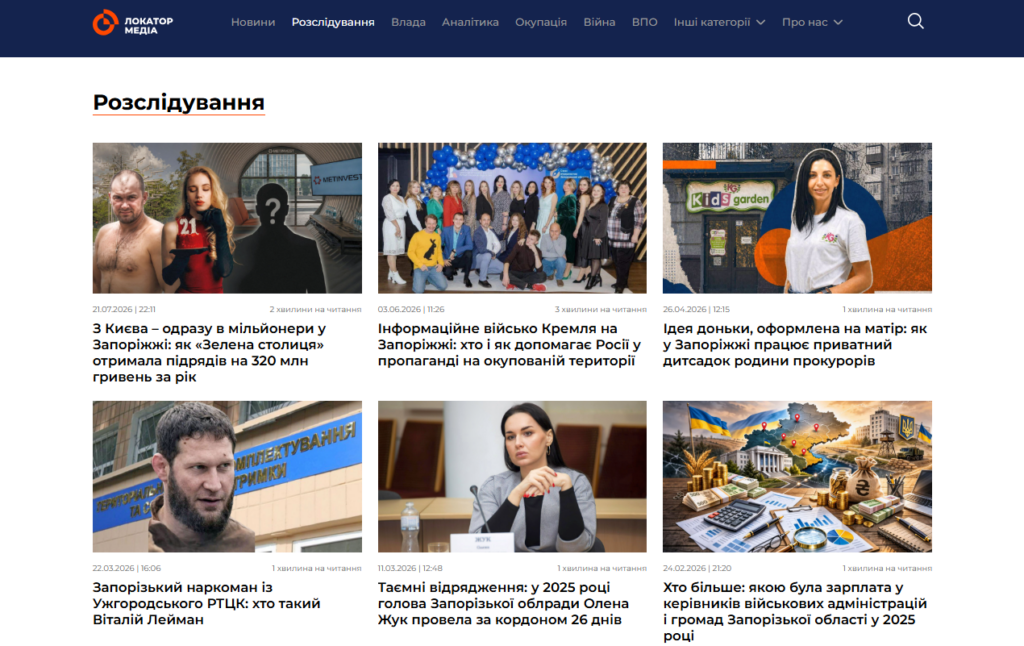
After the publication of the latest investigation (“The Kremlin’s Information Army in Zaporizhzhia”), the editorial team prepared eight reports to the Security Service of Ukraine regarding the alleged criminal activities of the individuals mentioned in the material. These reports have led to ongoing investigations into the activities of ten propagandists who are conducting subversive work against Ukraine in the temporarily occupied territory of Zaporizhzhia region.
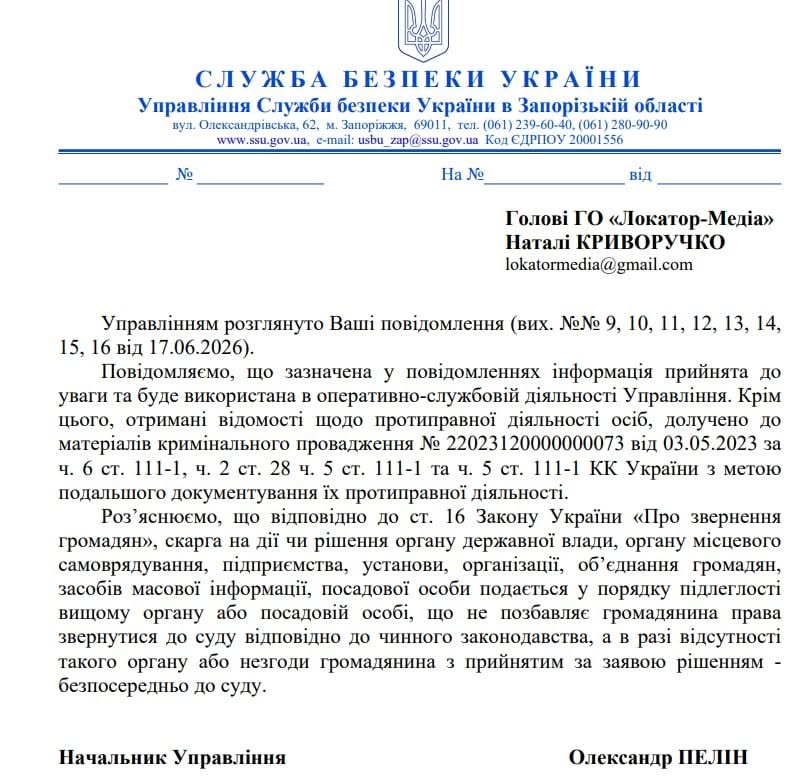
It was the support of the Stronger Together program that made it possible to bring the investigation to a result that is now being used by the Security Service of Ukraine.
— We are grateful to the Stronger Together program. It makes us independent and strengthens us, — says Natalia. — All our publications undergo legal review, and we receive support from our mentor Oleksandra Hubytska. The editorial team’s journalists regularly take part in trainings thanks to this program. They say that at every training they learn about “tricks” and tools they would never have discovered without this support.
We decided to ask Natalia in more detail about the editorial team’s work on this investigation and, more broadly, about the specifics of Russian propaganda in the temporarily occupied territory of Zaporizhzhia region.
Television, Cinema, and Telegram: How Russian Propaganda Spreads
— The situation in the temporarily occupied territories in the media sphere is extremely difficult, — says Natalia. — We must not underestimate our enemy. The Russians are characterized by very clear, consistent, and structured actions. One of the first things they do when taking control of a territory is depriving people of their usual communication channels. For example, in my hometown of Berdiansk, the Russians damaged the local TV tower literally on the first day of the occupation. People are completely immersed in the Russian information space.
Over four years of occupation, the Russians have significantly strengthened their position in the media sphere, which makes it much easier for them to promote their narratives.
— First of all, they install their own “Russkiy Mir” satellite kits instead of the “Horynych” satellite kits, — Natalia explains.
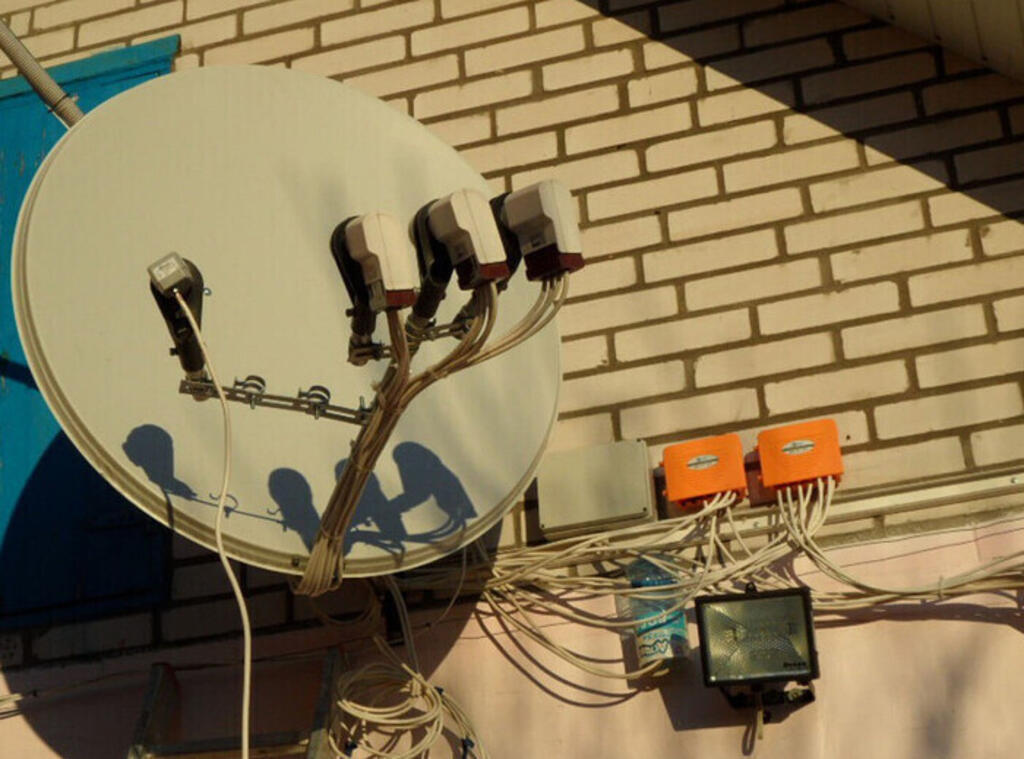
“Horynych” is a satellite antenna that allowed users to receive Ukrainian television channels. The Russians banned its use, replacing it with “Russkiy Mir” kits, which broadcast only Russian channels.
— The propaganda machine targets viewers through 20 major Russian television channels, 7 regional television channels, 14 entertainment channels, as well as 3 radio stations, — says Natalia.
In addition to television, Telegram has become an important channel for spreading propaganda in the temporarily occupied territories.
— Every day, I personally monitor around 40 Telegram channels run by the occupiers, studying their narratives, — Natalia says. — And I am very concerned about the lack of an effective mechanism to counter these narratives and messages.
The occupied territories appear in the occupiers’ media in very different ways. There is a huge difference in how a certain perception and understanding of these territories is being shaped.
— For example, Donetsk and Luhansk regions appear in the occupiers’ messages exclusively as the “DPR” and “LPR,” — says Natalia. — The essence of these messages is that residents of these regions allegedly decided on their own to separate from Ukraine and create quasi-republics.
The situation with Zaporizhzhia and Kherson regions is different:
— These territories are presented as “historical territories,” meaning the main narrative is that “they are historically Russian lands.” These regions are portrayed as part of Russia as separate regions.
Accordingly, the information space is shaped around the idea, Natalia says, that the so-called “special military operation” (the term Russia uses for the war against Ukraine — Ed.) is “the return of territories because they have always been Russian.”
A common narrative promoted by Russian propaganda is that everyone who fought (in World War II, or the “Great Patriotic War” in Russian terminology, and in the so-called “special military operation”) is a hero by definition. This creates a perception that the two wars are equivalent: that during World War II, people fought against the Nazis (evil), and now, supposedly, they are fighting against “Ukrainian Nazis” and evil.
The Russians also spread their propaganda through cinema, recommending Soviet films from the 1960s and 1970s for schoolchildren to watch:
— Through this type of propaganda, they impose narratives such as “one united country,” “the great Soviet Union,” “Ukrainians and Russians are one people,” “how good life was in the Soviet Union,” and others, — says Natalia. — Young Ukrainians, teenagers, and children do not have access to contemporary cinema. Instead, Russian propaganda immerses them in a distant past, creating a parallel reality in which Ukrainians are presented as “younger brothers of Russians.”
How to Counter Propaganda: Fact-Checking, Investigations, and a Database of Collaborators
Propagandists and collaborators, who serve as Russia’s mouthpieces, play a significant role in promoting these narratives. One of the tasks of regional media is to debunk these narratives and explain the nature of manipulation, outright lies, and propaganda, says Natalia.
— For example, at our Locator Media, we create video content called “Zaporizhzhia Fact Check.” In these videos, I talk about the occupiers’ lies, expose their manipulations, and show audiences events in the temporarily occupied territories through the lens of critical thinking.
Of course, security issues arise as well.
— Journalists cannot work safely in the occupied territories, — says Natalia. — This is not even something that should be debated. In the part of Ukraine under government control, we do not feel pressure because of our materials about the temporarily occupied territories.
Since 2022, part of the editorial team’s work has been directly connected with identifying the activities of collaborators:
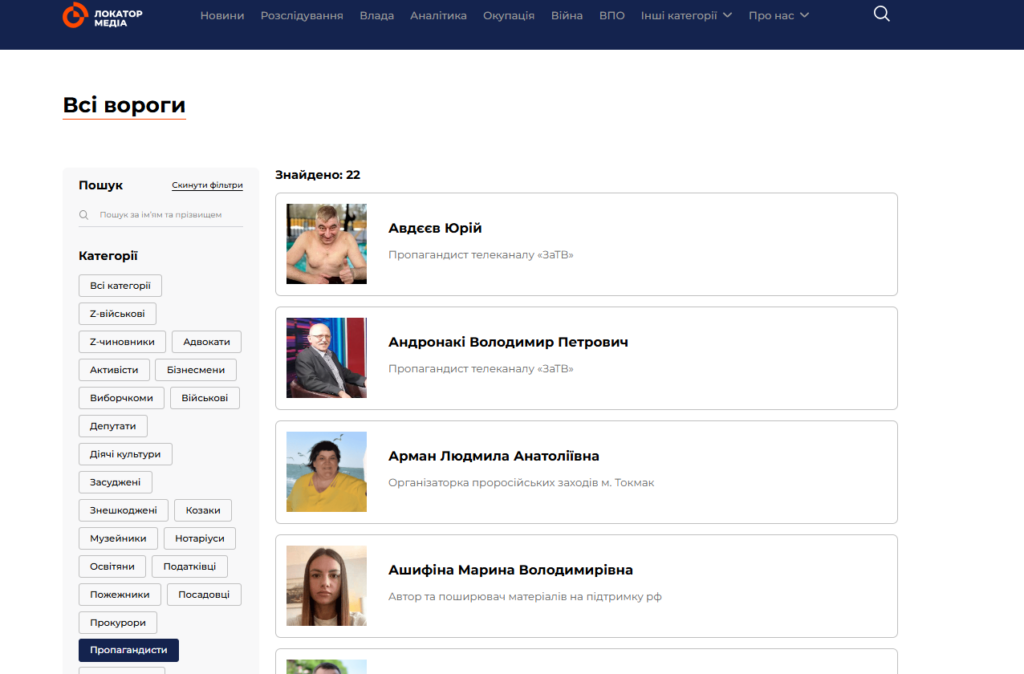
— We carefully collected information and published it on our platforms. This is how the first and only regional database of occupiers and collaborators, “Vorozy Zaporizhzhia” (“Enemies of Zaporizhzhia”), was created. Every month, it receives one of the highest numbers of views among our materials.
Natalia has already testified several times to law enforcement authorities, using profiles from this database.
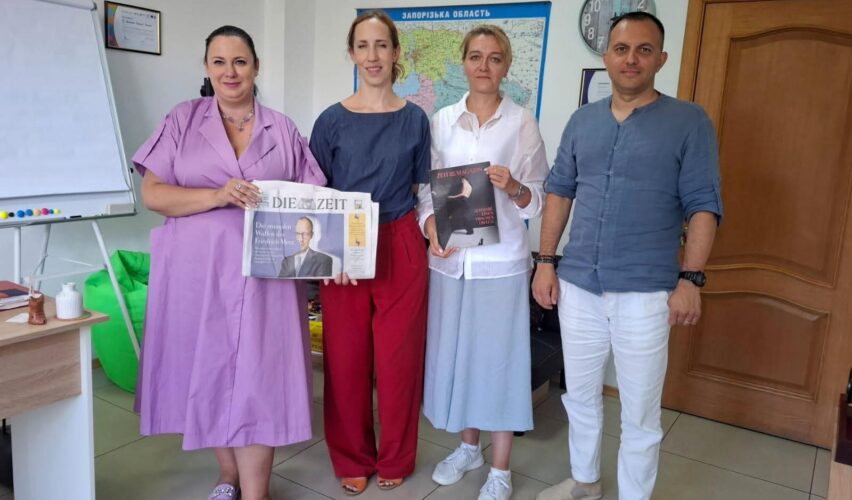
— We also provided information to Archives of War — interviews with people who lived through the occupation, photos, and videos, — says Natalia. — Our materials are regularly used by international organizations and journalists: in 2025, we spoke about the occupation to colleagues from Japan and Germany.
Investigations that reveal the mechanisms and individuals behind propaganda are, of course, complex and time-consuming work.
— Preparing an investigation was based not only on collecting information about propagandists, — says Natalia. — It involved gathering information about propaganda distribution channels and their owners. Of course, everything is made much more difficult by the fact that we do not have access to certain Russian websites. They cannot be opened even through a VPN. We cannot send requests for information or ask for comments. So a lot of time was spent collecting information literally piece by piece.
For example, the already mentioned investigation by Locator Media Editor-in-Chief Oleksandr Pylypenko, “The Kremlin’s Information Army in Zaporizhzhia: Who and How Helps Russia Spread Propaganda in the Occupied Territory”:
— The peculiarity of such investigations is that you need to give them time. It is impossible to immediately create a complete picture of the media landscape in the temporarily occupied territories; months or even years are needed to carry out such large-scale work.
Accordingly, journalists spend a long time collecting materials for an article:
— This is not something that can be done in three months, — says Natalia. — You need to verify many things. For example, you need to make sure that the individuals involved are engaged in propaganda activities in the temporarily occupied territories voluntarily, without coercion. This requires analyzing a large amount of information: participation in events, awards and certificates received from the occupiers and collaborators, personal statements supporting the so-called “SMO” or the occupation of territories. In addition, some of the people mentioned in the article are not even residents of Zaporizhzhia region or Ukraine.
For the editorial team, which relocated from the temporarily occupied territories of Zaporizhzhia region and is now based in Zakarpattia, such investigations are valuable from the perspective of its mission. They are a way to contribute to documenting Russia’s crimes against Ukraine, including its criminal influence on children and young people.
— Before publishing the article, we had already presented some of its findings to the public and to broader circles of influence, — Natalia explains.
She is referring to members of parliament and members of the Expert Council under the Temporary Investigative Commission of the Verkhovna Rada on investigating crimes committed by the armed formations of the Russian Federation against journalists and other media workers. Natalia is also a member
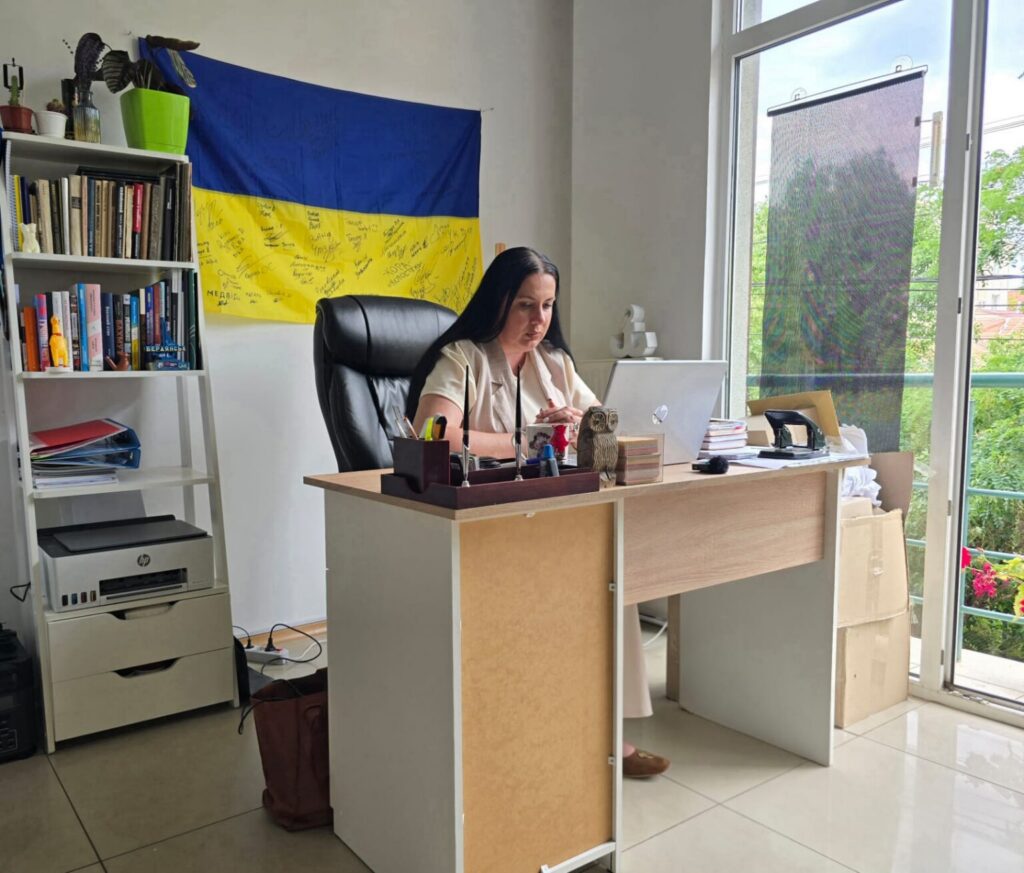
Natalia is convinced that a national media outlet would not be able to examine the situation in the temporarily occupied territories as deeply as a regional one that covers such issues on a regular and systematic basis.
— These are, in fact, chapters of future history textbooks about Russia’s war against Ukraine, — says Natalia. — They are educational materials for journalism students and a ready-made evidence base for law enforcement agencies. We must make greater efforts to bring this shift in focus and perception to a wider audience.
What’s Next
The editorial team is already preparing its next major investigation, dedicated to the State Duma elections in the temporarily occupied territories of Zaporizhzhia region, which the Kremlin has scheduled for September. It will be an in-depth study of the candidates’ backgrounds, the organization of the electoral process, and other related issues.
— Materials on similar topics should also be published regarding other occupied territories, — says Natalia. — Because, as I have said, this is a way of documenting historical events, and these are ready-made cases for students at specialized universities and more.
Systematic joint work against Russian narratives that are being imposed is extremely important, Natalia says:
— Because the occupation has lasted for years—more than a decade in some places. A new generation is growing up that has lived entirely within the Russian information space. How are we going to counter this? Of course, media outlets relocated from the temporarily occupied territories do not have enough resources to create separate products focused on countering Russian propaganda. But with donor support, it is possible to launch critical thinking schools, special projects about the situation in the temporarily occupied territories, and develop fact-checking guidelines and other resources.
In conclusion, Natalia addressed her colleagues from regional media:
— To colleagues who work with content about the temporarily occupied territories, I would like to encourage them to view events in these territories as an integral part of the content they create. The more we write about the temporarily occupied territories, the more chances we have to ensure that evil does not go unpunished. The results of the article “The Kremlin’s Information Army in Zaporizhzhia: Who and How Helps Russia Spread Propaganda in the Occupied Territory” are an example of how journalistic work can go hand in hand with the fight for freedom.
A reminder: insurance is available
Colleagues, a reminder: journalists working in high-risk regions have the opportunity to obtain free life and health insurance. This is part of the International Insurance Fund for Journalists (IIFJ) initiative, implemented in partnership with Ukrainian and European organisations.
Media professionals working in Kherson, Zaporizhzhia, Sumy, Mykolaiv, Donetsk, Luhansk, Odesa, Kharkiv, and Dnipropetrovsk regions, as well as border areas of Kyiv and Chernihiv regions, can apply. More information about the terms of free insurance is available here.
This article is part of a series of publications on the work of regional media in wartime conditions, safety protocols, and the psychological resilience of journalists. We have already published interviews with Zarina Zabrisky (Parts One and Two), Oleksandr Kachura, Vladyslav Safronov, Natalia Bilokudria, Serhii Horbatenko, Yevhen Khrypun, Anna Kaliuzhna, Polina Kulish, Nadia Sukha, Nadiia Karpova, Oleksandr Solomko (Parts One and Two), Diana Butsko, Oleksii Pasiuha, Oleksandr Chubukin, Aliona Serhiienko, Olha and Serhii Sydorov, Yevheniia Hrytsyna, Nataliia Kryvoruchko, Inna Shvydka, Pavlo Kliuchnyk, Larysa Hnatchenko, Diana Deliurman, Viktoriia Hnatiuk, Mariia Shevchenko, Anna Matviienko, Nastya Stanko, Iryna Sytnik, Svitlana Tomash, Olesia Bida, Yevhen Nazarenko, Oleksii Kovalchuk, Ilona Korotitsyna, Iryna Stolbova, Kateryna Tyshchenko, and Hanna Khaliman.
As a reminder, the International Insurance Fund for Journalists, implemented by the Association of Independent Regional Press Publishers of Ukraine, is part of the Voices of Ukraine / SAFE support program, coordinated by the European Centre for Press and Media Freedom. Voices of Ukraine / SAFE is implemented within the Hannah Arendt Initiative and supported by the German Federal Foreign Office