The most dangerous propaganda is the one that editorial staff disseminates unintentionally. When a journalist fails to verify the source and the editorial staff rushes to publish a story without the context — that’s when a lie has a chance of becoming the truth for the reader. And this makes the media vulnerable to manipulation.
The Russian propaganda has long since learned to exploit such vulnerabilities. It is no longer merely a tool for influencing public opinion — it has become a weapon no less destructive than artillery or missiles. Its goal is to change the reality in which people live and make lies more convincing than the truth.
But before you read on, why not test yourself:
Propaganda as a Weapon
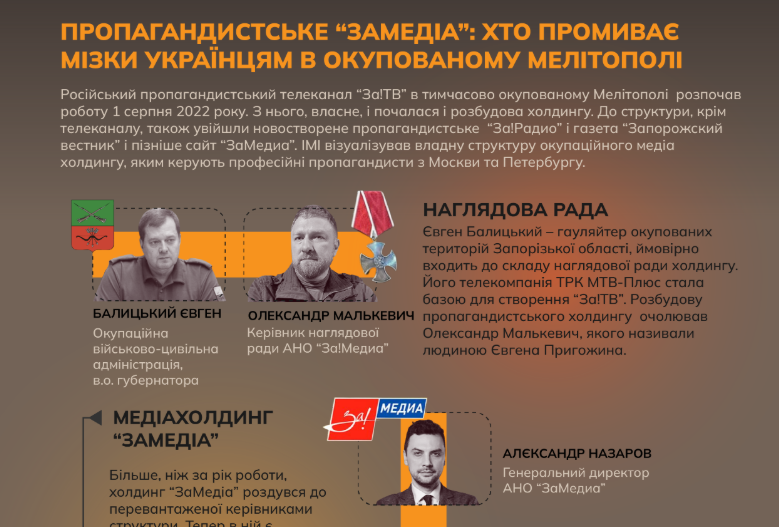
Russia has long used the information space as a tool of war. These aren’t just isolated, random hoaxes, but a well-thought-out strategy: to destabilize societies, sow panic, erase identities, and undermine statehood. Ukraine is experiencing a particularly acute attack – media holdings are being established in the occupied territories, which broadcast distorted reality on a daily basis and promote anti-Ukrainian sentiment and Russification.
For example, the “ZaMedia” network in Melitopol: a TV channel, website, newspaper, and radio broadcaster repeat the same messages over and over, creating the “hall of mirrors” effect. In such an environment, any alternative seems dangerous, and the imposed outlook is gradually accepted as the only one.
The propaganda is not limited to Ukraine. The Kremlin is actively engaged in Europe, the United States, Africa, and Latin America: it interferes in elections, spreads narratives about “Ukraine fatigue” or Ukraine as an alleged “terrorist state,” uses social media to polarize societies, creates a network of disinformation websites to influence artificial intelligence, and intensifies disinformation campaigns to undermine support among Europeans for Ukraine’s accession to the EU. This is a global strategy designed to justify the aggression and, more broadly, to undermine trust in democracy.
Its effects are slow, but the consequences are devastating: the propaganda lays the groundwork for political decisions, demoralizes societies, and justifies violence. That is precisely why the response must be systemic – ranging from fact-checking and education to explaining narratives and taking legal action.
Who Is Taking Action, And How?
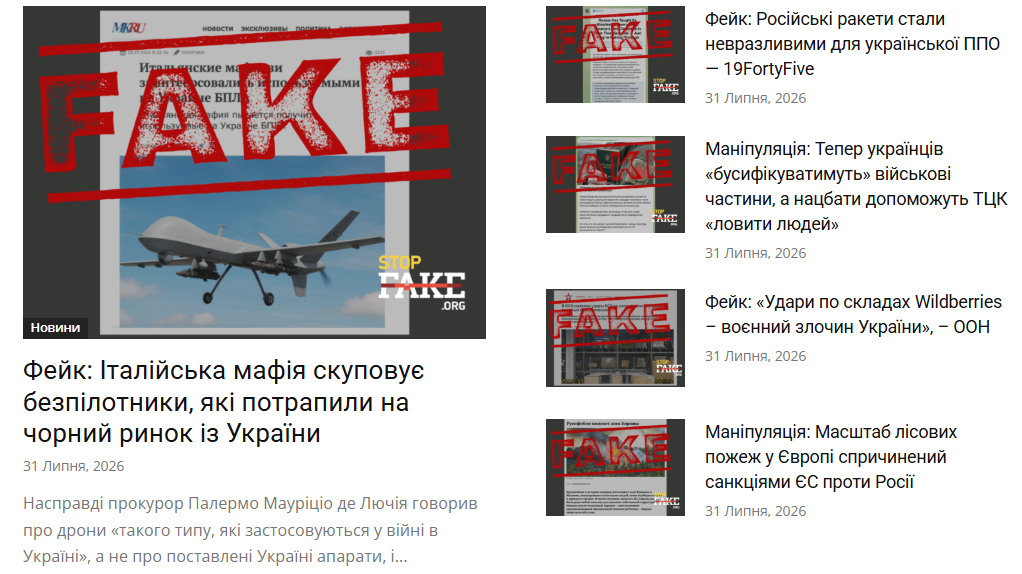
Countering the Russian propaganda is now a separate area of focus for journalists and media organizations. There are projects that specialize specifically in exposing fake news. For example, since 2014, StopFake has been systematically debunking false reports, explaining manipulation tactics, and compiling a database of cases for news organizations and the public.
At the same time, media organizations are working to combine analysis of disinformation with broader objectives. One of them is “Detector Media,” which regularly analyzes information campaigns, demonstrates how propaganda narratives work, and explains their influence on the Ukrainian society. Let’s mention, for example, the fake news story that circulated in the spring about “millions of Hindus” that the Ukrainian government was allegedly planning to bring into the country. At that time, on Telegram‑channels and social media, artificially generated photos and videos of “crowds of foreigners” began to appear, and manipulative headlines claimed that Ukraine was preparing for mass migration. In fact, as “Detector Media” investigated, propagandists took a hypothetical estimation by the Ministry of Economy out of context, presented it as a “governmental plan,” and backed it up with statements from politicians and AI-generated photos, even though the number of migrant workers in Ukraine has actually decreased. Dozens of Ukrainian newsrooms and think tanks stood up to that wave, and it was precisely this collective “immune response” that stopped the panic from spreading.
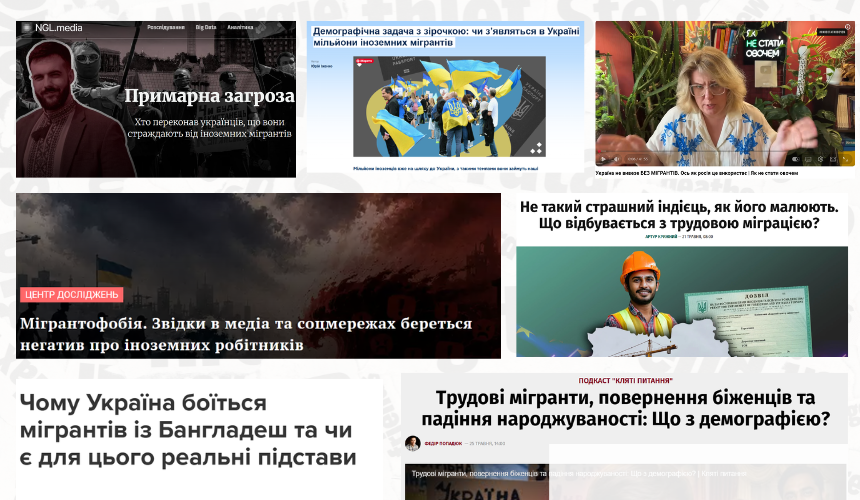
For more details on this case, read our article: Anti-clickbait in action: How Headlines Build a Reputation
However, countering propaganda is not just responsibility of large national news or international organizations. This is day-to-day work on the ground that builds trust within communities and lays the foundation for a systematic response to information attacks. It is here that the foundation for the society’s information resilience is laid.
Regional media play an important role in countering propaganda
It is regional newsrooms that are the first to witness and document instances of Russian propaganda. Their publications on this topic debunk misinformation and keep communities informed, they may also have legal consequences.
For example, an investigation by “Locator–Media” into propaganda in temporarily occupied territories of Zaporizhzhia Oblast. In the article “The Kremlin’s Information War in Zaporizhzhia,” journalists documented in detail activities of local collaborators and the channels through which Russian narratives are disseminated, they proved that their participation was voluntary, and forwarded the collected data to the SSU. It was this evidence that served as the basis for initiating criminal cases against ten propagandists engaged in subversive activities in the temporarily occupied territories.
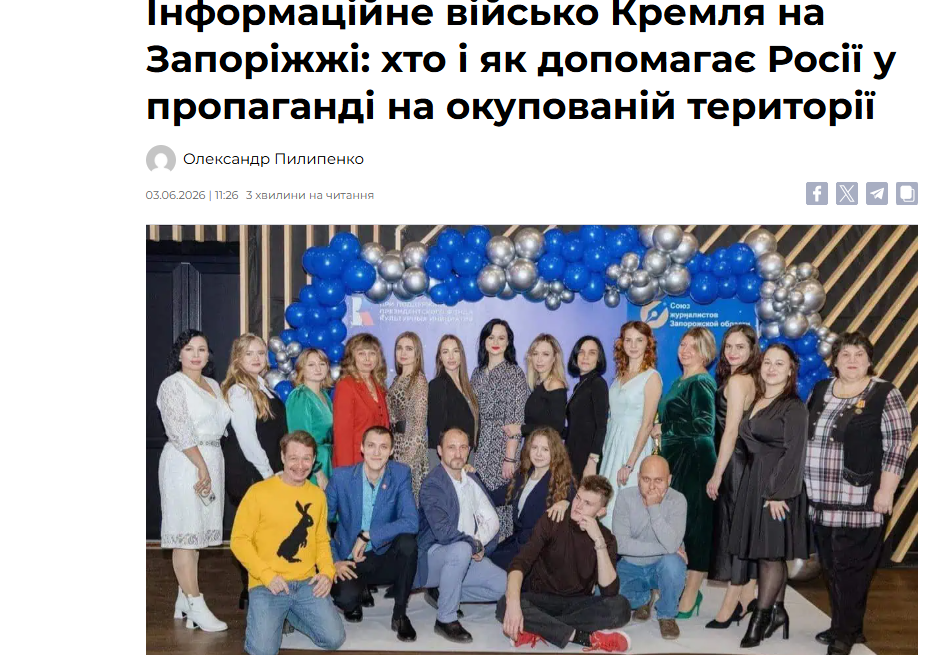
More details about this case: Investigations That Become Evidence: How Locator Media Documents Zaporizhzhia’s Information Occupation
Or, for example, the editorial staff of “Bakhmut.in.ua,” which monitors the situation in the occupied Bakhmut and the surrounding area on a daily basis and actively exposes Russian propagandists who come to film disinformation stories. The website features a special section titled “Lie Meter” and dedicated to fake news and manipulation, it regularly publishes files on representatives of the occupying authorities.
The practical procedures followed by such newsrooms – verifying photos and videos, creating own databases of contributors, and working with lawyers to ensure legalization of their content – have already become part of their daily routine. Another key aspect is the collaboration between regional media outlets and fact-checking organizations.
For example, last year, from August through December, IMI collaborated with a dozen regional media outlets – such as “Kordon.Media,” “Chernihiv Media Group,” “18000,” “Zhar.info,” and others – as part of its disinformation monitoring efforts. Journalists from these news organizations systematically monitored local news and Telegram channels. They documented 875 Russian disinformation stories and more than 3,700 instances of manipulation in local news feeds. This collaboration made it possible to identify the themes that propaganda uses most frequently: discrediting the mobilization process, the Armed Forces of Ukraine, the Ukrainian government, and Ukraine’s allies.
How Newsrooms Can Protect Themselves from Propaganda Traps
It is clear that Russian propaganda is spread not only through Kremlin-controlled media or anonymous Telegram channels. Sometimes its messages find their way into the media landscape through regular news reports – when newsrooms reproduce manipulative statements, emotional content, or unconfirmed reports without proper verification.
Not only journalistic standards but also clear editorial guidelines help prevent this. We have prepared a practical checklist for you, based on recommendations from Ukrainian and international organizations working in the fields of journalism, fact-checking, and countering disinformation.
Editorial Checklist: 8 Rules to Help You Avoid Reinforcing Russian Propaganda
1. Do not include propaganda statements in the headline. Even if the article debunks the fake news, the headline should not repeat the false claim. It is better to state a verified fact right away or to indicate that the information has not been confirmed. After all, many people only read headlines.
2. Start your article with facts, not statements from the Russian side. The first sentence sets the tone for the entire piece. If a news story begins with the words “The Russian Ministry of Defense stated…,” that very statement becomes the main highlight for the reader. First, you should present verified information, and only then report on the parties’ statements, providing the necessary context.
3. Do not use Russian state-owned media or anonymous Telegram channels as primary sources. If information can be verified through Ukrainian government agencies, international organizations, or independent sources, these should form the basis of the report. Posts from anonymous Telegram channels or Russian state media may only serve as a reason for verification, but not as a news source.
4. Do not share photos or videos without verifying them first. Before publishing, be sure to find out when and where the photo or video was taken, who took it, and whether it has been used before in a different context. This is especially important given the rapid spread of AI-generated content. If the origin of the content cannot be verified, this should be explicitly stated, or you should not use it. For more on the practice of verifying photos and videos based on Finland’s experience, read: Fact-checking as a Tool for Self-Regulation: Experience of the Finnish Public Broadcaster YLE
5. Explain the propaganda narrative, not just a single piece of fake news. It’s important to refute false claims – but it’s even more important to show readers exactly what kind of manipulation was attempted: appealing to fear, shifting blame, inciting internal conflicts, discrediting Ukrainian institutions, or other typical propaganda tactics. This helps the audience better recognize information attacks in the future.
6. Don’t create a false sense of balance. Our media seem to have largely grasped this point by now, but please take a moment to consider it. The fact that there are two positions does not mean that they are equally reliable. If one of the parties spreads misinformation or makes unsubstantiated claims, the editorial staff should explicitly point this out rather than present such claims as an equally valid alternative opinion.
7. If the information hasn’t been confirmed, be honest about it. Phrases such as “the newsroom has no independent confirmation,” “this information is being verified,” or “this information was provided by only one party” are not a sign of weakness. On the contrary, they demonstrate adherence to journalistic standards and help prevent spread of unverified reports.
8. Implement an internal algorithm for verifying questionable information. During information attacks or in situations where news must be published quickly, it is easier for newsrooms to avoid mistakes if there is a clear procedure in place. Even a small newsroom can agree on a simple procedure to be applied to all potentially risky content.
Before publishing, it’s a good idea to ask yourself a few questions:
Who is the original source of the information?
Is it corroborated by at least two independent sources?
Have the photos, videos, and other visual materials been verified?
Does this material simply repeat Russian propaganda narrative without providing the necessary context, or not?
Are facts clearly distinguished from statements, assumptions, and unconfirmed reports for the reader?
If there is no definitive answer to at least one of these questions, the material requires further verification or must include a clear explanation of the degree to which the information has been verified.
None of these rules are new to journalism. But it is precisely during wartime that systematic adherence to them becomes a component of information security. Self-regulation begins not with declarations, but with day-to-day editorial decisions.
Challenges and Difficulties
Even the best methods for countering propaganda have their limitations. The main problem is the speed and scale at which misinformation spreads: Russian campaigns operate like an assembly line, churning out dozens of posts every day that instantly spread across social media and messaging apps. Journalists and fact-checkers are often forced to refute claims that have already taken root.
New technologies are complicating the situation: artificial intelligence creates convincing fake photos, videos, and audio clips that look as realistic as possible. In wartime, there is also limited access to sources – journalists cannot work openly in the occupied territories, and along the front lines, they risk their lives. This creates a vacuum that propaganda quickly fills.
Striking a balance between freedom of speech and combating disinformation is no less challenging. Democracies cannot simply ban any information, so the question constantly arises: where does the right to freedom of expression end and deliberate manipulation begin?
All of this makes fight against propaganda a long-term effort that requires flexibility, technological readiness, and courage on the part of journalists, especially those working in front-line regions. And this is where self-regulation and collaboration among editorial teams become crucial: sharing experiences, agreed-upon standards, and collective practices help media become stronger and more effective in countering information attacks.
Additional Resources
Initiatives to combat disinformation:
StopFake — fact-checking of Russian disinformation.
Internews Ukraine – #AgainstRussianLies — counter-narratives, educational campaigns, TikTok‑projects.
The Center for Countering Disinformation under the National Security and Defense Council – a government agency responsible for coordinating efforts to counter information threats.
The Institute of Mass Information (IMI) — monitoring fake news, clickbait, and manipulation.
Detector Media. Projects: Chronicle of Disinformation, research on propaganda and influence.
EUvsDisinfo — a database of disinformation cases, analysis of Kremlin narratives.
Useful Educational Programs and Resources
“DezinFAKEtsiya” course on how to recognize and counter disinformation on the “Diya.Osvita” resource.
The course on “How to Protect Yourself from Fake News and Disinformation,” which covers basic fact-checking skills and ways to counter disinformation, on the “Diya.Osvita” resource.
Guide “Crimea: Facts vs. Fakes” on the “Diya.Osvita” resource.
The “Media Literacy: How Can One Avoid Being Manipulated?” course from Prometheus.
The guide on “Pro-Russian and Anti-Western Conspiracy Theories in the Information War” by the Institute of Mass Information.
This article was prepared as part of the “Media Bridges: Finland—Ukraine” Program implemented by the Association of Independent Regional Publishers of Ukraine in partnership with News Media Finland, and funded by the Finnish Ministry of Foreign Affairs