Over the course of a year, 18 Ukrainian regional newsrooms produced 161 investigative reports examining public spending, municipal property, decisions made by local officials, and other issues affecting their communities. But behind these results lie more than months of research and document analysis. Journalists have also faced threats of legal action, attempts to influence them through personal connections, offers of financial incentives, and interference in editorial decisions.
The findings of these investigations and the challenges facing independent media were among the topics discussed at AIRPPU’s 15th Media Congress, “People. Trust. Solutions.”, held in Lviv on October 2–4, 2026. The Association of Independent Regional Press Publishers of Ukraine (AIRPPU) presented its “12 TOP” collection of investigations, while a dedicated panel explored how journalists can resist pressure and protect their newsrooms’ independence.
From Local Issues to a Collection of Outstanding Investigations
Investigative journalism enables local communities to scrutinize government decisions and the use of public resources. For smaller newsrooms, this is demanding work that requires specialised skills, time, and professional support.
AIRPPU supports this work through its “Stronger Together: Transparency and Anti-Corruption” project, which brings together regional newsrooms and six experienced investigative journalism mentors. Working alongside their more experienced colleagues, journalists analyse documents and open data, test hypotheses, gather evidence, and develop their own investigative reporting capabilities.
An important part of this work is building a professional community where newsrooms can share experience and support one another while working on complex investigations.
In April 2026, AIRPPU presented international partners with a selection of 13 investigations chosen by mentors and translated into English. Later, at the 15th Media Congress in Lviv, the Association unveiled “12 TOP”, a collection of 12 outstanding investigations selected from the 161 reports produced by participating newsrooms over the year.
The investigations cover the use of public funds, municipal property, Russian occupation, collaboration with occupying authorities, and connections to Russia. According to AIRPPU, journalists’ findings have already prompted inspections of shelters, reviews of how grant funding was used, and referrals to law enforcement agencies concerning possible abuses.
When Journalists Have to Fight for Their Investigations
Investigating local officials and influential businesses is particularly challenging in communities where journalists and the people they investigate have lived in the same city for years. Professional relationships can become channels for attempts to influence reporting, while a dispute over a single publication can threaten the future of an entire newsroom.
These challenges were discussed during the panel “Stronger Together: How to Investigate People You See Every Day and Avoid Media Owners’ Influence.” The speakers included Olha Zyma, editor-in-chief of Dostup.Media; Alona Bereza, founder of ZHAR.INFO; Anna Matviienko of Dnipro.media; and Vitalii Ulybin, head of Poltava Wave. The discussion was moderated by Maksym Opanasenko, an editor at Bihus.Info.

One of the most difficult experiences was shared by the Kropyvnytskyi-based newsroom Tochka Dostupu. Olha Zyma recalled receiving a phone call demanding that an investigation be removed after its publication.
According to Zyma, the newsroom’s editorial policy, agreed upon with its founders, guaranteed non-interference in the preparation of publications. The demand to remove the investigation was therefore unacceptable to her.
“For me, this is unacceptable. It is a red line that I simply cannot cross,” Olha Zyma explained.
Olha decided to end the working relationship. All ten members of her team supported her decision and also chose to leave the newsroom. After negotiations with the investor, the journalists purchased the website’s domain, preserved the publication archive, and continued their work as the independent media outlet Dostup.Media.
During this period of uncertainty, support from readers proved especially important. People donated to the team, set up regular contributions, and local lawyers offered legal assistance.

Another challenge for investigative journalists comes in the form of complaints and demands following publication. The Dnipro.media newsroom faced such a situation after publishing an investigation into the reconstruction of an apartment building at 118 Naberezhna Peremohy, which had been partially destroyed by a Russian missile strike.
According to Anna Matviienko, a news report based on the investigation omitted the qualifier “possibly” when describing a connection between a company and Hennadii Korban. Following the publication, the newsroom received a complaint from his lawyer demanding the removal of the materials.
The team sought support from colleagues and did not remove the investigation. At the same time, Anna emphasised that the newsroom was prepared to review disputed wording and correct confirmed inaccuracies without withdrawing the entire report.
In Khmelnytskyi, journalists from ZHAR.INFO encountered offers of financial incentives. Alona Bereza recalled that she and a colleague had been offered apartments on separate occasions. In one case, the offer was linked to a demand not to publish an investigation concerning a property developer.
The newsroom also faced threats of lawsuits, while communication with some subjects of investigations became psychologically difficult for its journalists. The team established a rule: if speaking with a particular person creates risks or causes distress, another newsroom member takes responsibility for requesting comment. This allows the subject of an investigation to respond without leaving an individual journalist alone to deal with a difficult interviewee.
Pressure does not always take the form of a direct demand or threat. While preparing an investigation into the assets of the First Deputy Head of the Poltava Regional Police, Vitalii Ulybin, head of Poltava Wave, was approached by someone he knew.
The acquaintance suggested that the journalists switch to another, supposedly more significant story. However, the newsroom had already gathered the main evidence and was awaiting a response from the person under investigation.
“The investigation will be published regardless. And it is entirely in the subject’s interest to provide whatever response they consider appropriate, if they have facts to present,” Vitalii Ulybin said, describing his position.
These experiences illustrate the different professional dilemmas investigative journalists face: how to respond to interference in editorial decisions, distinguish legitimate criticism from attempts at pressure, and ensure the safety of their teams.
Support from colleagues and readers is equally important. Reflecting on the experience of the Kropyvnytskyi newsroom, panel moderator Maksym Opanasenko highlighted how audience trust can become a source of real support for independent media during a crisis.
“Invest in your audience. Your audience will be there and return that support when you need it most,” he emphasised.
For smaller newsrooms, being part of a professional community means having opportunities to exchange experience, seek advice, and receive support from colleagues who have already faced similar challenges.

From Lviv to Spain: Ukrainian Investigations Attract International Attention
Following its presentation at the Congress, the “12 TOP” collection was also introduced to the Spanish media community. In October 2026, AIRPPU Director Oksana Brovko brought the collection to the Europa Press news agency.
In an interview, she spoke about the work of independent regional newsrooms during the war, their efforts to document war crimes, and investigations into abuses of power. The conversation also addressed the risks facing Ukrainian journalists and the importance of maintaining international attention on developments in Ukraine.
“Our journalists are writing history,” Oksana Brovko said in her interview with Europa Press.
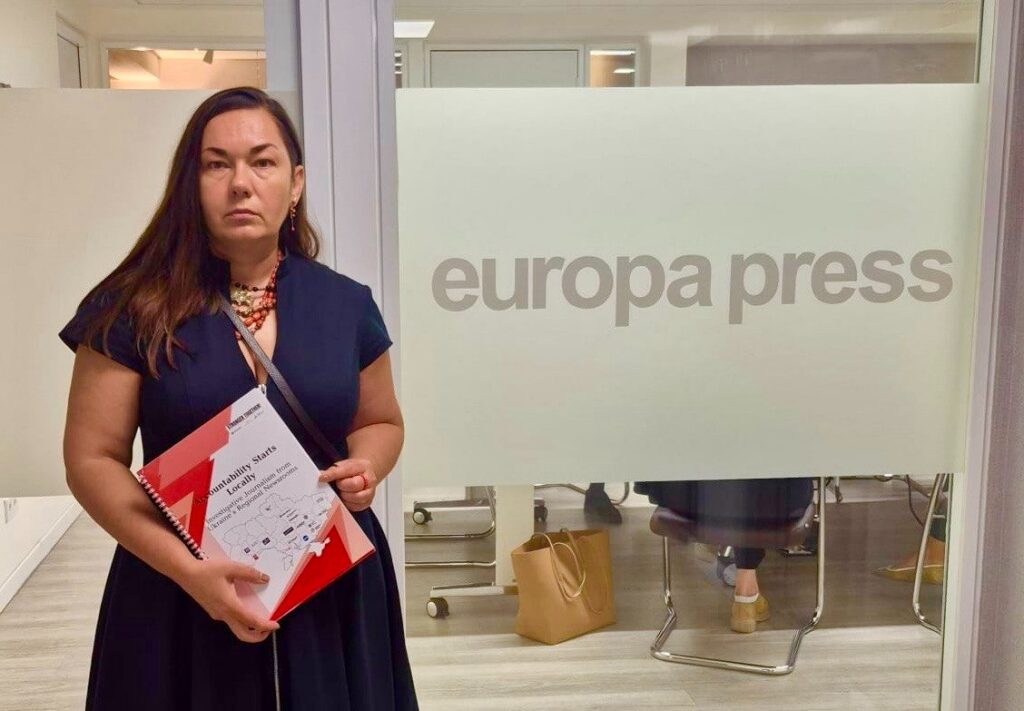
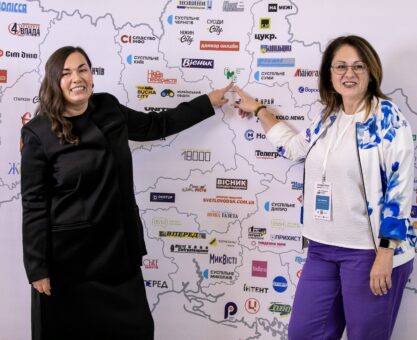
Oksana Brovko with the “12 TOP” collection at the Europa Press news agency, Spain, October 2026.
AIRPPU shared more details about these international meetings and the presentation of Ukrainian investigations in its article “From Survival to Development: What Ukrainian Regional Media Are Teaching the World.”
For regional newsrooms, international attention creates opportunities to present their work to a wider professional community. At the same time, the experiences shared in Lviv demonstrated that every investigation involves more than gathering evidence. It also depends on journalists having the freedom to decide independently what stories to pursue and what to publish.
The “Stronger Together: Media and Democracy” programme is implemented by the Association of Independent Regional Press Publishers of Ukraine (AIRPPU) in partnership with WAN-IFRA and the Norwegian Media Businesses’ Association (MBL), with the support of Norway.