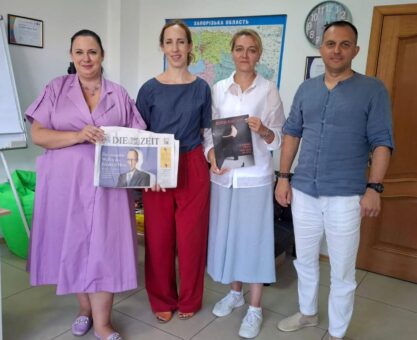



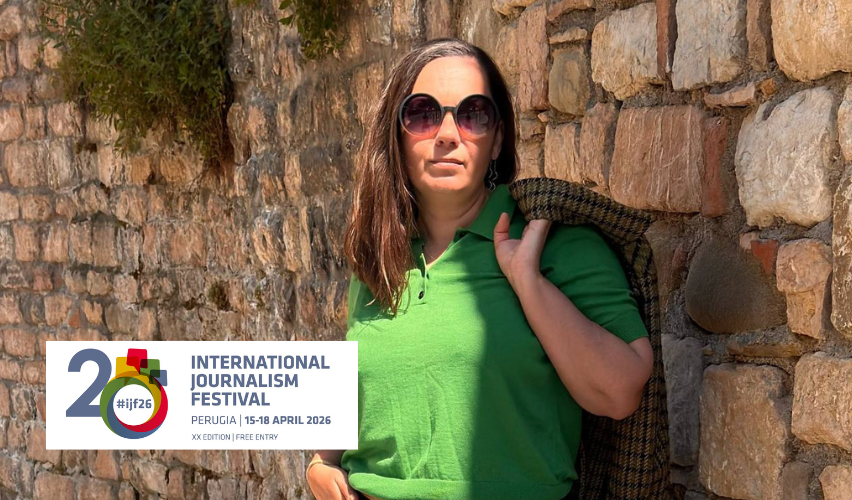
On April 15, 2026, at the International Journalism Festival in Perugia, the CEO of the Association of Independent Regional Press Publishers of Ukraine, Oksana Brovko, spoke at the Hannah Arendt Initiative Reception dedicated to practical tools and lessons in supporting journalists across different countries. Her speech became one of the Ukrainian voices at the festival. Oksana shared her experience of building an insurance and support system for regional media operating in high-risk environments.
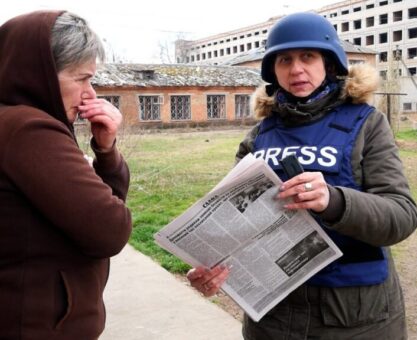
I live in Ukraine, where a good journalist is an alive journalist. One journalist told me: “The ‘press’ sign doesn’t protect us anymore. It makes us a target.”
This is what journalism looks like in Ukraine today. I work with independent regional media, and one of the projects I lead is about safety systems for journalists working under risk.
Through our work within the Hannah Arendt Initiative ecosystem, we focus on one question: What makes a journalist continue — when continuing might cost them their life?
In frontline regions, journalists are deliberately targeted. Russians call it “human safari.” When drones see a “Press” sign on a bulletproof vest, they attack.
So the question is not whether journalists take risks. They already do.
The question is: What makes it possible for them not to stop?
We had to rethink safety — not as individual protection, but as a system. We built a structure that combines insurance, safety training, and storytelling through frontline journalists’ voices — to show that they are not alone.
One journalist told me: “I am not afraid to go to the frontline. I am afraid of what happens if I don’t come back. What happens to my family, my team, my newsroom.”
Insurance does not remove danger. But it changes the decision.
And in Ukraine, this did not exist before. There was no insurance system for journalists at all. No protection at the state level. So we built it — from scratch — as a unique programme.
We built a system inside newsrooms — where safety becomes part of how journalism is done.
As a result, journalists stay. Newsrooms keep publishing. Because they are no longer alone.
And there is another side of the safety – psychological. One journalist who works on cases of missing soldiers told me a story. One of the mothers wrote to her in the late evening: “I buried him.” “I was just… broken.”
This is also part of safety. Not only physical, but psychological. Safety is not only about staying alive. It is about being able to continue after what you carry.
Other journalist told us: “A woman stepped on a mine. I remembered the training, applied the tourniquet, and she survived.”
We are not insuring people. We are insuring the possibility to continue telling the truth. 20 And for some time, this was enough. But not anymore.
The reality is changing faster than our systems. War changes. And the risks change with it.
Do you know that today, in frontline areas, journalists are exposed to chemical weapon, and many already live with long-term health problems?
Do you know that these risks are still not covered by most insurance systems?
Do you know that journalists are now hunted by drones — and what used to protect them can now make them a target? And that the new protection for the journalist in our conditions is already not a bulletproof vest but an anti-drone device?
And this is not only about Ukraine. What we are facing today, others may face tomorrow.
So this is not just our experience. It is a signal that the rules of safety are already outdated. And we need to change them — now.
Because this is no longer about support. This is about survival. Thank you.
***
Colleagues, a reminder: journalists working in high-risk regions have the opportunity to obtain free life and health insurance. This is part of the International Insurance Fund for Journalists (IIFJ) initiative, implemented in partnership with Ukrainian and European organisations.
Media professionals working in Kherson, Zaporizhzhia, Sumy, Mykolaiv, Donetsk, Luhansk, Odesa, Kharkiv, and Dnipropetrovsk regions, as well as border areas of Kyiv and Chernihiv regions, can apply. More information about the terms of free insurance is available here.
The content was produced with the support of the International Insurance Fund for Journalists implemented by the Association of Independent Regional Press Publishers of Ukraine is part of the Voices of Ukraine / SAFE support program, coordinated by the European Centre for Press and Media Freedom. Voices of Ukraine / SAFE is implemented within the Hannah Arendt Initiative and supported by the German Federal Foreign Office