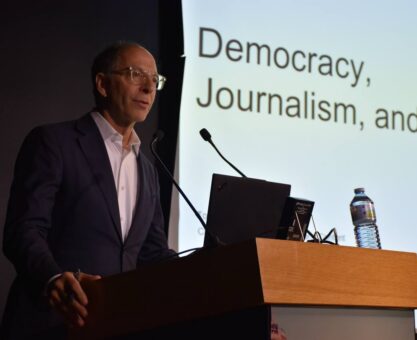
On September 16, at the Paris AI Forum 2026 in Paris, Tom Rubin, OpenAI’s Head of Intellectual Property and Content, spoke about the role of AI in journalism and addressed Ukrainian newsrooms in particular. He said that in recent years, OpenAI, together with WAN-IFRA, has provided AI training and support to 160 newsrooms around the world, while in Ukraine, 45 newsrooms and more than 193 participants have already taken part in the AI Masterclass Series. Another 10 Ukrainian newsrooms will work on their own AI solutions through the Newsroom AI Catalyst, in partnership with WAN-IFRA and the Association of Independent Regional Press Publishers of Ukraine (AIRPPU).
Why OpenAI Supports Journalists
Tom Rubin explained that his connection to Ukrainian journalists is both professional and personal. Before joining OpenAI, he worked as a journalist at The New York Times.
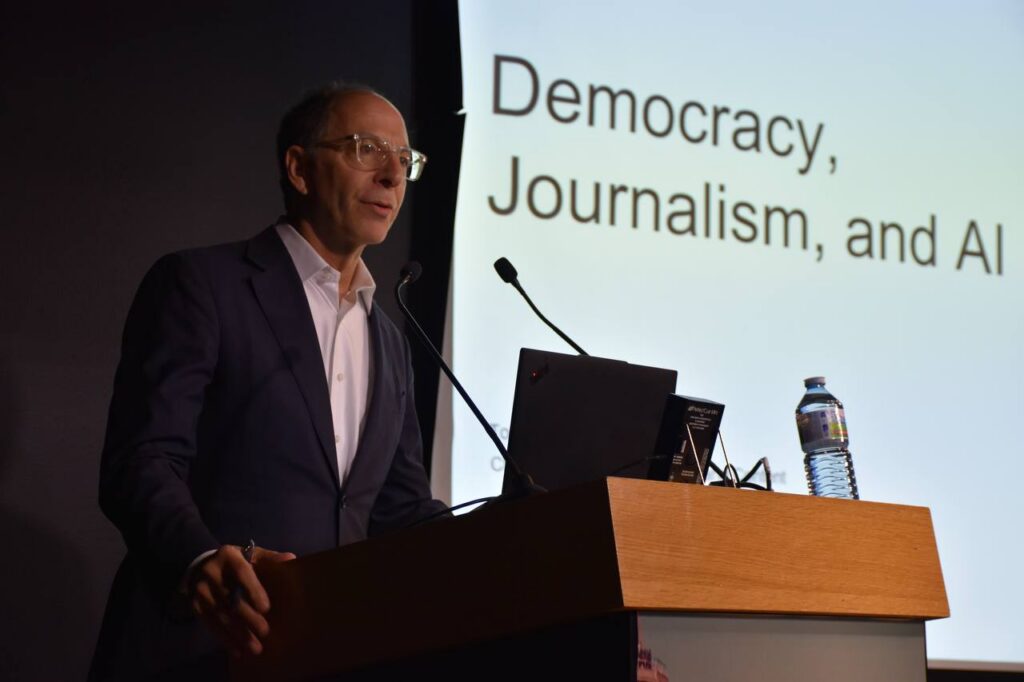
Tom Rubin emphasized the need to support independent journalism while the country is simultaneously fighting for its survival.
In his speech, Tom Rubin highlighted the work of local Ukrainian journalists in communities where the war affects not only the topics they cover but also the very ability to distribute information.
As an example, Tom Rubin mentioned preparing information about evacuation routes, as well as publishing newspapers for people who have been left without internet access due to the war.
“Someone is analyzing the municipal budget. Someone else is asking why the school has still not reopened. Another journalist is checking whether the hospital has everything it needs. People whose problems were previously ignored are being given a chance to be heard,” Tom Rubin emphasized.
From the Dreyfus Affair to Watergate: Why Society Needs an Independent Press
To explain the role of journalism, the speaker turned to historical examples.
The first was the case of Alfred Dreyfus in France. He noted that it took another eight years, as well as the efforts of many people, to secure Dreyfus’s eventual exoneration.

At the same time, the press played a complex role. According to the speaker, some newspapers helped fuel prejudice against Dreyfus, while others spoke out against the injustice.
For him, this example demonstrates that journalism can stand up to injustice.
The second example in his speech was the Watergate scandal in the United States, which ultimately led President Nixon to resign in 1974.
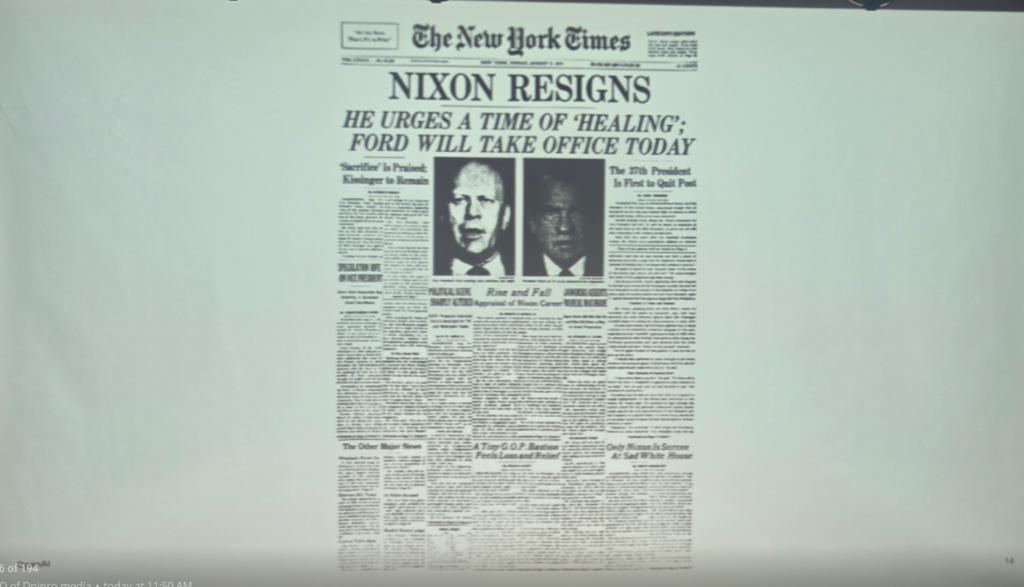
Tom Rubin emphasized that persistent journalistic work demonstrated that even a president can be held accountable.

According to him, journalists earn trust by seeking facts, analyzing information, listening carefully, and questioning those in power. For this, they need independence.
War Makes Journalism Both More Important and More Difficult
The speaker also discussed what happens to this work during wartime. Journalists have to tell people where to find medical assistance and which roads are safe to travel, while at the same time worrying about their own families, friends, and colleagues.
Newsrooms have to relocate, change their places of work, and operate during power outages. The speaker drew a historical parallel with France itself.
During the occupation of Paris, the people behind the underground newspaper Défense de la France began printing it in basements. Later, according to the speaker, the publication’s circulation reached hundreds of thousands of copies. A printing press gave a small group of people the ability to scale up the distribution of information.
“Someone Still Has to Go There and See What’s Happening”
One of the central slides featured a quote from war correspondent Marie Colvin:
“War journalism remains fundamentally the same — someone has to go there and see what’s happening.”
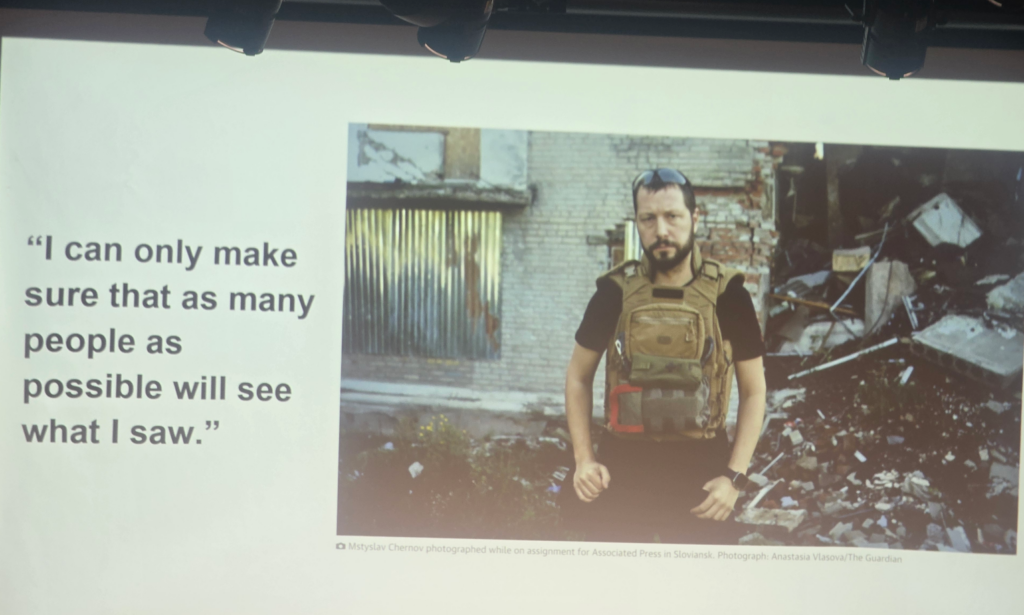
Alongside this, Tom Rubin mentioned Ukrainian journalist Mstyslav Chernov:
“I can only make sure that as many people as possible see what I have seen.”
What Exactly Can AI Do for a Journalist?
Tom outlined examples of tasks where AI can serve as a journalist’s assistant:
- Prepare for an interview;
- Analyze a large volume of documents;
- Search archives or identify connections between facts.
But the journalist brings the most important elements to the process: knowledge of their community, their own sources, and professional judgment about what truly matters and when it is necessary to consult an expert.

For this reason, saving time in a newsroom has a different meaning than simply increasing the number of stories published. AI tools can help newsrooms work on stories that previously would have been impossible to pursue because of the volume of information involved or limited resources.
This represents a different stage of using the technology. The goal is not only to save a few minutes on a routine task. AI can help journalists process and narrow down a huge flow of information to identify what deserves further journalistic scrutiny.
AI Can Make Mistakes
After discussing the opportunities, the speaker turned specifically to the risks.
According to Tom Rubin, news will remain essential, especially when people’s safety depends on information. But the risks associated with AI require the same practical attention as its benefits.
He pointed to specific challenges: AI can misunderstand context and produce an incorrect response.
The technology can also be used to manipulate images and voices.
That is why AI-generated results need to be checked against evidence. Journalists and editors remain responsible for what they publish.
The Media Crisis Did Not Begin with ChatGPT
Another major section of the presentation focused on the economic crisis facing journalism.
The speaker emphasized that the industry’s problems did not begin with the emergence of AI, despite how this is sometimes portrayed by people in the media industry.
According to him, for more than two decades, American newspapers have been dealing with declining print circulation, falling advertising revenues, and declining public trust in news media.
“The chronology matters.”
To illustrate this point, the presentation featured Walter Isaacson’s article “How to Save Your Newspaper,” published on February 5, 2009.
The article was already addressing the crisis in journalism and the prospect that some major cities could be left without their own newspapers, while magazines and online newsrooms could be left with very few reporters.

In other words, the question of who would fund journalism serving the public interest and the work of bureaus in war zones had been facing the media long before the rise of today’s generative AI.
At the same time, the speaker emphasized that this history does not diminish either OpenAI’s commitment to helping media organizations with new tools or its responsibility to address the new risks brought by AI.
For a Small Newsroom, AI Can Open Up Opportunities That Were Once Available Only to Large Outlets
OpenAI sees particular potential for small publishers.
The speaker identified three practical areas where AI can help:
- Supporting reporting and research;
- Reducing administrative work within the newsroom;
- Helping readers find the journalistic content that matters to them.
“Ukraine Is Fighting for the Truth. And We Will Help in Any Way We Can”
Tom Rubin devoted several slides to Ukraine.
The presentation included a map showing newsrooms from different regions that had taken part in the AI Masterclass Series. A total of 45 Ukrainian newsrooms and more than 193 participants have completed the AI masterclass series. The next stage is the Newsroom AI Catalyst, which includes 10 newsrooms.
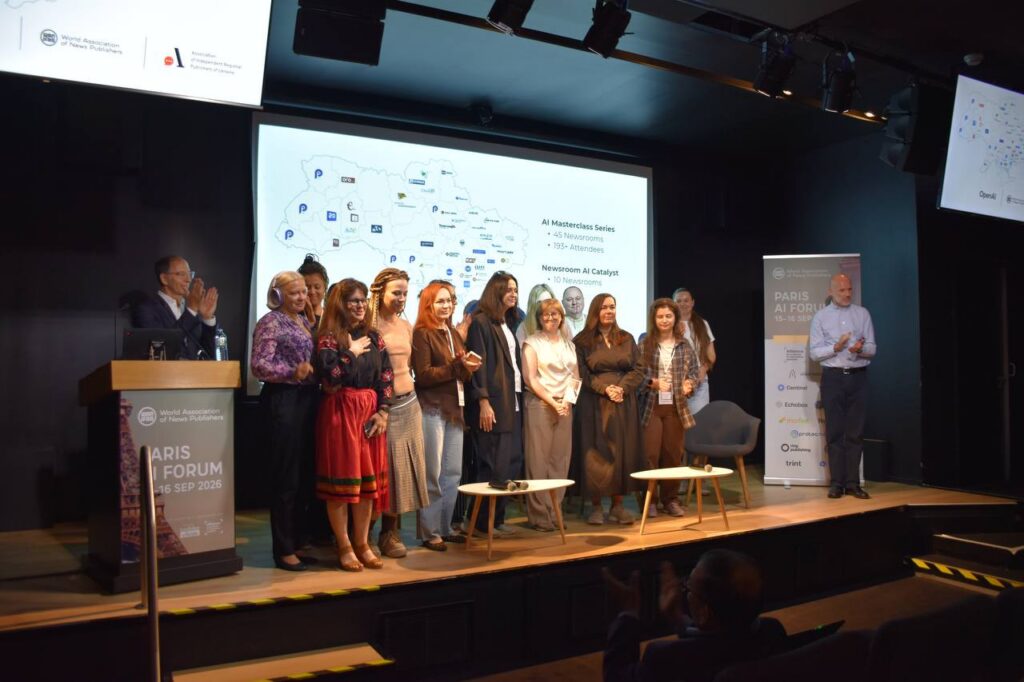
These are the very teams tasked with developing and testing AI projects tailored to the specific needs of their newsrooms.
Oksana Brovko: “We are not just surviving — we are evolving”
The stage welcomed Oksana Brovko, CEO of AIRPPU, together with Ukrainian journalists.
Oksana spoke about the reality in which Ukrainian newsrooms operate today and addressed the audience:
“For you, this may look like a different reality, but for us — it is everyday life.”
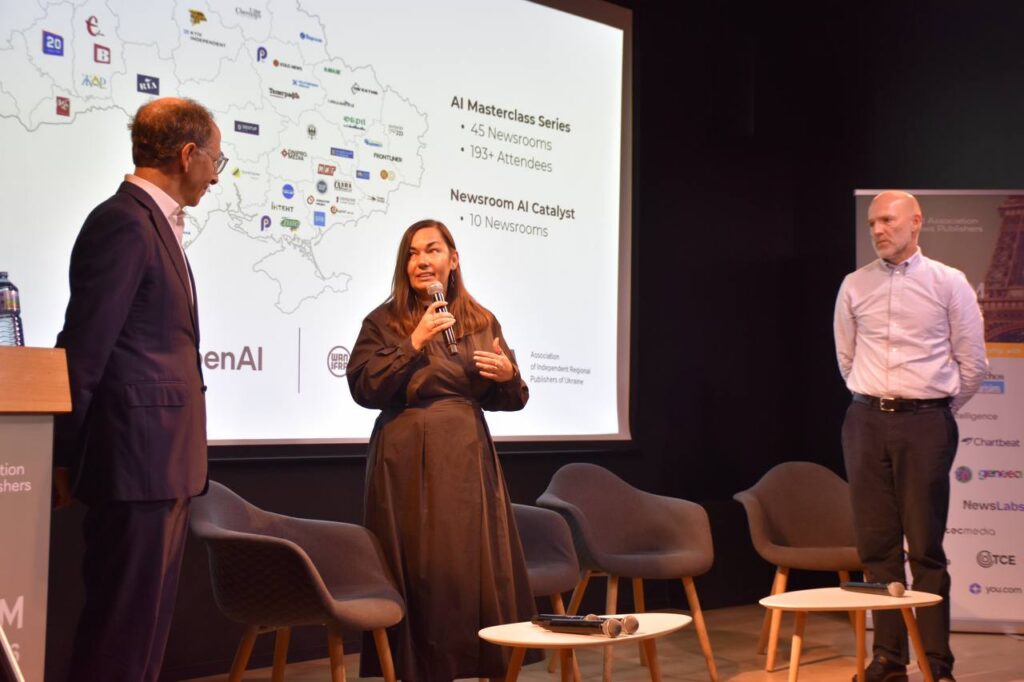
Oksana Brovko went on to explain the practical value of the partnership with OpenAI and media organizations. For ten local newsrooms, it is an opportunity to test how AI can support their work under extremely challenging conditions.
The goal is to give journalists more time for genuine reporting on the ground:
“We are not just in survival mode — we are evolving. And AI is part of that for us. Even when we are under attack.”
For local newsrooms, AI is not about technology that automatically produces the maximum number of texts. It is a way to return limited human time to the places where a journalist’s presence is irreplaceable.

To be on the ground. To gather evidence. To help people understand what is happening. This is journalism. And a useful tool should help journalists do more of exactly this work.