


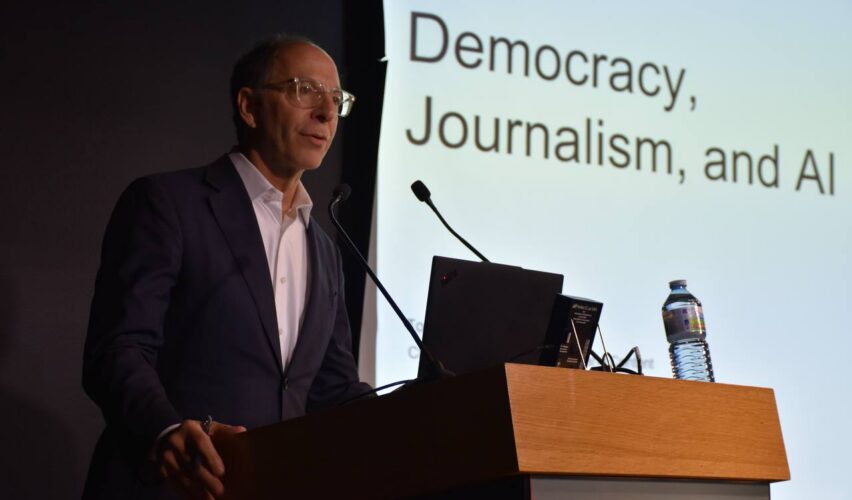
Democracy cannot exist without strong journalism. This was the message delivered by Tom Rubin, Chief of Intellectual Property and Content at OpenAI, during the Paris AI Forum 2026. He explained how artificial intelligence can become a tool for newsrooms — helping them process large volumes of data, analyze information, and discover new solutions. At the same time, he emphasized that it is journalists who bring to this process their knowledge of communities, trusted sources, and professional judgment.
Ukraine was highlighted in his speech: dozens of newsrooms have already completed training in our joint AI project, while new teams are developing their own tools to continue working even under the difficult conditions of war.
Discover the full speech below.
***
Tom Rubin, Chief of Intellectual Property and Content, OpenAI
WAN-IFRA Paris AI Forum
Paris | September 16, 2026
Bonjour and good morning.
It’s an honor to join you at this Paris AI Forum. OpenAI deeply values our longstanding partnership with WAN-IFRA. Over the past two years, we’ve worked together to provide practical AI training and support to 160 newsrooms around the world, helping them develop tools to strengthen their journalism and build more sustainable businesses. We also value the partnerships and conversations we’ve had with so many of you here today.
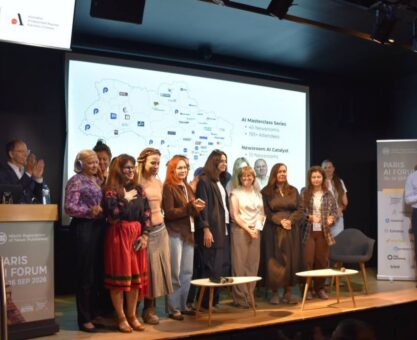
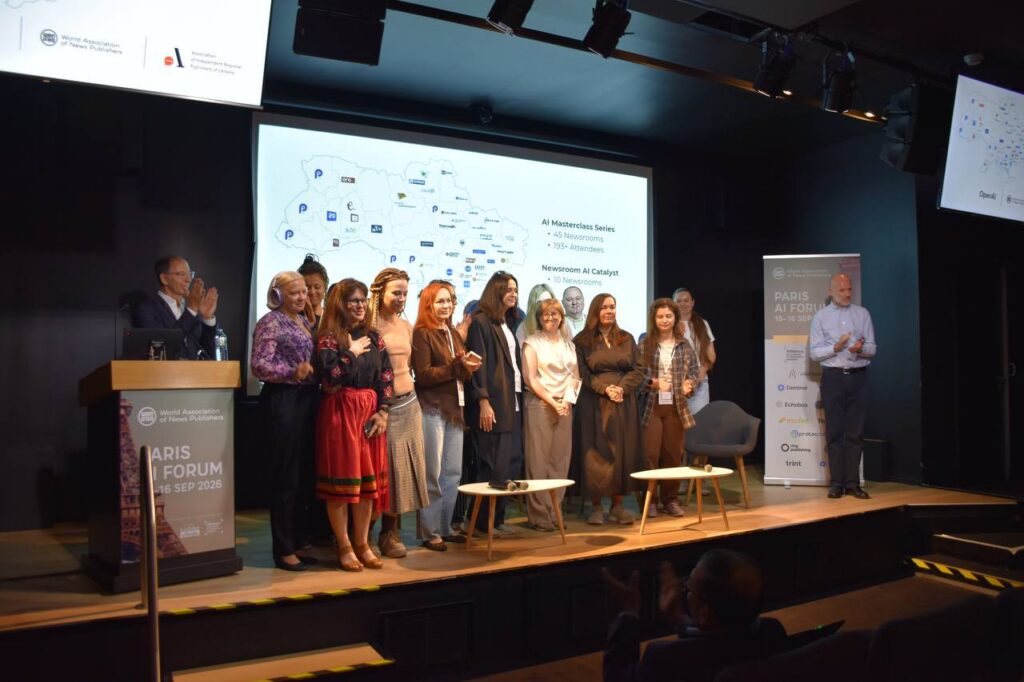
I want to give a special welcome to the Ukrainian journalists who are joining us for the first time. Dobroho ranku!
OpenAI is proud to support this new partnership with the Association of Independent Regional Press Publishers of Ukraine. Let me tell you how it began.
At the board dinner at WAN-IFRA’s annual Congress in Marseille in June, I was fortunate to be seated across from Oksana Brovko, AIRPPU’s longtime leader and a fierce defender of an independent press. I asked her two simple questions that night: “What do you need and how can we help?” From that conversation, together with WAN-IFRA, we quickly developed this program to support Ukrainian newsrooms – because there is no time to lose.
To the Ukrainian journalists here with us today, my respect for your work is professional and it is personal.
I was a journalist at The New York Times, Associated Press and CBS News early in my career, and covered stories from terrorism and murder to the everyday affairs of communities and universities. I continue to fight for press freedom on the executive committee of the Reporters Committee for Freedom of the Press in the United States.
That background gives me some understanding of your work. But nothing in my own journalism experience remotely compares with the reality facing our Ukrainian colleagues: keeping independent journalism alive while your country is fighting for its survival.
That’s what brings me here…

When darkness falls over a Ukrainian town, it can mean an air raid, a missile strike, or another attack on the power grid.
And somewhere, a journalist is finding a way to keep working: charging her phone, checking an evacuation route, preparing a newspaper for people the internet can no longer reach.
Oksana has spoken of the journalists in small towns who “did not switch off the lights, even when everything around them was falling into darkness.”
We are here because those lights must not go out.
Think about what a community gains when it has a good local newsroom, in Ukraine or anywhere else. Someone digs into municipal budgets. Someone asks why a school hasn’t reopened, or whether a hospital has what it needs. People whose concerns have been ignored get a hearing. Local news helps make a community feel like a community: neighbors discover that a problem they thought was theirs alone is something they can work on together.
Alexis de Tocqueville saw that connection nearly two centuries ago. In Democracy in America, he wrote: “The newspaper brought them together, and the newspaper is still necessary to keep them united.” …
That is democracy at work. We elect our leaders, but we also need to know what they do and whose interests they serve between elections. We need information we can trust, and room to question it. Journalism helps us see what needs to change, and decide what to do about it.
Here in France, the Dreyfus affair remains a powerful example. In 1898, Émile Zola used the pages of L’Aurore to challenge Alfred Dreyfus’s wrongful conviction. “Mon devoir est de parler, je ne veux pas être complice.” My duty is to speak; I do not want to be an accomplice.
Dreyfus’s exoneration took another eight years and the work of many people. Some newspapers had helped fuel the prejudice against him. Others challenged it. The case showed what journalism can do when it confronts injustice, even when that means questioning the press’s own earlier accounts.
In the United States, Watergate showed how persistent reporting could help hold even a president accountable. Journalists pursued leads. Sources came forward. Courts and Congress did their work. Television brought the Senate hearings into people’s homes. Reporting helped the public follow the evidence and understand what was at stake.
Most journalism may not become a chapter in a history book. But as the saying goes, all journalism is a rough first draft of history. The reporter scouring a local budget or investigating unsafe housing is doing work that matters deeply to their community.
Journalists earn trust by pursuing facts, analyzing information, listening closely, and challenging authority. And they need the freedom to follow a story wherever it leads, even when it leads to a political leader, a school superintendent, a local business, or a well-known company, including OpenAI.
That is the kind of independent journalism we want to help thrive.
War makes that work more urgent and much harder. People need to know where to find medical care, which roads are safe, and whether a warning is real. Reporters are trying to answer those questions while worrying about their own families, losing colleagues, moving offices and working through power cuts. Advertising income can disappear in wartime just when the need for reliable news is greatest.
Oksana has described how the question has changed since the first days of Russia’s full-scale invasion. Then, it was about getting through the day. Now it is also about remaining independent for years to come.
That word, independent, matters. A newsroom needs enough financial security to ask uncomfortable questions, even of people who could help pay its bills. Supporting it means helping it stand on its own feet.
And courage needs practical support. A reporter needs a working phone, a way to check information, and a way to get it to readers. That support can determine whether a story reaches people at all.
Journalists have always found ways to use new tools to serve their mission. The printing press let a story travel far beyond the person telling it. The telegraph meant news could move faster than a horse, a train or a ship. Photography let people see events they could never witness themselves.
Here in Paris, during the occupation, the people behind the underground newspaper Défense de la France began printing in the cellars of the Sorbonne. Their publication eventually reached hundreds of thousands of copies. A printing machine helped a small group make itself heard under extraordinary conditions.
During the Blitz, Edward R. Murrow reported from a London rooftop, with anti-aircraft fire audible behind him. Radio let Americans hear something of what Londoners were living through.
The progression of technology and its benefits to journalism continued. Satellites carried live television reports from battlefields and embattled cities to viewers around the world. Computers, which were in their infancy when I was in the New York Times newsroom, accelerated all aspects of a news organization’s workflows. The internet let small publishers reach audiences without having to invest capital in a press or a broadcast tower. Smartphones put cameras in witnesses’ hands, giving reporters new firsthand evidence to verify and use.
Technology keeps giving journalists more powerful ways to report and tell stories. The public’s need to know the truth endures.
The great war correspondent Marie Colvin, who wrote for the Yale Daily News just before I did, put it plainly:
“War reporting is still essentially the same — someone has to go there and see what is happening.” She was killed in Syria serving that mission.
And in Ukraine, Pulitzer Prize winner Mstyslav Chernov, speaking about his reporting in Mariupol, put it this way:
“I can only make sure that as many people as possible will see what I saw.”
Being there, gathering evidence, and helping people understand it: that is the work. Every useful tool should help journalists do more of it.
That is where AI can help.
We see AI as a tool to support journalists, not a substitute for them. As Oksana has explained, “AI … is about making sure that limited human capacity is spent where journalism matters most.” It can help a reporter prepare for an interview, analyze a stack of documents, search an archive, or spot a connection worth investigating. The journalist brings the knowledge of the community, the trust of sources, and the judgment to know which questions matter—and when an answer should be challenged.

The time saved can mean more time to follow a lead.
Newsrooms are already seeing benefits. In WAN-IFRA’s survey of more than a hundred media leaders last year, three quarters reported efficiency improvements from AI.
Just last week, data journalist Jacopo Ottaviani described his experience in a piece for the Reuters Institute. Using AI, he built a working prototype in hours: a searchable atlas helping people understand flood and landslide risks in Italian communities. He said AI helped him work through a technical report in under an hour—a task he estimated would otherwise take days. But deciding which questions matter—and whether the answers can be trusted—remained his responsibility. As he wrote: “Those questions and their ultimate answers stay with the journalist.”
For a reporter, time saved can mean time to make another call or visit a neighborhood or tell another story that might otherwise never be told.
Rubina Madan Fillion, an AI editor at The New York Times, makes the point that the promise goes beyond saving time. As she wrote in Nieman Lab: “AI tools are empowering newsrooms to report stories that would’ve otherwise been impossible to pursue.”
During war, that extra time and ability to investigate can matter even more. An overstretched team could use AI’s help translating urgent information, organizing hours of witness testimony, finding leads in public contracts, and uncovering propaganda or disinformation claims for reporters to investigate. Human review will always remain essential, especially when people’s safety depends on the information. Used appropriately, these tools can help a stretched newsroom advance its mission.
The risks deserve the same practical attention. AI can miss context and produce answers that are wrong. It can also be misused to falsify images and voices. Newsrooms need to check outputs against evidence. Reporters and editors remain responsible for what they publish. …
Journalism’s challenges did not begin with generative AI, despite what some industry leaders seem to claim. For more than two decades, American newspapers have faced falling print circulation, lost advertising revenue, and declining public trust in the news media.
In a speech in 2008, I was already asking who would pay for investigative reporting and reporters in war zones.
A year later – 17 years ago – Walter Isaacson said “the crisis in journalism has … reached meltdown proportions.” The timeline matters. …
But that history doesn’t lessen our commitment to assist the news industry with new tools or our responsibility to address new risks AI may bring. It makes it more urgent to work with publishers to develop the technology in ways that help: supporting reporting and research, easing the administrative work of running a newsroom, and helping readers find journalism they value.
There is a lot that’s hopeful here for smaller publishers. Capabilities that once required a large staff and budget could become available to a local team. That can mean more original reporting, and more communities getting the attention they deserve. The size of a newsroom’s budget should not prevent it from investigating an important story.
AI’s ability to help readers find reporting relevant to their interests and needs can also create new market opportunities for publishers small and large. Change has been a constant in how journalism reaches people: radio, television, and the internet each opened new channels and new possibilities.
We’re still early in this new era, but I expect AI will do the same. In some tests, Schibsted reported a 75 percent increase in subscriptions sold through front-page articles after changing both its AI recommendations and their placement. Those are encouraging early results. Through our news partnerships, OpenAI is working with publishers to turn opportunities like those into lasting relationships with readers and sustainable businesses.
This is the spirit of our partnerships with WAN-IFRA, and now with AIRPPU.
The Ukrainian program launched last month with a masterclass series open to forty newsrooms. The next stage begins here in Paris tomorrow, with twelve weeks of intensive support for ten Ukrainian newsrooms to develop projects tailored to their needs. The program covers both reporting and the business of keeping a newsroom going. OpenAI is also pleased to provide credits to participating Ukrainian organizations to build tools using our technology.

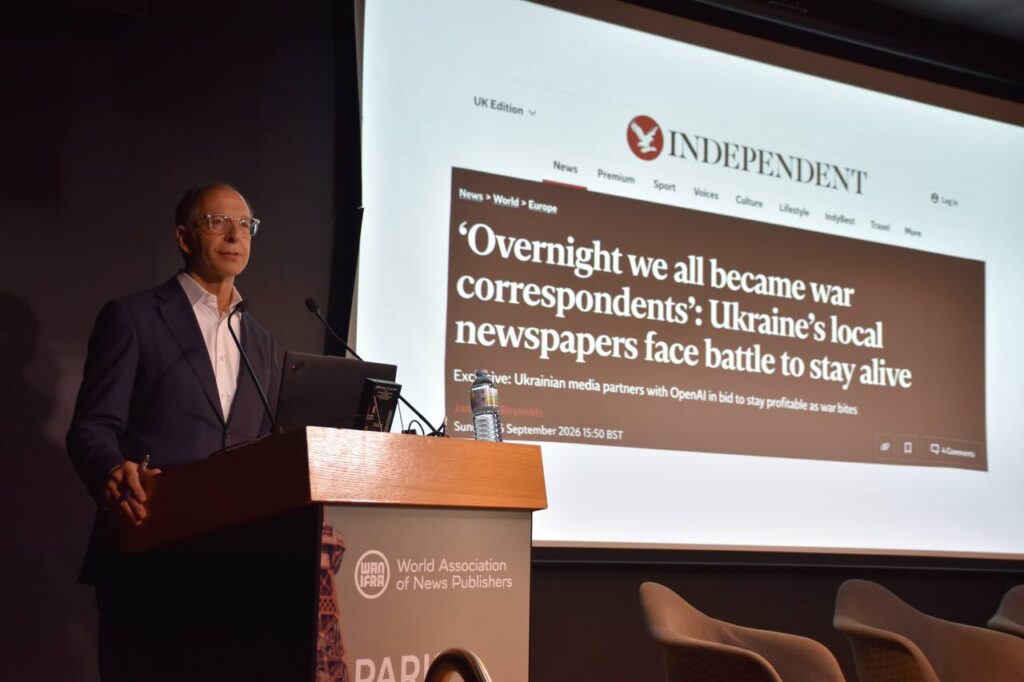
Ukrainian newsrooms are already clear about where AI can help. Trudova Slava told The Independent it wants AI to help monitor online sources and find stories across communities scattered by war. The Kremenchuk Telegraph plans to use it to search public records for investigative leads.
We look forward to learning from the journalists doing that work and those leading the other projects. They know their communities best and understand the problems they need to solve. The editorial decisions remain theirs. Our support is designed to strengthen that independence.
This work is vital today, and it will matter just as much during reconstruction, as communities rebuild. Local reporters will follow rebuilding funds, ask when schools will reopen, and tell the stories of families returning home. They will help their communities remember what happened and have a say in what comes next.
That is a future worth working for.
To Ukraine’s journalists: thank you for continuing to show up for your communities. We remember and honor the colleagues you have lost. We recognize all that this work demands of you and your families.
OpenAI is proud to work with AIRPPU and WAN-IFRA to support you. We hope these AI tools give you more time, and a greater ability, to investigate and report on the stories that matter – including stories that once seemed beyond your newsroom’s resources.
It is an honor to play even a small part in your work for a free and democratic Ukraine.
Thank you.
Read also: “The Light of Journalism Must Not Go Out”: How OpenAI Supports Ukrainian Newsrooms