


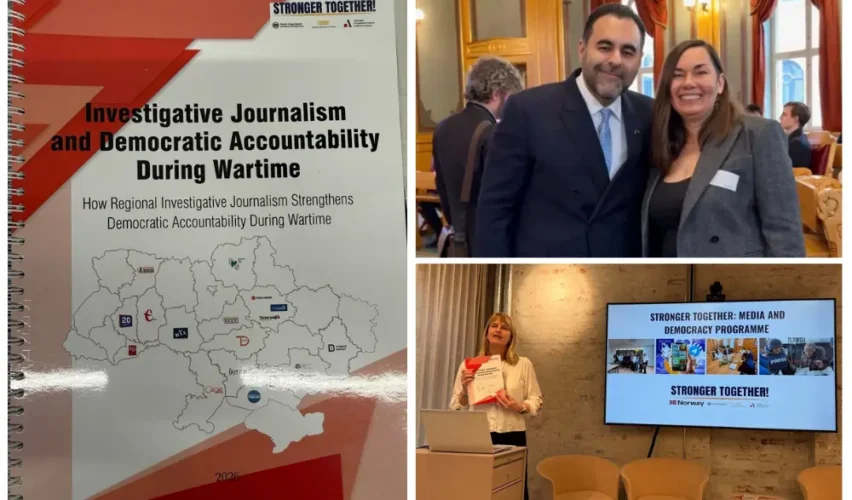
When the work of regional journalists leads not only to public discussion but to real change, when investigations uncover violations and abuse of power, it becomes a step toward stronger and more independent journalism. These are exactly the kinds of stories the team of the Association of Independent Regional Press Publishers of Ukraine gathered in the coffee table book Regional Investigative Journalism During the War.
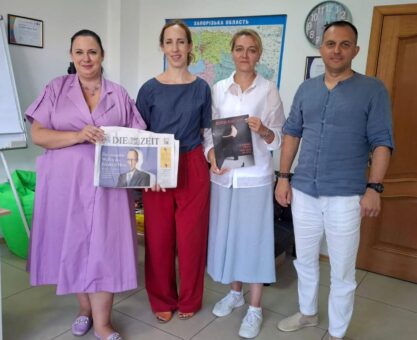
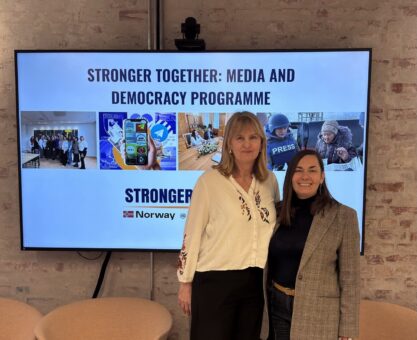
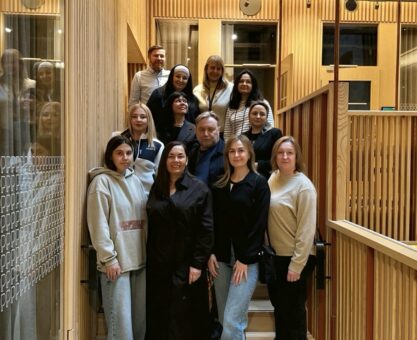
We have already presented this collection to the international community. During a visit to Norway, it was introduced to Norwegian partners within the framework of the Stronger Together program. AIRPPU CEO Oksana Brovko presented a copy to Masud Gharahkhani, President of the Norwegian Parliament, as a shared result of the strong and reliable partnership between our countries.
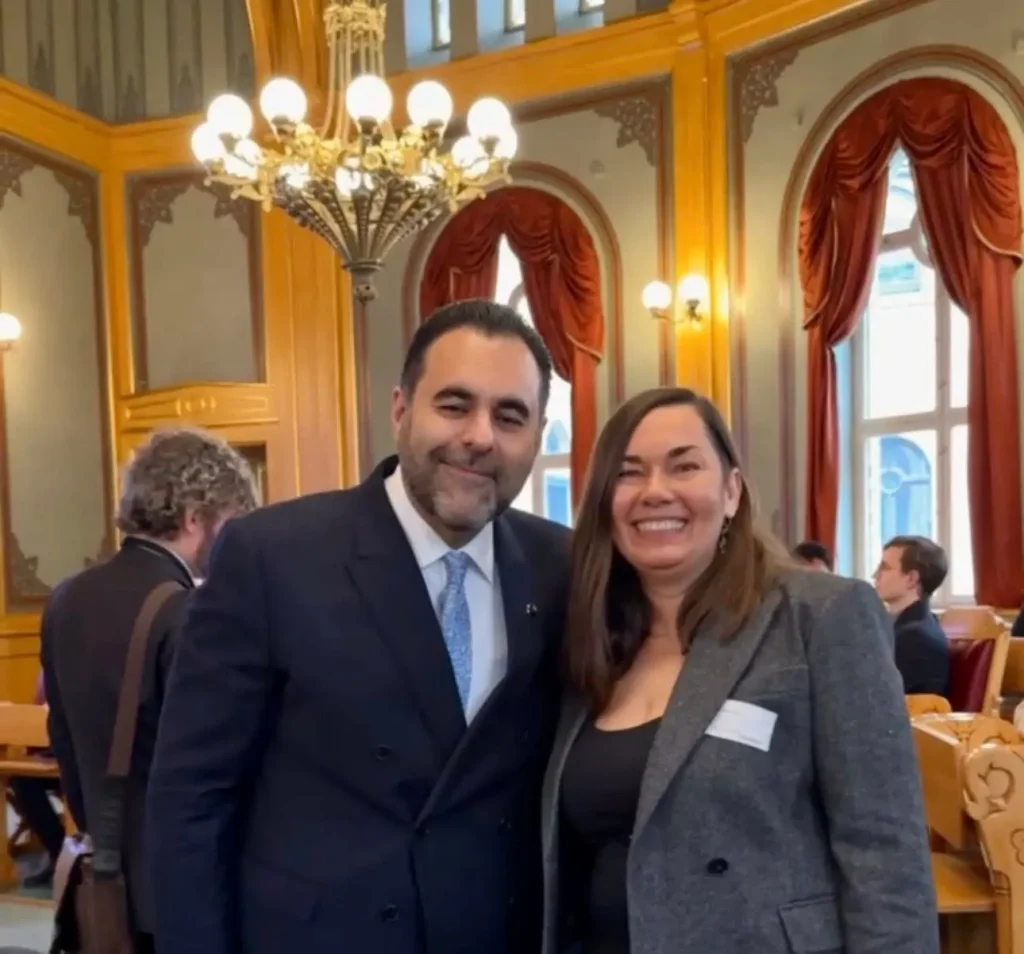
Copies of the collection were also presented to our partners in the Stronger Together project, as well as to Norwegian media representatives. Among them was Randi Øgrey, CEO of the Mediebedriftenes Landsforening (MBL), who emphasized the importance of such cooperation. According to her, strengthening independent media and protecting freedom of speech are essential parts of the democratic world.
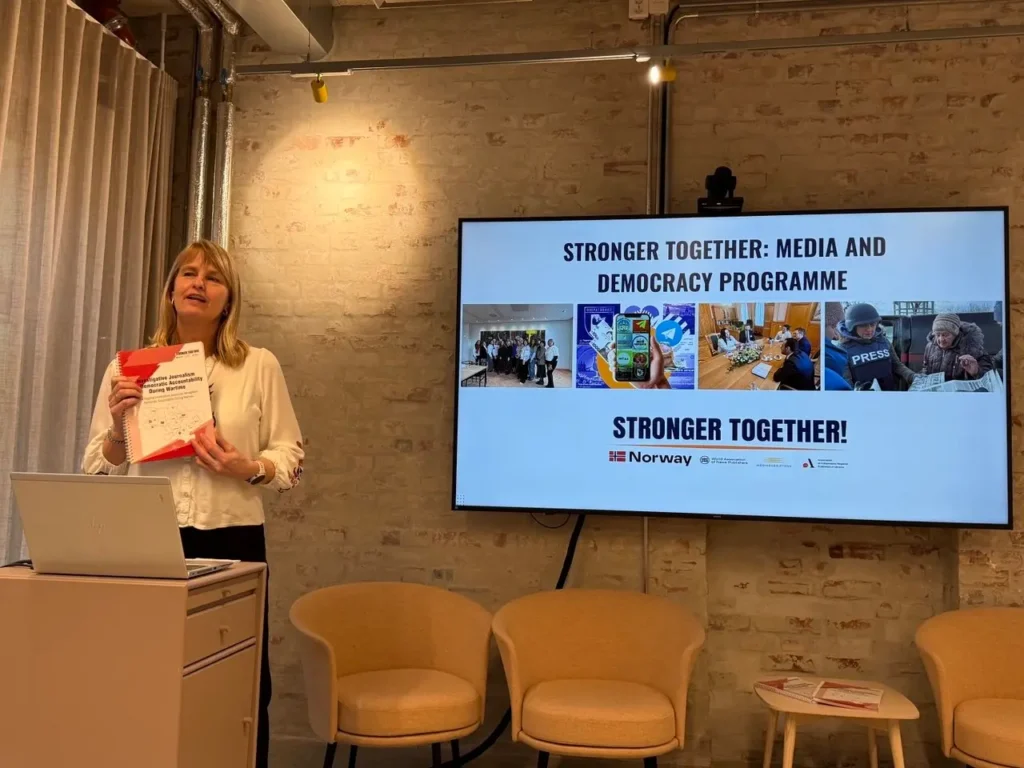
This publication brings together 13 investigations selected by mentors through a voting process following the first year of the Stronger Together: Transparency and Anti-Corruption program. All of them have been translated into English.
As a reminder, the project brought together 18 regional Ukrainian newsrooms and six investigative journalism mentors to strengthen the capacity of local media to work with data, develop hypotheses, build evidence-based reporting, and uphold high professional standards even during wartime.
Building a Community of Investigative Journalists
The project’s goal was not only to produce individual stories, but also to build a network of regional investigative journalists capable of carrying out systematic public oversight in their communities. Over the course of six months, participating teams produced 105 investigations. The book includes stories that reflect both the diversity of topics covered and the professional quality of the participating teams.
These are not simply articles, but examples of how local journalism upholds the principles of accountability, the rule of law, and transparency.
“Accountability cannot be postponed until the war is over. Crisis does not cancel democratic responsibility — on the contrary, it makes it even more necessary. When oversight weakens, emergency spending is left without proper scrutiny, public assets pass into private hands, reconstruction funds lose transparency, and influence operations expand unnoticed. The investigations gathered in this publication document precisely these risks. By tracking money, property, influence, and power at the community level, independent newsrooms help ensure that resilience is not only military, but institutional as well. Democracy is strengthened not after war, but during it,” says Oksana Brovko.
What Is Included in the Coffee Table Book
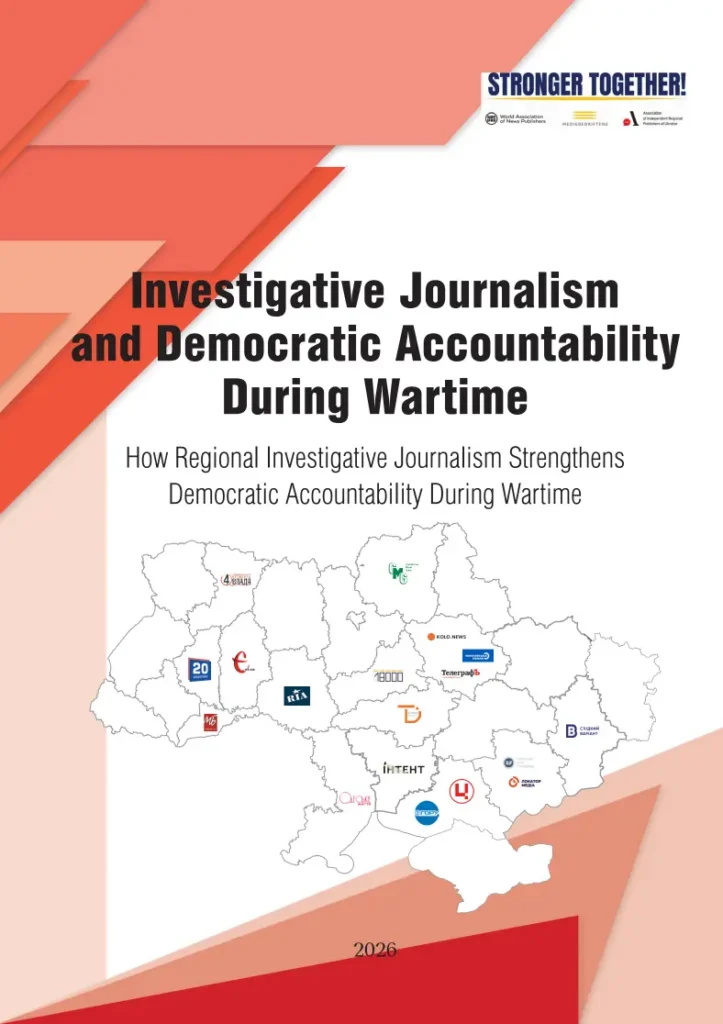
The collection features original investigations by 13 regional media outlets, organized into thematic sections:
Section I. Power, Money, and Accountability During Wartime
- Why are shelters in Chernivtsi, which cost millions of hryvnias to build, abandoned?
- The Donetsk regional administration spent 25 million hryvnias on a sanatorium center in the frontline territory that cannot be used
- How teachers train each other using budget funds: how the internal «professional development» system works
- How a state college in Odesa was effectively replaced by private management
Section II. Public Property and Private Interests During Wartime
- The Secrets of the Saint-Tropez Resort Base: How a Facility Slated for Partial Demolition Became an Asset of a Company Linked to a Prosecutor’s Circle page
- Scheme Thinking: How a Gift to the City Turned into a «Present» for the Mayor’s Inner Circle
- A «Pump House Cottage» on the Banks of the Dnipro for an MP (or His Family)
- The Banks of the Southern Bug for the Chosen Few: Who Is Blocking Residents’ Access to the River?
- Kyiv Residential Complexes at «Fairy-Tale» Prices and Suspicion: What Was Uncovered About Kropyvnytskyi’s Chief Architect
Section III. War Crimes, the Wartime Economy, and Global Impact
- How Companies of FSB Anchored in EU Ports and Countries
- Treason for Export: Which Businesses in Occupied Kherson Region Are Reaping Windfall Profits During the War
Section IV. The Social Sphere and Accountability
Section V. Information, Influence, and Propaganda
Real Impact
The results of these investigations go far beyond published stories. Concrete consequences can already be seen: inspections of bomb shelters, reviews of the use of grant funding, and appeals to the National Anti-Corruption Bureau of Ukraine (NABU) regarding possible abuses. Some topics have already reached the international level, with media outlets in Lithuania and Latvia examining the influence of Russian business and information networks based on the experience of Ukrainian journalists.
New challenges lie ahead. The Stronger Together project continues to systematically strengthen investigative journalism in the regions. Because war is not only a struggle for territory. It is also a struggle for rules, trust, and the future. Independent regional journalism remains one of the key instruments in that fight.
Follow our pages so you do not miss important updates.
***
As a reminder, the programme «Stronger Together: Media and Democracy» is implemented by the Association of Independent Regional Press Publishers of Ukraine (AIRPPU) in partnership with WAN-IFRA and the Norwegian Media Businesses’ Association (MBL), with the support of Norway.