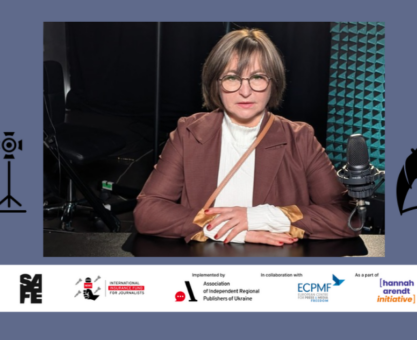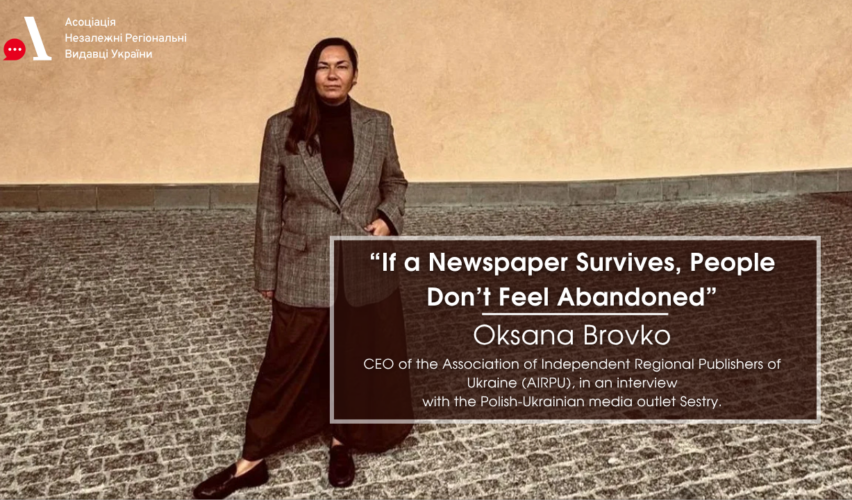
The experience of Ukrainian regional media continuing their work during Russia’s full-scale war is attracting growing attention from international colleagues. The Polish-Ukrainian media outlet Sestry has published an in-depth interview with Oksana Brovko, Director of the Association of Independent Regional Press Publishers of Ukraine (AIRPPU). Speaking with journalist Iryna Skosar, Brovko discussed the everyday challenges facing local newsrooms, international solidarity, and the experience of supporting independent journalism during wartime.
The interest shown by this Polish-Ukrainian publication is particularly important because it helps international audiences understand not only the difficulties facing Ukrainian journalism but also the practical solutions that enable newsrooms to survive and continue their work. Polish media professionals have repeatedly supported their Ukrainian colleagues, and these experiences are now becoming part of a broader international conversation about the future of independent journalism.
International Media Solidarity That Delivers Results
Since the beginning of Russia’s full-scale invasion, more than 330 media outlets in Ukraine have ceased operating. Occupation, displacement, the loss of advertising revenue, and the destruction of infrastructure have forced newsrooms to find new ways to preserve their teams and remain connected to the communities they serve.
Since the start of the full-scale war, AIRPPU has been building an international support network for regional newsrooms, bringing together not only traditional donors but also foreign media companies and professional organisations.
Back in 2022, when Ukrainian newspapers faced a severe paper shortage, Oksana Brovko reached out to international colleagues for help. Poland’s Gazeta Wyborcza and WAN-IFRA were among the first to respond. Polish media professionals donated paper from their own supplies, WAN-IFRA provided financial support, and partners helped organise delivery to Ukraine.
This network of professional relationships proved especially valuable following the suspension of USAID funding. When dozens of newsrooms suddenly lost a substantial share of their budgets, AIRPPU began seeking alternative sources of support among its international media partners.
In less than a week, Oksana Brovko secured a partnership with Norway’s Amedia Foundation. Through this cooperation, the Association was able to restore support for 50 Ukrainian regional media outlets, enabling them to continue operating for six months while seeking longer-term funding. Nearly €300,000 was transferred even before the contract was signed, reflecting the trust established between the partners.
International cooperation also helps address the immediate needs of individual newsrooms. When a Russian strike hit a Nova Poshta warehouse in Dnipro, destroying more than 2,000 copies of the Mezhivskyi Meridian newspaper, AIRPPU stepped in through its Emergency Support Programme for Regional Media. The Association helped the newsroom reprint the edition and deliver it to readers.
Alongside emergency assistance, however, newsroom development is becoming increasingly important. Training programmes alone are not enough. Media organisations also need resources to put new skills into practice, develop digital platforms, and build their own revenue streams.
“It is not enough to simply teach people something new. We also need to give them the resources to put that knowledge into practice, grow, and continue their work.”
Oksana Brovko, Director of AIRPPU
AIRPPU applied this approach in its cooperation with Trudova Slava, a regional newspaper from Zaporizhzhia Oblast. Previously focused primarily on its print edition, the newsroom received support to develop its social media presence and went on to reach half a million users.
Independent Newsrooms, Stronger Communities
International support is helping Ukrainian media survive today, but the long-term goal is to create the conditions for their financial independence. This makes knowledge exchange with European colleagues, the development of independent revenue streams, and the search for new business models especially important.
Financial sustainability also enables newsrooms to continue independent reporting, including holding local authorities accountable. AIRPPU has selected 18 regional newsrooms to strengthen their investigative journalism, examining public spending, procurement contracts, and officials’ asset declarations. Some of these outlets are already facing threats of legal action, making it essential that support extends beyond producing investigations to protecting journalists from pressure.
For local communities, the importance of independent media goes far beyond news and investigative reporting. In towns and villages near the front line, a local newspaper often remains one of the few sources of reliable information. For people forced to leave their homes, it can also provide a vital connection to their hometowns and villages.
“It is a connection to their homeland, their community, the life they had to leave behind, and the home that no longer exists.”
Oksana Brovko, Director of AIRPPU
This is why sharing the experience of Ukrainian regional newsrooms with international colleagues matters. Behind every partnership, support programme, or reprinted newspaper edition is an opportunity for journalists to continue their work and for communities to access independent information and preserve their own voice.
Read Oksana Brovko’s full interview with Sestry: “As Long as the Newspaper Survives, People Do Not Feel Abandoned.”