In Finland, persecution of journalists has turned out to be a widespread phenomenon that universities explore and that is addressed in legislation and support practices.
We continue our discussion on combating hate speech and persecution of journalists. A webinar was dedicated to this topic as part of the “Media Bridges: Finland—Ukraine” project organized by the Association of Independent Regional Publishers of Ukraine with the support of News Media Finland. We previously wrote about the Ukrainian experience – editorial policies, personal stories, and the gender dimension – that was described by Alyona Bereza, a journalist and founder of NGO “ZHAR” and the online‑publication “ZHAR.INFO.”
Now let’s turn to the Finnish experience, as shared by Tytti Oras, a lawyer at the Union of Journalists in Finland. In short: in the Finnish media landscape, this issue has also come to the fore and has become the subject of research, legislative decisions, and support initiatives.
The Scale of the Problem
Surveys conducted by the University of Tampere (2014, 2017, 2021) showed: persecution of journalists in Finland is systematic. Each year, 33% of journalists face insults, 17% face offensive statements, 13% – physical threats, 28% – legal threats (especially editors-in-chief), and 17% face surveillance or stalking.
The breakdown is as follows: a quarter of journalists have never experienced harassment, half encounter it occasionally, and another quarter face it on a regular basis.
The greatest risks are associated with investigative journalism, working in national media, social media activity, and personal visibility (video, audio). Young journalists are particularly vulnerable, especially women.
The consequences are obvious: harassment influences the choice of publication topics and decisions, it creates a “chilling effect,” increases self-censorship, and undermines the sense of security.
The Legal and Institutional Framework
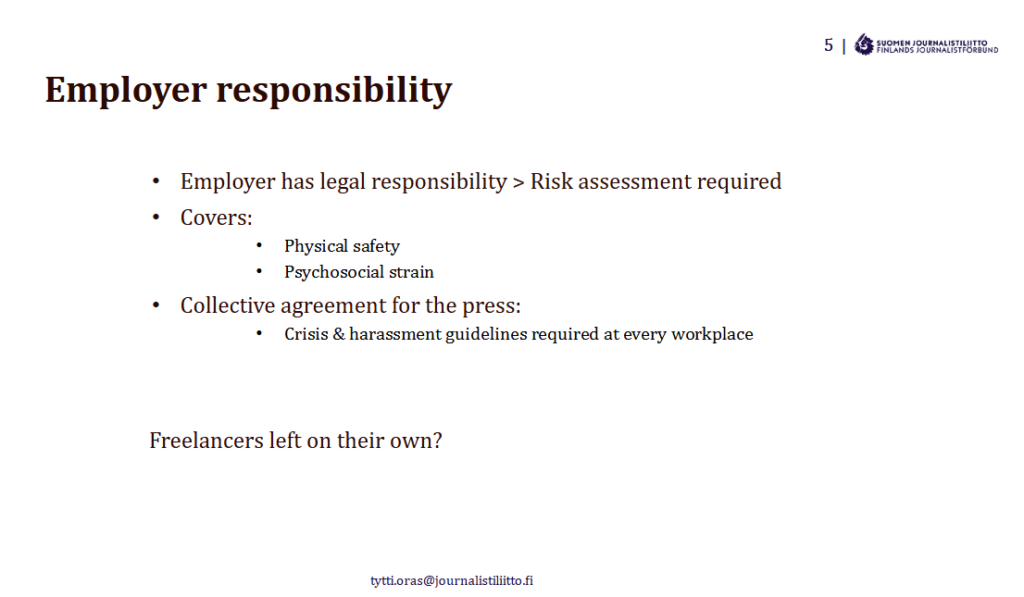
In Finland, the issue of harassment of journalists is addressed through the lens of occupational safety and health legislation. The Occupational Safety and Health Law requires that employers conduct risk assessments, take physical and psychosocial safety into account, and have a workplace safety program in place. If an employee is subject to stress or pressure that poses a threat to their health, the employer must take action.
Collective bargaining agreements for the press require that every outlet have crisis and anti-crisis guidelines in place. However, there is another aspect to the issue: Freelancers are often left unprotected.
Violations of safety regulations may be punishable by a fine or imprisonment for up to one year, as well as a corporate fine. This means that the employer’s liability is not merely a formality but it has actual legal consequences.
Practices and Case Studies
Finnish media outlets and trade unions have developed strategies to counter this.
- Prevention: identify high-risk topics and situations, protect personal data, and consider safety of the loved ones.
- Response: clear procedures, a low threshold for reporting, a designated contact person, support from colleagues, assistance from the occupational safety and health department, and legal support.
- Support: legal advice, insurance, a financial fund to assist journalists, and advice on countering online hate.
- Operating model: preparation (risk assessment), crisis phase (deescalation, resource allocation), post-crisis phase (analysis, restoration of operations, legal consequences).
The case of journalist Ida Erämaa is a prime example. In July 2023, she published a column about political activities of the Finns Party, which led to her being subjected to harassment and personal attacks. In February 2025, the investigation was curtailed, but following a complaint from the Journalists’ Union, the Finnish Prosecutor General ordered a review of the decision. In August of that same year, the first conviction for defamation was issued.
In practice, the employer had guidelines in place, colleagues were supportive, the police were slow to act, the Journalists’ Union provided assistance, and insurance covered the attorney’s fees. This case study showed: without the systemic support, the journalist would have been left on her own in a crisis situation.
***
The Finnish experience demonstrates a systematic approach: from research and legislative requirements to specific case studies and support practices. It shows that harassment of journalists is not a private matter, but an issue of professional safety that must be addressed collectively: by employers, labor unions, foundations, and legal institutions. For Ukrainian newsrooms, this is an example of how one can establish long-term mechanisms for protection and support.
This article was prepared as part of the “Media Bridges: Finland—Ukraine” Program implemented by the Association of Independent Regional Publishers of Ukraine in partnership with News Media Finland, and funded by the Finnish Ministry of Foreign Affairs