In today’s flood of information, we often can’t trust what we see or hear. And while people used to think: “If I see it, then it must be true” — that logic doesn’t work anymore. Artificial intelligence offers us many opportunities and helps us optimize workflows, but at the same time, generative models make it possible to create vast amounts of disinformation — quickly and on a massive scale — and, most importantly, to tailor it to specific topics and audiences. This leads to blurring of the information landscape: truth and fiction become intertwined, and it becomes much harder to tell them apart.
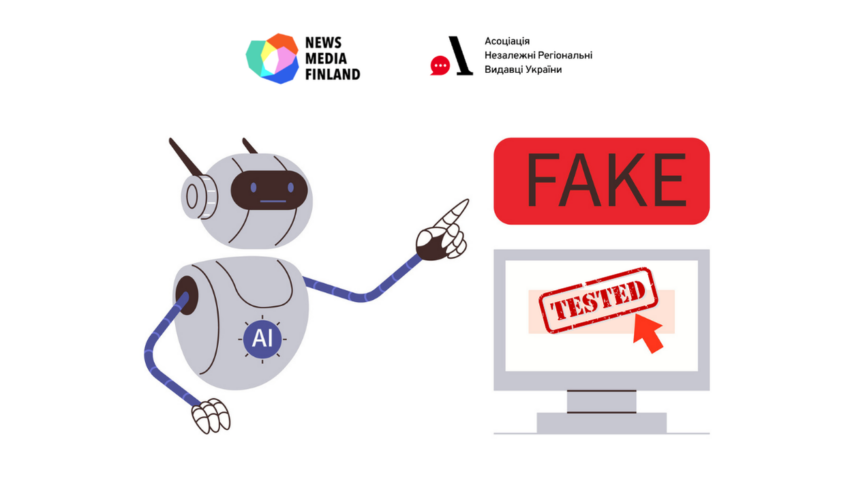
Take the TEST to check yourself.
So how can we tell truth from fake news and avoid becoming part of this information noise? As part of the “Media Bridges: Finland—Ukraine”, we’ve put together an interesting and, most importantly, practical guide on how to verify AI-generated content and avoid falling for it. After all, as our expert, media trainer and StopFake fact-checker Olena Churanova explains: “We often overestimate our ability to spot fake news. Even when we’re sure we’re seeing a fake or truth, we may still be wrong.” People may make mistakes.
To test your ability to spot manipulation and understand how important media literacy is, take the quiz we’ve prepared. However, we recommend that you do this after you’ve finished reading the article. After all, it contains lots of hints and answers to the questions.
When and Why Do “Hallucinations” Occur
Let’s start by saying that these days we all live in a world where fake news may seem more convincing than the truth. AI makes it possible to create not only individual pieces of content, but entire disinformation systems — texts, videos, accounts, and even websites — that reinforce one another and create the illusion of credibility. Olena Churanova explains that what sets modern disinformation apart is its precision, since it can be tailored to a specific audience. We’re not just talking about widespread fake news, but about content that takes into account emotions, context, and even local events.
“Today, disinformation can be hyper-personalized — essentially ‘tailored’ to an individual or a group of people,” she notes. “Moreover, a new problem arises: the possibility of dismissing any evidence by claiming it is the result of AI. This phenomenon is also known as the “Liar’s Dividend,” which undermines trust in facts.

A particular danger lies in the fact that artificial intelligence is actively used in disinformation campaigns. For example, in the Ukrainian context, we are already seeing how these technologies are being used to create fake videos, doctored audio clips and images that are spread through social media. Such content often exploits sensitive topics—such as mobilization or the war. Such narratives spread rapidly, creating the illusion of widespread acceptance and “credibility.” And most importantly — now even real videos or audio recordings can be called into question: it’s enough to say that they are fake.

It is equally important to understand the nature of artificial intelligence itself. It doesn’t “know” the truth and doesn’t try to find it. This is an algorithm that uses the statistics and data on which it was trained to generate the most likely response. Therefore, its results may contain errors, biases, or even fabricated facts — “hallucinations.”

That is precisely why healthy skepticism is becoming a key principle today. It’s not about the tools, which are constantly changing, but the ability to ask questions: Is this possible in real life? Are there other sources? Does this contradict logic or laws of physics? In the age of artificial intelligence, the truth no longer lies on the surface — it must be sought out, verified, and proven. Do you agree?
How to Check AI-Generated Content in Practice
But then the question arises: where, exactly, should I start?
Media coach Olena Churanova advises starting with something simple — paying attention to details. According to her, you can spot signs of manipulation even without any tools.
— Pay attention to little things: anatomy, shadows, reflections. Very often, it’s the details that give away that the content is fake, she explains. — When watching a video, pay attention to the lip-sync and the overall naturalness of the behavior. In an audio recording — pay attention to breathing, intonation, and emphasis.
Another important step is checking the context. If it is a high-profile event, it must be corroborated by other sources.
— If there’s only one video, for example, that’s not enough. We need to look for additional evidence, she notes.

Will these tools help?
If not manually, then how? After all, modern technology also offers a number of tools for verifying content. They can analyze images, videos, or text and detect signs of generation. These tools are called AI detectors.
These services help:
- look for pixel anomalies;
- analyze light and shadow;
- monitor biological signals;
- work with file metadata.

However, as Olena Churanova points out, one cannot rely solely on such services.
— No tool offers a 100% guarantee. It’s a support measure, but not a final solution, she notes. — There are several reasons: files are compressed on social media, the quality may be intentionally reduced, and the technologies are constantly improving.

And when it comes to texts, that’s a whole other story. AI-generated content often has a “sterile” structure, a monotonous sentence rhythm, and lack of a clear stance, or it contains fabricated sources, the expert explains. Detectors, however, analyze not the content of what is written, but the mathematical probability of the text — how predictable it is. So this just proves that automated verification is no substitute for human analysis. And this is something that journalists and editors, as well as readers and viewers, should keep in mind.
By the way, especially for all of the Association’s subscribers, we’re sharing some tools that will help you work with generated content:
informationlaundromat.com — a service that shows how information changes and “migrates” through various AI systems, often losing or distorting its original meaning. It helps explain how fake news or manipulation can appear to be credible information after being processed by AI.
searchwhisperer.ai — a tool that analyzes how different AI search engines respond to the same query. It allows you to compare answers, identify inaccuracies, biases, or absense of important sources.
llmadvisor.replit.app — a service that helps assess how language models interpret a topic, brand, or information query. It allows one to identify errors, “hallucinations,” or distortions in the AI’s responses.
Let’s summarize
Here are a few important tips for media professionals from Olena Churanova:
- Cultivate a healthy dose of skepticism: Trust your professional instincts and always question content that seems too perfect or overly emotional.
- Look for “physical” errors: when analyzing visual content, pay attention to anatomy (fingers, teeth), the laws of physics (shadows, reflections), and unnatural movements (blinking, breathing). Don’t limit yourself to just a visual inspection — use verification services such as InVID, WeVerify, Deepware, or Hive.
- Check facts, not just the pixels: always look for the original source of information; consult witnesses and official channels, especially if the event is high-profile.
- Be transparent with your audience: notify them about your newsroom’s policies on AI use and label any AI-generated content when it is used.
- No tool offers a 100% guarantee. Your reputation is based on a multi-tiered verification process and accountability to your audience.
For readers. How to avoid falling victim to AI-generated misinformation:
- Don’t trust your first impression: if the content evokes strong emotions or seems “too perfect,” that’s a reason to pause and not share it right away.
- Take a look at the details: pay attention to anything that seems unnatural, such as strange fingers, shadows, movements, voice, or intonation. Even minor inconsistencies may indicate that the content is artificial.
- Check the source: check where the photo or video came from, see if there is any information about it in other media outlets, and see if official sources confirm the event.
- Do not share questionable content: even if you’re not sure whether it’s fake, it’s best to refrain from sharing it — that’s exactly how misinformation spreads.
- Be aware of limitations of AI: artificial intelligence may make mistakes, invent facts, or distort information, so you shouldn’t take its answers as the absolute truth.
The most important thing for both media professionals and the audience is to understand that the responsibility is shared. In a world where anyone can be a source of information, it is each user’s attentiveness and critical thinking that help reduce the impact of misinformation.
Now take the test and see how well you’ve mastered this content and whether you’re ready to review AI-generated content.
***
The “Media Bridges: Finland—Ukraine” Project is implemented by the Association of Independent Regional Publishers of Ukraine in partnership with News Media Finland, and funded by the Finnish Ministry of Foreign Affairs.