


Since the start of Russia’s full-scale invasion, Ukrainian journalists have been forced to constantly adapt to new challenges, as traditional safety protocols are increasingly proving ineffective. For example, the «PRESS» marking—which, under international humanitarian law, is intended to protect civilian journalists—has, in the context of Russia’s war against Ukraine, often turned them into targets. At the same time, the greatest threat to reporters working in frontline areas now comes from drones, rather than artillery or small arms alone.
Since 2022, the Association of Independent Regional Press Publishers of Ukraine (AIRPPU), together with Ukrainian and international partners, has been implementing the INTERNATIONAL INSURANCE FUND FOR JOURNALISTS project. The initiative provides Ukrainian media professionals with life and health insurance while working in high-risk areas, helping to fill the gap left by the country’s still limited system of state protection.
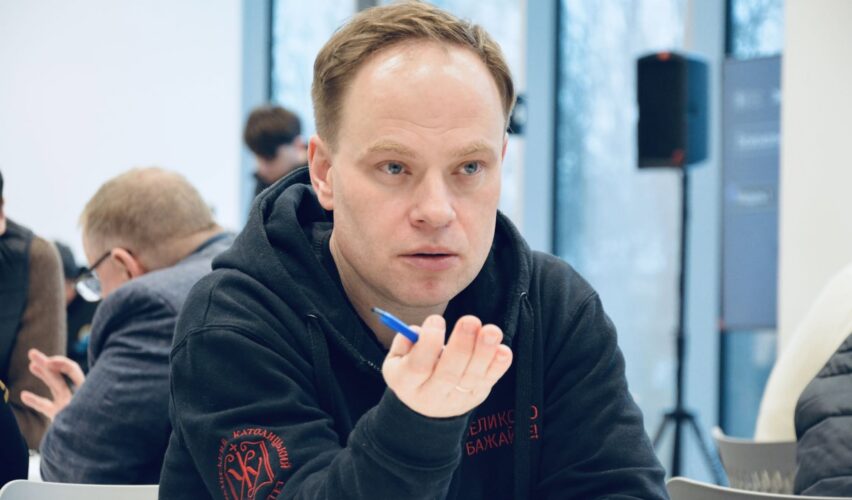
In this interview, Yaroslav Yurchyshyn, civic activist and Chair of the Verkhovna Rada Committee on Freedom of Speech, discusses why safety protocols for journalists must evolve, why international humanitarian law needs to be reconsidered in light of modern warfare, the growing need for anti-drone protection, and the importance of stronger state guarantees for media professionals. The interview was recorded exclusively by the AIRPPU team for our partners and colleagues.
Anti-Drone Protection Is Essential
— To begin with, are the current safety protocols for journalists still relevant during the full-scale war? What needs to change right now?
— First and foremost, they need to be updated. Today, protection means much more than just wearing a bulletproof vest—it also requires anti-drone protection. Since this includes both drone detectors and drone-jamming devices, often referred to as anti-drone guns, many of our international partners classify them as weapons, meaning journalists are not allowed to use them.
In my view, journalists should be allowed to use anti-drone protection, including drone detectors and anti-drone guns. It is understandable that these technologies are not covered by existing international humanitarian law because when those rules were drafted after the Second World War, drones simply did not exist.
Safety protocols themselves also need to be revised. Current international guidelines recommend wearing clearly identifiable protective gear and marking vehicles with «PRESS». But in wars of annihilation like Russia’s war against Ukraine, such markings often become an additional reason for the enemy to target civilians. This applies not only to journalists but also to humanitarian missions.
That is why the international community should reconsider how wars are classified according to their intensity and whether the parties involved comply with international humanitarian law in the first place. Russia clearly does not—it merely pretends to. Meanwhile, Ukrainian journalists, media organizations, and humanitarian workers have become priority targets for Russian forces.
We see this very clearly through the work of the Temporary Special Commission investigating Russia’s crimes against journalists and the media. That is why international humanitarian law should be revised to rethink how civilians are protected in war zones. For the media, the priorities are clear: update safety protocols, allow the use of anti-drone protection, and classify wars according to their level of intensity so that journalists are not put at greater risk by being required to display «PRESS» markings.
— How difficult is it to advance these changes internationally?
— We also have work to do within Ukraine. The first step should be updating the internal regulations of the Ministry of Defence, as well as the recommendations issued by the National Council of Television and Radio Broadcasting.
The greatest challenge, however, is at the international level. Most foreign correspondents are able to work thanks to international assistance programmes and cooperation with international monitoring missions, all of which rely on existing international humanitarian law. And that legal framework is extremely difficult to change. In fact, there have been no major revisions since the Balkan wars.
That is why it is so important to raise this issue on international platforms. We are actively advocating for changes to international humanitarian law within the Parliamentary Assembly of the Council of Europe, the OSCE Parliamentary Assembly, and NATO Parliamentary Assembly forums. Ultimately, however, the key role belongs to the United Nations system, as it is the custodian of international humanitarian law.
Advancing these changes has become even more difficult because Russia is highly active within these institutions, China is highly active, and so are their allies. But that does not mean we should give up.
In the near future, we are preparing a resolution for the summer session of the OSCE Parliamentary Assembly. We also plan to organize a dedicated event focusing on the situation of Ukrainian media and journalists, who have become one of Russia’s priority targets in this war.
«We Need to Join Forces to Make These Changes Happen»
— Is there sufficient coordination between the government, media organizations, and civil society to advance these changes?
— Yes. Only a joint effort by the government, international organizations, and media communities—including Ukrainian civil society organizations—can deliver real results. If these efforts come only from the government or only from civil society, it is highly unlikely that international humanitarian law protecting civilian journalists will be revised.
Independent experts have their own perspective, while the government has its official position. When those positions align, the chances of being heard are much greater.
We need a genuine coalition that brings together government institutions, diplomatic bodies, civil society organizations, parliamentarians, and international organizations that already cooperate with Ukrainian media groups—from «Reporters Without Borders» to many others.
— What is Parliament’s position? Are enough efforts being made to help journalists carry out their work while ensuring their safety?
— When it comes to independent media, we have to be careful that state support is not perceived as government interference. That is why we should work through partners and international assistance programmes.
Another idea currently under consideration is the creation of a dedicated fund under the Ministry of Culture. Since information policy remains within the Ministry of Culture and the State Committee for Television and Radio Broadcasting, these institutions could assume part of the responsibility for providing war correspondents with protective equipment.
At the same time, this process must run in parallel with cooperation with international organizations. If we document war crimes and later present them before an international tribunal, we need solid evidence.
If Russia claims, «Journalists were shooting at our drones with anti-drone guns,» it will try to portray this as an act of aggression and justify its own actions as «self-defense.» In reality, journalists would simply be protecting themselves from attack.
That is why we must work together very carefully and in a coordinated way, without giving our enemies additional arguments. Bureaucratic challenges will certainly exist, but I do not see any major difficulty in convincing Ukrainian society that journalists deserve proper protection.
— Are Ukrainian journalists themselves ready for these new rules of working in frontline areas?
— Those who work along the border or on the front line abandoned the old humanitarian rules long ago. Today, it is difficult to find anyone—apart from some international correspondents—who would travel to frontline areas with a clearly visible «PRESS» marking.
Ukrainian local producers also explain that this is no longer advisable. What really matters now is having anti-drone protection. Sometimes simple intuition can save your life.
So I would say that Ukrainian journalists are already living under these new realities. Unfortunately, they have been forced to adapt to rules that international humanitarian law has yet to recognize.
— Are journalists prepared to use anti-drone protection?
— Those working in frontline areas have been using it for quite some time. Most other journalists also know how to operate this equipment.
We considered different options, including military escorts. However, that would actually increase the danger because military personnel are, by definition, a higher-priority target.
Of course, journalists will need training and specialized courses, and support from the military in providing that training would be extremely valuable.
— Do you think it is realistic for the government to equip every reporting crew or every journalist with anti-drone protection?
— No. The state simply does not have the necessary resources. Even when it comes to manufacturing anti-drone equipment, the priority must naturally go to the military—to those serving on the front lines who need it the most.
«Crimes Against Journalists and Insurance»
— Is there currently a systematic effort to analyze attacks on journalists working in frontline areas while displaying «PRESS» markings? Does the state document such cases?
— Unfortunately, there is still no comprehensive state database tracking attacks on journalists. In most cases, this information is collected by media and expert organizations that document injuries, killings, and attacks on journalists working in combat zones, including cases where media workers were clearly identified with «PRESS» markings.
At present, the state’s primary role is to investigate crimes after they have occurred. However, during a closed meeting involving law enforcement agencies, government institutions, and the Human Rights Commissioner, everyone acknowledged a clear trend: the number of attacks against journalists displaying «PRESS» markings has increased. Over the past two years, these incidents can already be regarded as evidence of a systematic pattern of attacks.
Another challenge is that for the Prosecutor General’s Office, the National Police, the Main Investigation Department, or the Security Service of Ukraine (SBU), which investigate these crimes, it has not traditionally been a priority to determine whether a journalist was clearly identified with a «PRESS» marking, since the attack itself already qualifies as a war crime.
For the international community, however, such data is critically important. The issue is not only the number of journalists who have been injured or killed, but the growing pattern showing that journalists who openly identify themselves in accordance with international recommendations are increasingly becoming deliberate targets.
This should serve as a clear signal to the international community: Russia is not simply violating international humanitarian law—it is systematically escalating those violations. Consequently, the mechanisms designed to protect journalists and civilians in conflict zones require urgent revision, because under current conditions they are no longer providing effective protection.
— Beyond updating safety protocols and international humanitarian law, another crucial issue is insurance for journalists, especially those working in frontline regions or directly on the front line. Much of this support is currently provided by international partners and professional associations, including AIRPPU. How realistic is it to establish a comprehensive state insurance and protection system for journalists in Ukraine in the future?
— Our Committee began working on this issue after receiving appeals from journalists, as insurance companies were effectively refusing to insure media professionals working on the front line. This is understandable—such insurance carries exceptionally high risks, while for many years the state created neither the legal framework nor the incentives necessary for such programmes.
Today, the greatest challenge is funding. These insurance programmes are expensive, and no dedicated budget has been allocated for them. However, in my opinion, covering the war is itself an element of national security. If we do not tell the world what is happening in Ukraine, Russian propaganda will fill that space instead.
That is why the role of our international partners is so important today. They help meet needs that the Ukrainian state is not yet able to fully cover. And this is not only about Ukraine—we are defending the democratic world as a whole.
Strategically, however, Ukraine must develop its own system of guarantees. If the state values independent reporting on the war—not only information provided by military press officers—then it must also provide basic protection mechanisms for journalists working in combat zones.
This includes not only insurance, but also support in cases of injury, disability, or death, including assistance for journalists’ families. Even the mechanisms that formally exist today often fail to function because adequate funding is unavailable.
— In reality, journalists now work under dangerous conditions throughout Ukraine. Is it possible to build an effective protection system under such circumstances?
— Today, all of Ukraine is a high-risk environment. At the same time, there is still a significant difference between working in Lviv and reporting from the border areas of Sumy, Kharkiv, or Zaporizhzhia regions.
The security situation is constantly evolving. Two years ago, we were seriously concerned about the possibility of an offensive from Belarus. Today, we face different threats.
That is why these issues should be regulated as flexibly as possible—not only through legislation, but also through decisions of the Cabinet of Ministers and military administrations, allowing authorities to respond quickly to changes in the security environment.
For now, however, our immediate goal is to establish at least basic state guarantees for journalists working closest to the front line.
— How realistic is it that such guarantees will eventually be provided by the Ukrainian state rather than relying solely on international assistance?
— It certainly will not be a quick or easy process. We have to be realistic. Today, the state faces enormous challenges: supplying the Armed Forces, mobilization, and paying military personnel. Under these circumstances, it is difficult to expect immediate decisions on state-funded insurance for journalists.
Nevertheless, we are committed to working on this issue. As the Committee on Freedom of Speech, together with our colleagues from the humanitarian committee, we will do everything possible to move these decisions forward.
For now, it is critically important that professional associations and international partners continue supporting Ukrainian journalists. At the same time, we must already be developing mechanisms that will eventually allow Ukraine to provide these guarantees independently, through its own national system.
We remind journalists traveling on assignments to high-risk areas that they can apply for insurance through the «INTERNATIONAL INSURANCE FUND FOR JOURNALISTS». The programme provides insurance coverage of up to USD 100,000. Full details and eligibility criteria are available on the project website. Our coordinators will be happy to assist you with the application process.
***
The content was produced with the support of the International Insurance Fund for Journalists implemented by the Association of Independent Regional Press Publishers of Ukraine is part of the Voices of Ukraine / SAFE support program, coordinated by the European Centre for Press and Media Freedom. Voices of Ukraine / SAFE is implemented within the Hannah Arendt Initiative and supported by the German Federal Foreign Office