


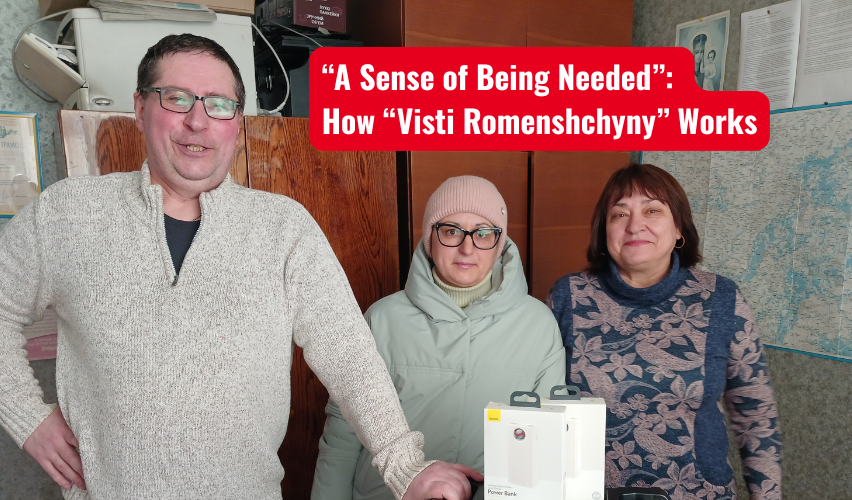
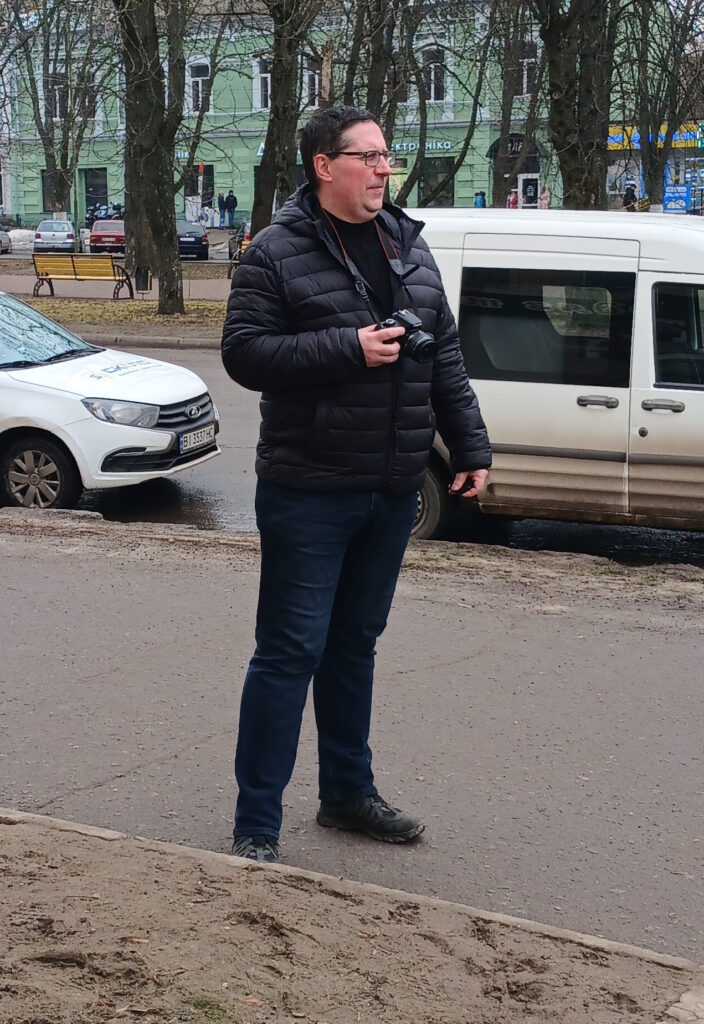
Editor-in-chief of “Visti Romenshchyny”, Pavlo Kliuchnyk, speaks about the challenges of journalistic work in a border region of Sumy oblast during wartime.
The war has turned journalism (and not only journalism) in Ukraine into a high-risk profession. For newsrooms in border and frontline regions, daily work is marked by a constant background danger. At the same time, all our interviewees emphasise that it is also a responsibility to remain the community’s voice and to document its life, losses, and victories.
Today, we are discussing these challenges with Pavlo Kliuchnyk, editor-in-chief of the newspaper Visti Romenshchyny. He explains how a small team maintains contact with readers, how their work has changed during the war, and what journalistic dignity means today.
As Pavlo recalls, the Romny area was occupied by Russian forces for several months.
— There were casualties, and people were injured. But overall, we got off relatively lightly. The occupiers mostly moved along the main routes in transit.
“The coronavirus pandemic prepared the newsroom”
— Pavlo, Ukrainian media, especially in border and frontline regions, are now working in conditions where danger is always nearby. How does this change your focus and the way you work?
— Thanks to the daily heroism of the Armed Forces of Ukraine and the efforts of everyone involved in defending Ukraine from Russian aggression, the Romny area in general, and Visti Romenshchyny in particular, are relatively “in the rear” compared to border communities of the region. Unfortunately, the enemy still strikes our territory — there is destruction and damage to buildings, wounded and killed fellow residents. But what has “reached” us since the start of the full-scale invasion can happen in border areas within a single day. So today the most realistic threat from Russia for us is drone or missile strikes — but, fortunately, not artillery shelling or guided aerial bombs. The relative proximity to the border (less than 150 kilometres) forces us to closely monitor the situation in the northern Slobozhansky sector.
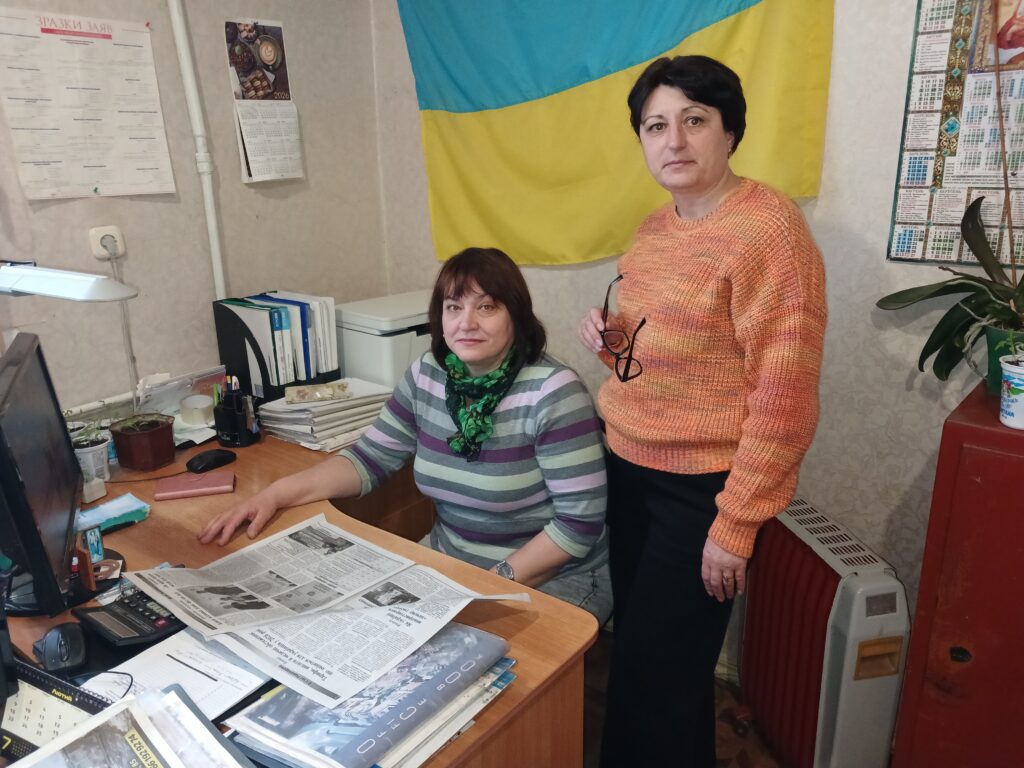
Strangely enough, the coronavirus pandemic prepared the newsroom for difficult conditions. Quarantine restrictions and limited mobility within the district forced us to revise our workflows: remote work, mobile and video communication for gathering information and preparing issues for print, cloud tools for shared documents, working with freelance contributors, often voluntarily, and more. Unfortunately, a joke from the pandemic era — that “in a few years you’ll find a forgotten mask in your pocket and look at it nostalgically while adjusting your bulletproof vest” — turned out to be a grim prophecy. After the full-scale invasion, problems increased: the printing house in Kharkiv was destroyed, and we had to find another one. Fortunately, already in April, after the Russians withdrew from the Romny area, we resumed printing the newspaper in Vinnytsia. Now the newsroom works mostly remotely — more because of power outages than shelling.
“Work becomes a way to maintain inner balance”
— What rules or habits help you reduce risks during field trips? Have you taken part in any safety programs or projects that actually helped?
— In the Romny area, the security situation is much calmer than in northern communities directly on the frontline. So for us, it is enough to follow basic safety rules to avoid putting our health and lives at risk. Of course, we follow recommendations from emergency services and law enforcement. The newsroom has a first aid kit with all necessary supplies.
Another rule is to always stay in touch. Everyone informs colleagues where they are going and when they plan to return, and calls or messages if delayed. As for safety programs, our journalists have participated in trainings for regional media, but fortunately, we have not yet had to apply these skills in practice.
Another rule is to always stay in touch. Everyone informs colleagues where they are going and when they plan to return, and calls or messages if delayed.
— Does this help cope with anxiety or a sense of danger? Do you have your own ways of psychological support?
— Probably the main thing that helps cope with anxiety is understanding your role and the meaning of your work. People are waiting for the newspaper; they want to know what is happening in their communities, to read stories about fellow residents, about support for the military, and about how the Romny area lives. This gives a sense of being needed and of the importance of what we do.
Support within the team also plays a major role: we are constantly in touch, discussing not only work issues but also what concerns each of us. Sometimes it’s enough just to talk, share worries, or even a joke to relieve tension.
Work discipline also helps: when there are clear tasks and deadlines for preparing an issue, there is less time left for “extra” anxious thoughts. Overall, journalistic work — when you have to do everything and even a bit more to ensure the newspaper is published on schedule — becomes a way to maintain inner balance.
— Tell us about your newsroom: how large it is, what topics you cover, how you organize your work, and how you stay connected with the community. What does daily safety monitoring mean for your newsroom? What do you check first?
— Our newsroom is a small team of three people. With the support of the Association of Independent Regional Press Publishers of Ukraine and Amediastiftelsen under the Emergency Support Program for Regional Media, since March, we have been working with a journalist who had to evacuate from Donbas and now lives in Andriashivka, Romny district. This way, we gained another journalist, and Natalia received at least a modest income.
Despite our compact size, we cover a wide range of topics: life in the Andriashivka, Romny, and Khmeliv communities, the work of local authorities, stories of our defenders and wartime losses, social issues, culture, education, healthcare, the lives of internally displaced people, and the activities of volunteers and businesses. It is important for us that readers see a complete picture of life in the Romny area — with its difficulties, challenges, and victories.
Much of our work is organised remotely. We receive feedback from communities through readers and freelance contributors, as well as via social media and direct requests to the newsroom. We cooperate with institutions and civil society organisations.
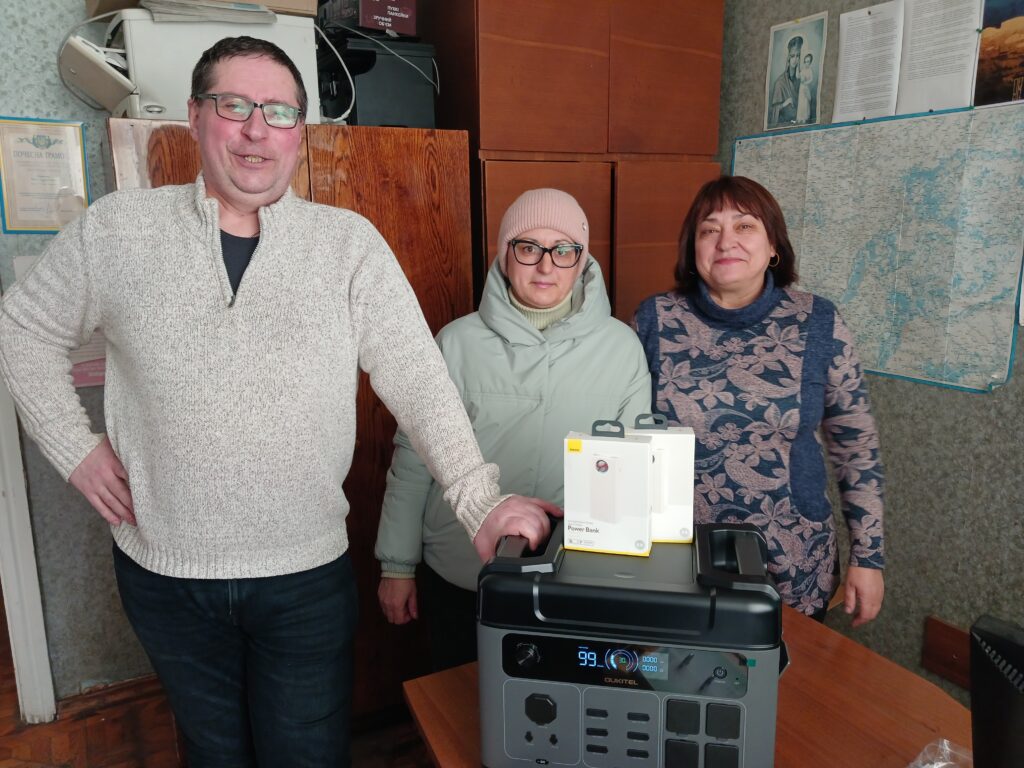
Often, it is readers who suggest topics, report important events, or highlight issues that need attention. Daily safety monitoring for our newsroom primarily means constant tracking of the situation in the region and in the northern Slobozhansky sector. It also includes monitoring electricity supply schedules. Thanks to a grant from AIRPPU, we have already ordered a powerful charging station and power banks capable of charging laptops, so we will be less dependent on long power outages.
“Not to dwell on cruel details”
— Were there moments when you decided not to publish material or show footage due to safety or ethical concerns?
— There were cases when people asked us not to publish photos of damage to their homes or not to disturb relatives who were psychologically affected by shelling. Even before 2022, the newsroom tried to avoid dwelling on cruel details.
— Which topics are the most difficult for you to cover — and why?
— These are topics related to the war. When you prepare materials about funerals, communicate with families, and see the pain of loved ones, it is very difficult to remain just an outside observer. Because it is always a personal tragedy for the family.
In a small community, many people know each other, so such stories are felt especially deeply. Therefore, in such materials, it is extremely important to be as accurate and careful as possible.
We also try, in publications about fallen fellow residents, to tell not only about the loss itself, but also about their lives, character, and the deeds for which they will be remembered. At the same time, we understand that these topics must be covered — because people need to remember and preserve the memory of those who gave their lives for them.
In publications about fallen fellow residents, we try to tell not only about the loss itself, but also about their lives, character, and the deeds for which they will be remembered.
— What helps you recover after working on such difficult materials? Do you have your own rituals for returning to normal life?
— Our team is small, so often after a hard story, you simply switch to another topic — cultural events, the achievements of fellow residents, interesting hobbies, and so on. Despite the war, life goes on, and many good and important things happen in our communities.
There are also simple personal rituals: walking through the town, spending time in our city park — it is next to the newsroom and very beautiful, especially in the warm season — taking a short break from the news. Sometimes it is enough just to pause to restore inner strength. Feedback from readers is also very supportive. When people thank us for a story, for preserving the memory of their loved ones, or for drawing attention to community problems, you realise that your work is needed and important.
“Responsibility for the information people receive”
— Finally: how do you understand dignity in the work of a journalist in wartime or under constant risk?
— Above all, it is about responsibility for the information readers receive, and about speaking honestly about the most difficult things, while respecting human pain.
When we write about fallen defenders or civilian tragedies, it is important not to turn these stories into “headline-grabbing” news, but above all to preserve the memory of people and show them as individuals. It is also important to remember that any information can have consequences: not to publish data that could harm the military, not to spread unverified information, not to give in to panic or manipulation.
And, of course, dignity means continuing to work even when it is difficult — when there are power outages or other challenges — and continuing to do your job.
Not to turn these stories into “headline-grabbing” news, but above all to preserve the memory of people and show them as individuals.
Take care of your safety
The Association of Independent Regional Press Publishers of Ukraine (AIRPPU) offers journalists working in dangerous regions the opportunity to obtain life and health insurance. This is part of the International Insurance Fund for Journalists (IIFJ) initiative, implemented in partnership with Ukrainian and European organisations.
Media professionals working in Kherson, Zaporizhzhia, Sumy, Mykolaiv, Donetsk, Luhansk, Odesa, Kharkiv, and Dnipropetrovsk regions, as well as border areas of Kyiv and Chernihiv regions, can apply. More information about the terms of free insurance is available here.
This publication continues a series of interviews with media professionals working in frontline and border regions. Previously, we published interviews with Zarina Zabrisky (Parts One and Two), Oleksandr Kachura, Vladyslav Safronov, Natalia Bilokudria, Serhii Horbatenko, Yevhen Khrypun, Anna Kaliuzhna, Polina Kulish, Nadia Sukha, Nadiia Karpova, Oleksandr Solomko (Parts One and Two), Diana Butsko, Oleksii Pasiuha, Oleksandr Chubukin, Aliona Serhiienko, Olha and Serhii Sydorov, Yevheniia Hrytsyna, Nataliia Kryvoruchko, and Inna Shvydka.
Let us recall that the Emergency Support Program for Regional Media was launched in autumn 2025 in cooperation with Amedia Foundation and aims to preserve and strengthen independent local and regional newsrooms producing print and online media under the difficult conditions of war and energy crises.
It should also be noted that the International Insurance Fund for Journalists project is part of the Voices of Ukraine program, which is included in the SAFE programme coordinated by the European Centre for Press and Media Freedom. Voices of Ukraine is implemented within the Hannah Arendt Initiative.