


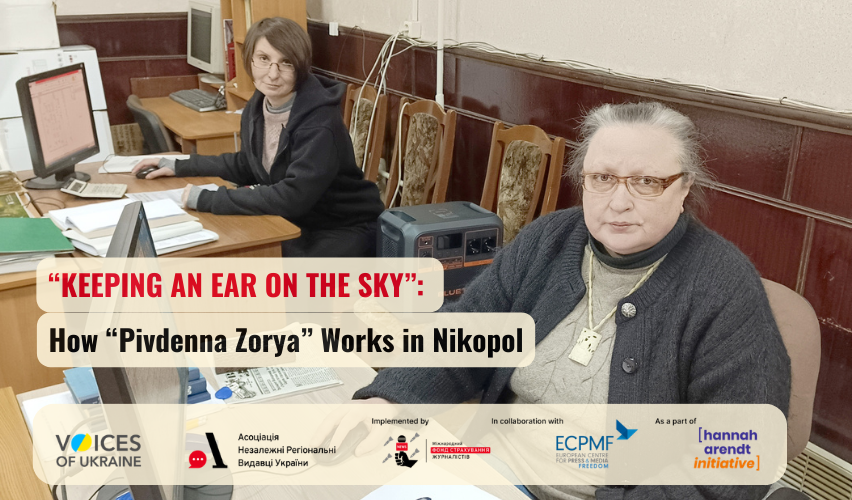
The team at ‘Pivdenna Zorya’ works in Nikopol — a city living under daily shelling and drone attacks. The CEO, Inna Shvydka, talks about safety, team support, and the ethical challenges of journalism during wartime.
Since July 2022, Nikopol has been under constant shelling and drone attacks. In these conditions, a small team at the newspaper ‘Pivdenna Zorya’ continues its work. We spoke with Inna Shvydka about the daily challenges, participation in support programs, and what helps journalists keep going even in a frontline reality.
Keeping an Ear on the Sky
— Inna, you work in a place where danger is always close. How does this change the way you work?
— Nikopol officially has the status of a “Hero City.” The enemy is about 5 kilometers away — on the opposite bank of the Dnipro (formerly the Kakhovka Reservoir). Since July 2022, we have been working in an area that is regularly shelled several times a day or attacked by drones, most often FPV drones. The threat of shelling or kamikaze drone attacks is now our reality — the reality we live in every day.
Danger, Inna says, has significantly affected the ability to concentrate:
— Because of the strain on the nervous system and the almost constant stress, it became much harder to focus on intellectual work. But over time, during these nearly four years of continuous life in a frontline area under the threat of attacks and shelling, the body and psyche adapted to the strain and new conditions. We have learned to work quite effectively even within such wartime realities.
— What does a daily safety check mean for you? Which things do you monitor first?
— The issue of safety is always very important for Nikopol. We receive danger alerts very frequently. Also in the apps. Many people have apps where you can see in which direction a drone is currently flying. Or whether there is a threat of artillery shelling (and that threat almost always exists). This makes it possible to adjust one’s route through the city in a relatively safer way.
— Do you have your own “signals”—when it’s worth continuing work, and when to take a pause?
— If every time there is a threat of kamikaze drone attacks or artillery shelling, we were to hide in shelters, there would be no time left to live or work. These are our realities. But over these years we have all already learned to distinguish by sound what it was: a drone, a shell, or something else. We know a little of the enemy’s vile tactics: if something was hit, there is a high risk it will be hit again soon (the occupiers deliberately do this so that ambulance crews, emergency services, police, and others come under fire). Residents of Nikopol district exchange information about what new tactics the enemy is using. This can be truly useful.
If every time there is a threat of kamikaze drone attacks or artillery shelling, we were to hide in shelters, there would be no time left to live or work. These are our realities.
— What rules or habits help you reduce risks during outings? Have you taken part in safety programs or projects that truly helped?
— Yes, I have taken part in some NSJU activities. Communication with the military or with employees of various services dealing with the aftermath of shelling is very useful. For us it’s not about outings: we live and work in a frontline area. In fact, there is a zone where entry is forbidden—the coastal strip, practically zero, like at the front. Strikes can happen at any time and in any place.
An important skill learned from the military: when you are outside, you must listen to the sky—listen constantly! Listen so that you can hear a drone or a shell in time and manage to do something to save yourself (hide in a shelter, behind a fence or wall, enter a building, or even simply drop to the ground and cover your head with your hands, etc.).
“Thank God everyone is alive”
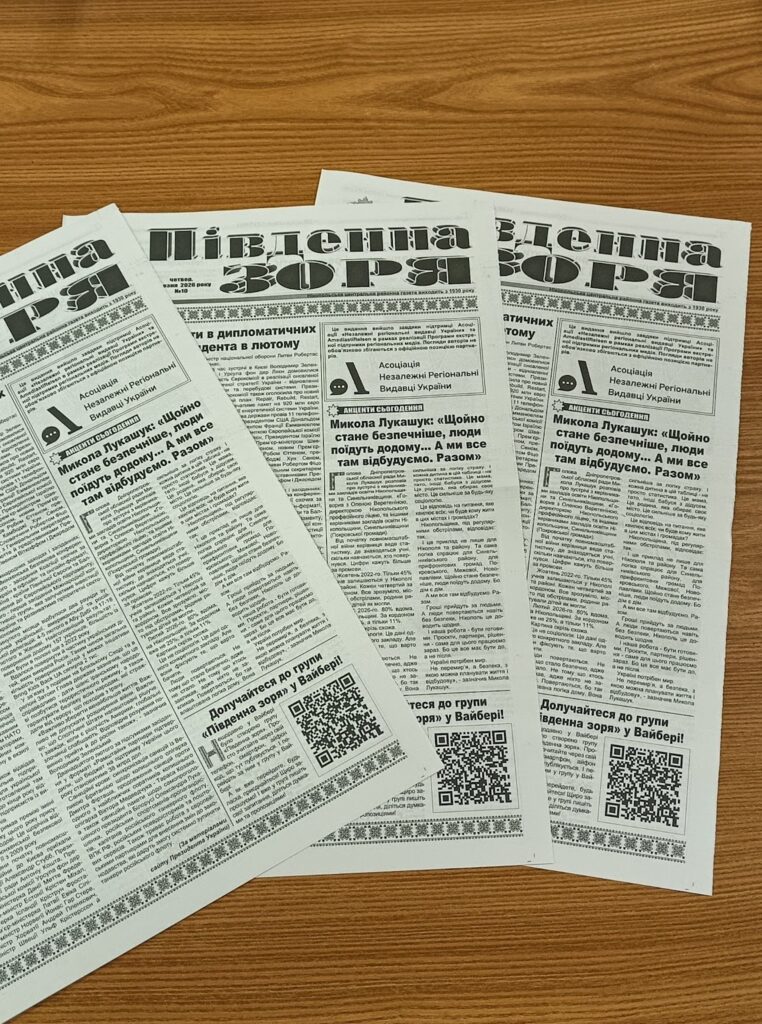
For Pivdenna Zoria, participation in our Emergency Support Program for regional media became an opportunity to resume printing in a frontline city. Inna emphasizes that this is their first experience of cooperation with the Association of Independent Regional Publishers of Ukraine, and it holds great significance for the editorial team.
— In those difficult conditions in which we now have to work, the Emergency Support Program is very important for us. Today we received the first tranche. Tomorrow (the conversation took place on March 4. — Ed.) the first issue of the Pivdenna Zoria newspaper will be published, made possible thanks to this support. In total, within the project, 24 issues of the newspaper are planned.
Inna adds that the newspaper has also become a space of support for readers: already at the beginning of the war, they published exercises for recovery after stress.
The most important thing, in my view, is to focus on breathing and bring it into a controlled rhythm, back to normal. It is also important to direct attention to the body and the space around you. Find, for example, five green or red objects, notice how a certain item feels to the touch, and so on.
— Does this help you cope with feelings of anxiety or danger? Do you have your own ways of psychological support?
— Personally, a philosophical approach helps me a lot. Something like: no one knows their time, when they will have to leave for other worlds; this can happen in wartime or in peace, but one must leave with dignity. As many soldiers say, there are no atheists in war. To me, that’s exactly how it is.
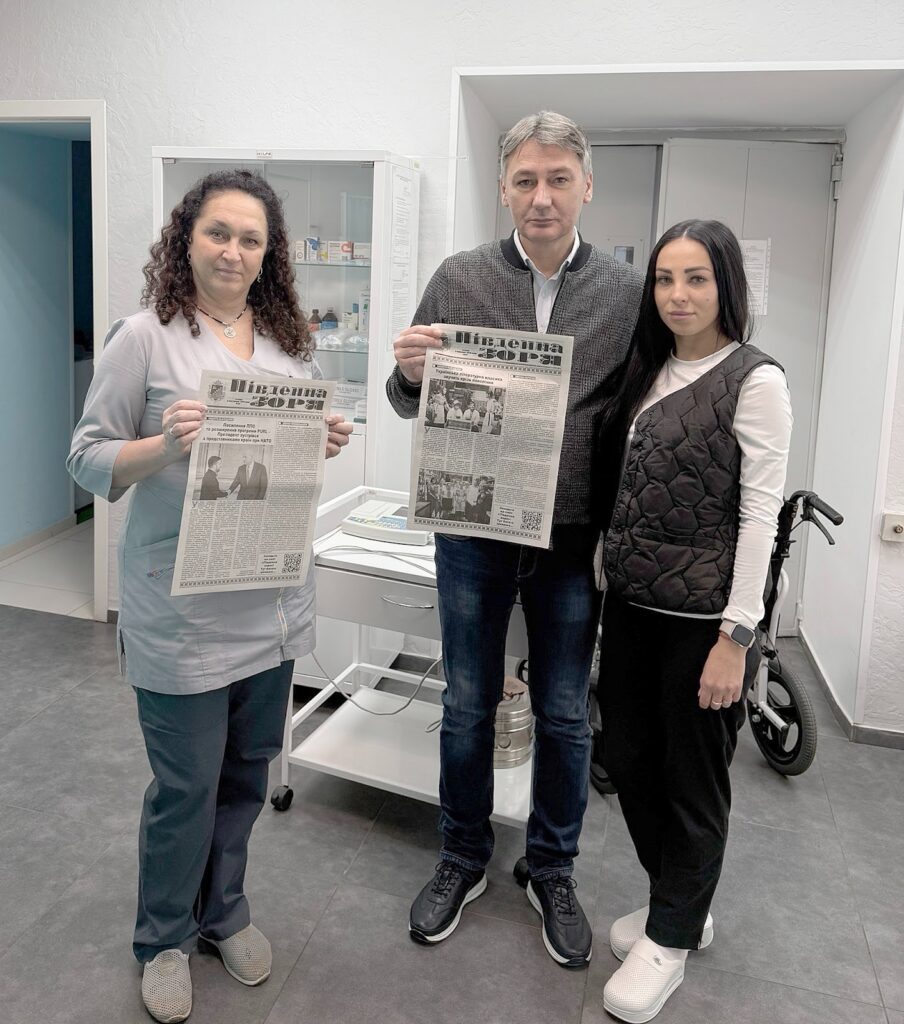
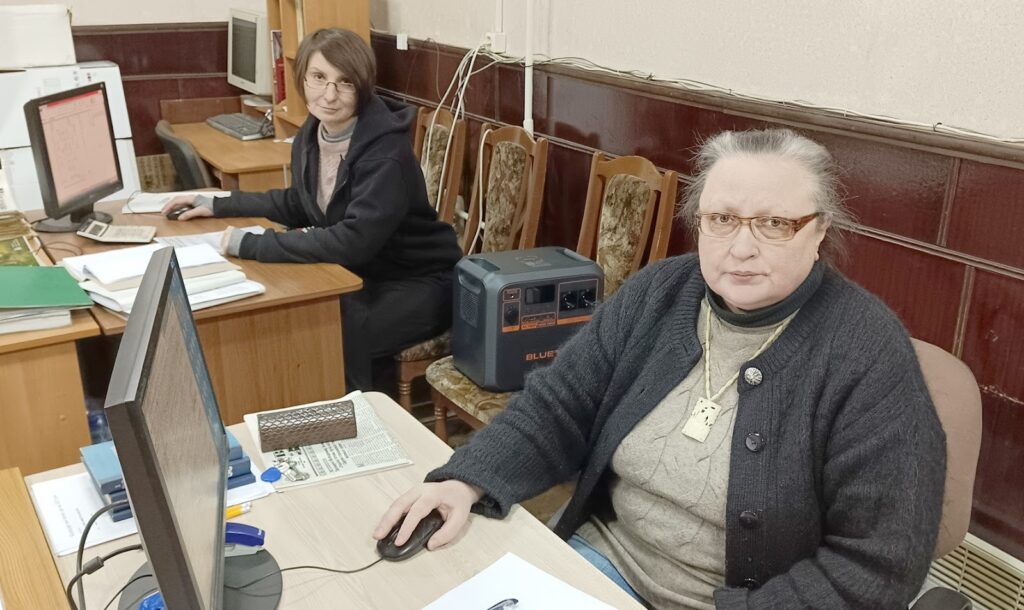
Inna says that two people work in the editorial office—that is the entire staff. But there are close people nearby who also help. Over the years of war they have endured a lot: the editorial office building was damaged twice by shelling, the homes of staff members as well, and once a drone chased their car during newspaper delivery.
— We are all rather restrained in our emotions. We simply tell what happened. We share information, sit together… Then we say: “Thank God everyone is alive and at least it passed like this!” And we do what we have to do.
Sometimes journalists have to refuse to publish certain data, Inna says. It’s a matter of safety: even seemingly innocent information can become a clue for the enemy.
— Kindergartens and schools in the Nikopol district do a lot of volunteering—sewing clothes for the military, weaving camouflage nets, and more. Wonderful people! I wrote about them, but didn’t include photos—they remain in the archive for better times—and I didn’t mention the exact name or address. Because the enemy reads our media, and once something is written, very soon that exact place gets hit.
The hardest topics to cover remain stories about people’s deaths.
— “There is so much pain and so many tears in this,” Inna says.
Finally, we asked what dignity in journalistic work during wartime means for her.
— You must respect yourself, your colleagues, and your readers. Be honest. First of all, with yourself. Do not compromise with your conscience. Follow professional ethics and the law. Do what will benefit Ukraine and Ukrainians—according to your vision and your professional level. Simply do your work honestly.
Take care of your safety
The Association of Independent Regional Press Publishers of Ukraine (AIRPPU) offers journalists working in dangerous regions the opportunity to obtain life and health insurance. This is part of the International Insurance Fund for Journalists (IIFJ) initiative, implemented in partnership with Ukrainian and European organisations.
Media professionals working in Kherson, Zaporizhzhia, Sumy, Mykolaiv, Donetsk, Luhansk, Odesa, Kharkiv, and Dnipropetrovsk regions, as well as border areas of Kyiv and Chernihiv regions, can apply. More information about the terms of free insurance is available here.
This publication continues a series of interviews with media professionals working in frontline and border regions. Previously, we published interviews with Zarina Zabrisky (Parts One and Two), Oleksandr Kachura, Vladyslav Safronov, Natalia Bilokudria, Serhii Horbatenko, Yevhen Khrypun, Anna Kaliuzhna, Polina Kulish, Nadia Sukha, Nadiia Karpova, Oleksandr Solomko (Parts One and Two), Diana Butsko, Oleksii Pasiuha, Oleksandr Chubukin, Aliona Serhiienko, Olha and Serhii Sydorov, Yevheniia Hrytsyna, and Nataliia Kryvoruchko.
Let us recall that the Emergency Support Program for Regional Media was launched in autumn 2025 in cooperation with Amedia Foundation and aims to preserve and strengthen independent local and regional newsrooms producing print and online media under the difficult conditions of war and energy crises.
It should also be noted that the International Insurance Fund for Journalists project is part of the Voices of Ukraine program, which is included in the SAFE programme coordinated by the European Centre for Press and Media Freedom. Voices of Ukraine is implemented within the Hannah Arendt Initiative.