The experience of Ukraine’s regional media has become a major topic of discussion within Spain’s journalistic community. Newspapers ABC and El Norte de Castilla explored how local newsrooms help people during the war, news agency Europa Press focused on investigative journalism, while Heraldo de Aragón published an in-depth interview about the human cost of war, exhaustion, and Ukrainians’ determination to keep living and working.
These stories were brought to Spanish audiences by Oksana Brovko, CEO of the Association of Independent Regional Press Publishers of Ukraine (AIRPPU). Her meeting with more than 300 employees of the Vocento media group, interviews with Spanish journalists, and keynote address at an international journalism forum in Valladolid provided an opportunity to discuss far more than the daily challenges of newsrooms working under shelling. The conversations also addressed questions that matter to the future of journalism everywhere: how to remain independent, maintain audience trust, and find opportunities for growth even during a prolonged crisis.
When Local Newspapers Help Save Lives
“Many Newspapers Save Lives” was the headline journalist Fernando Belzunce chose for his interview with Oksana Brovko in ABC. The conversation explored how the role of Ukraine’s local press has changed during the war. Alongside the news, local newspapers publish evacuation routes, information about humanitarian assistance, and practical safety advice. In areas where shelling disrupts internet and mobile connections, a printed newspaper can remain an accessible source of reliable information.
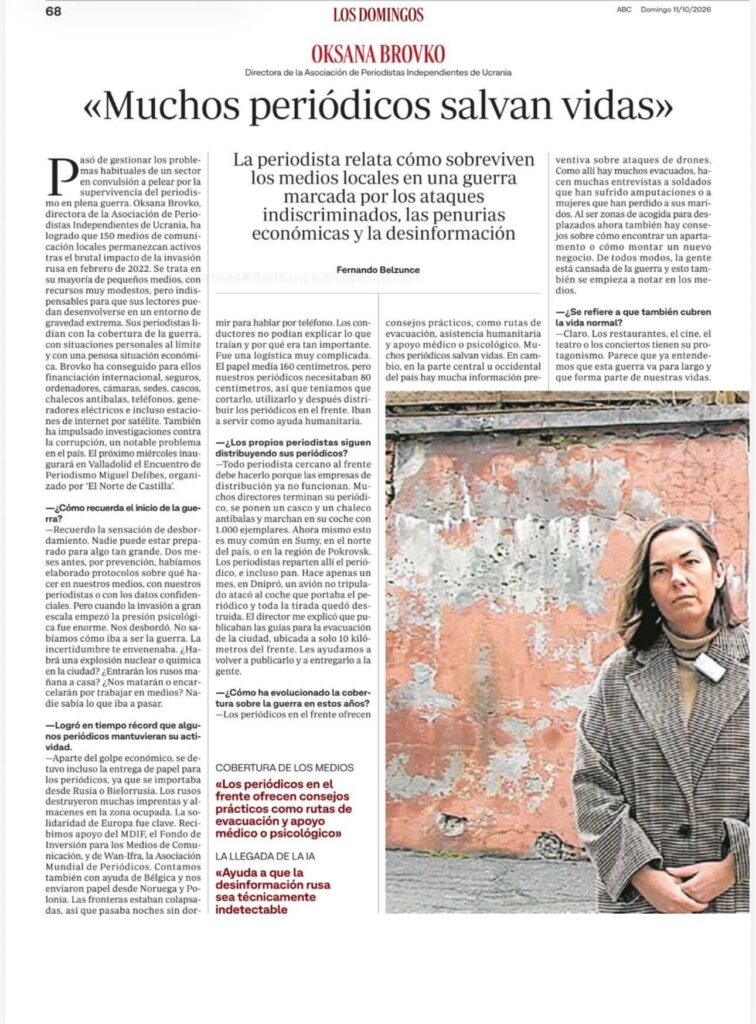
ABC, October 11, 2026. Interview: “Many Newspapers Save Lives.”
Producing those newspapers, however, has become a challenge in itself. At the beginning of Russia’s full-scale invasion, destroyed printing facilities and disrupted supply chains left newsrooms struggling to obtain even basic supplies of paper. AIRPPU worked with international partners to help restore newspaper printing. Journalists often have to deliver copies themselves near the front line, wearing helmets and body armour. In her ABC interview, Brovko described an incident in which a Russian drone struck a vehicle carrying newspapers containing evacuation information. The entire print run was destroyed, but the newspaper was eventually printed again.
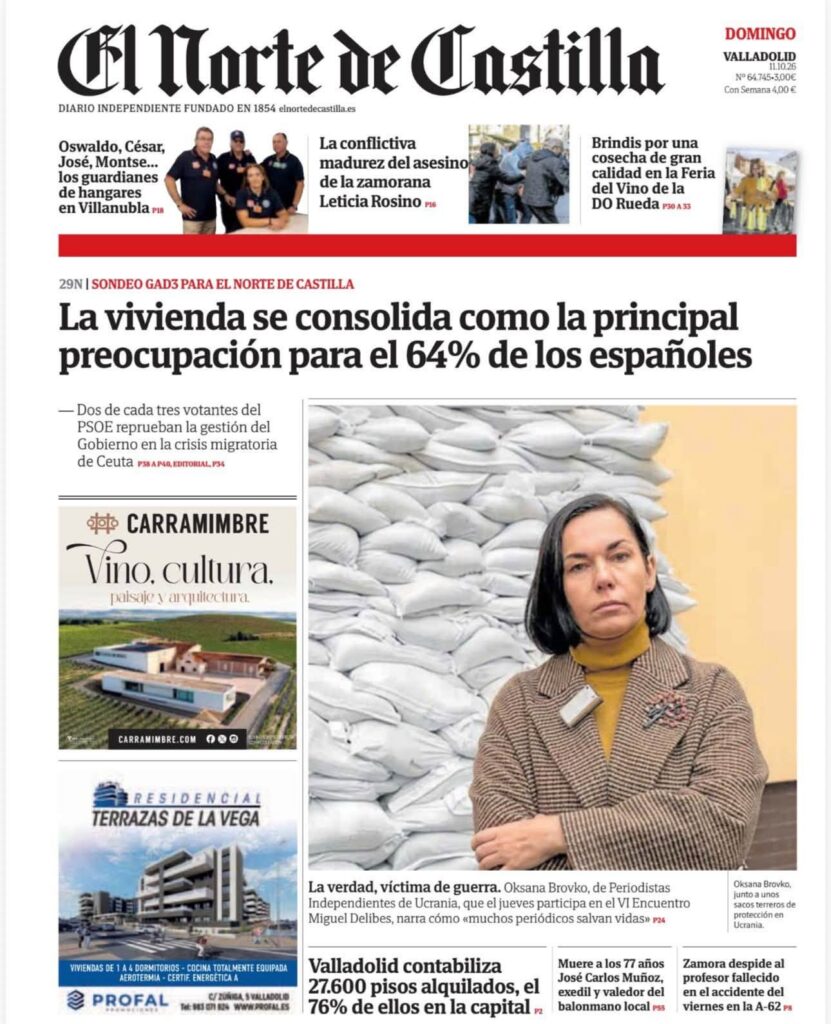
El Norte de Castilla, October 11, 2026. Article about Ukraine’s local press.
Brovko also discussed the working conditions of Ukrainian journalists with colleagues at Vocento, the Spanish media group that owns ABC. More than 300 employees attended the meeting in Madrid. Their questions covered Russian attacks, threats to civilians, exhausted newsroom teams, and international support for Ukraine. The ABC interview was also published across 18 of the group’s regional titles.
Securing Journalism’s Future During a Crisis
Reporting under constant threat was only one part of the Ukrainian experience presented in Spain. At the sixth Miguel Delibes International Journalism Forum in Valladolid, the discussion turned towards the future of the profession. On October 15, Oksana Brovko opened the forum with a keynote address. Organised by El Norte de Castilla and the Miguel Delibes Foundation, the event focused on investigative journalism, conflicts, innovation, and the pursuit of truth.
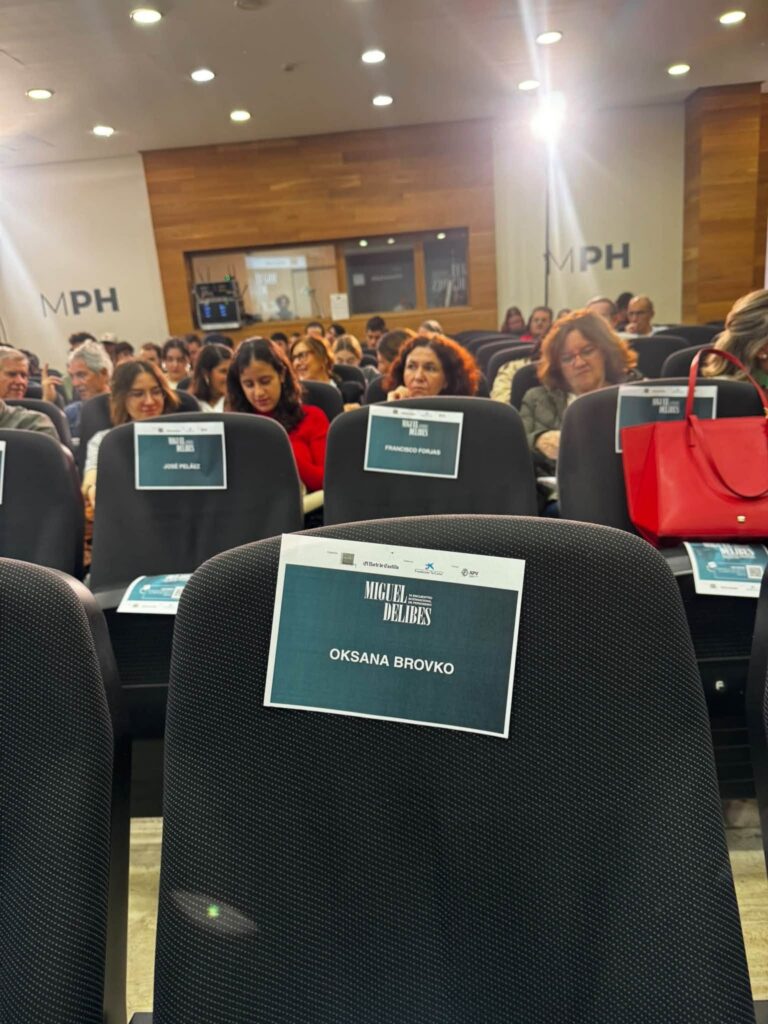
Sixth Miguel Delibes International Journalism Forum, Valladolid, October 15, 2026.
For Ukrainian newsrooms, resilience has long meant finding a way to publish the next edition, stay connected with readers, secure essential equipment, or find a safe place for their teams. But as Brovko emphasised, constantly dealing with immediate emergencies must not deprive media outlets of a future. Even during wartime, they need to develop their own content, find sustainable revenue streams, adopt new technologies, and maintain strong connections with their communities. Otherwise, a newsroom may overcome today’s difficulties only to lose the ability to continue operating tomorrow.
For the international journalism community, Ukraine’s experience demonstrated that responding to a crisis and investing in long-term development must go hand in hand. New tools can make the work of small teams easier, but they cannot replace fact-checking, knowledge of the local context, or a newsroom’s right to make independent editorial decisions.
“We often discuss the future of our profession in terms of technology, artificial intelligence, and new business models. But behind all of this, what matters most remains the same: trust, independence, and journalism’s ability to seek the truth even when doing so is dangerous, difficult, or unprofitable.”
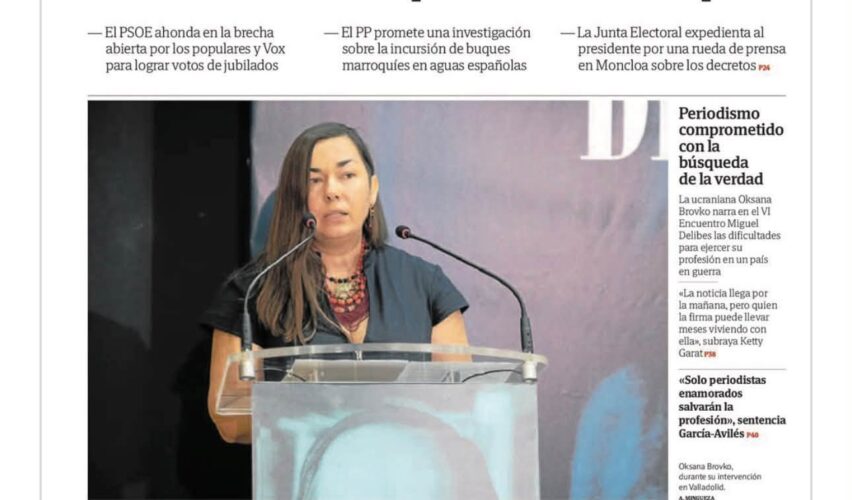
El Norte de Castilla dedicated an article to Brovko’s address and its message about journalism’s commitment to seeking the truth. On October 16, the newspaper also featured her photograph on its front page and reported on the challenges Ukrainian journalists face during the war.
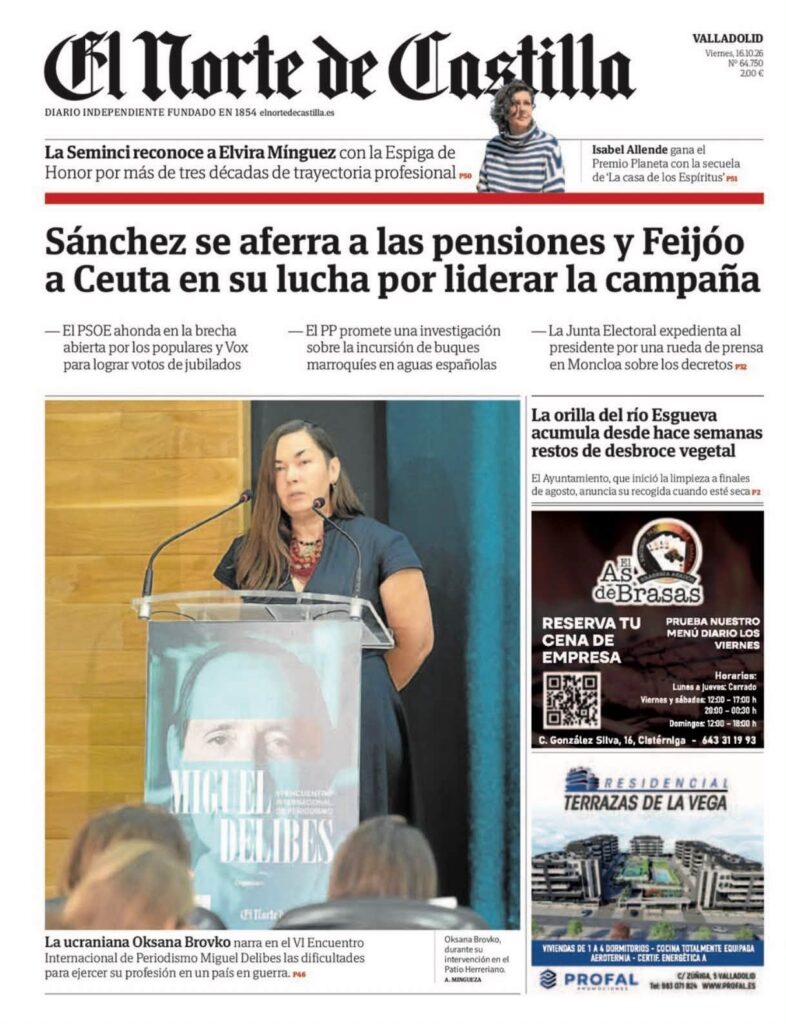
El Norte de Castilla, October 16, 2026. Coverage of Oksana Brovko’s address in Valladolid.
Local Investigations and Pressure on Journalists
Editorial independence also has a very practical meaning: the ability to scrutinise government decisions and investigate the use of public funds without yielding to pressure. This aspect of Ukrainian journalism was the focus of an interview with the Europa Press news agency. Brovko presented the “12 TOP” collection, which AIRPPU had also introduced during its 15th Media Congress. It features 12 investigations selected from 161 reports produced over one year by 18 local newsrooms. Their subjects include public spending, municipal property, occupation, collaboration with Russian forces, and connections to Russia.
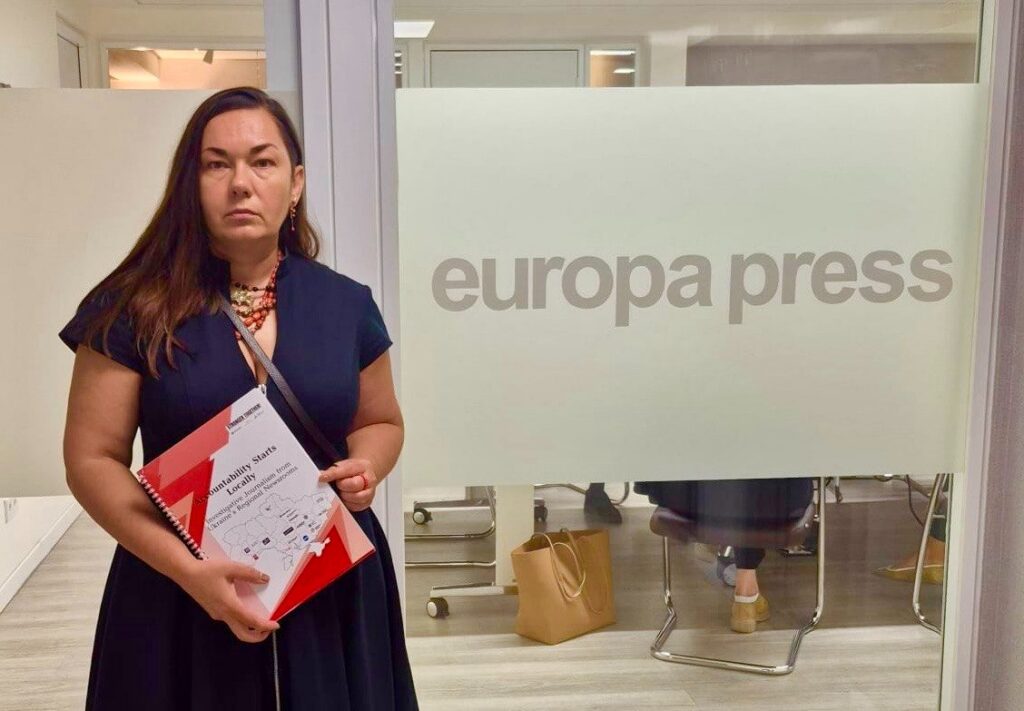
Oksana Brovko with the “12 TOP” investigative journalism collection at Europa Press, October 2026.
Behind these investigations are newsrooms struggling with limited staff and resources, while their reporting can expose journalists to pressure from those they investigate. Brovko stressed that the war does not remove the responsibility of local authorities to be accountable or the right of communities to know how public money is spent. Alongside investigative reporting, journalists also document war crimes and collect testimonies about destroyed towns and villages.
“Our journalists are writing history,” Oksana Brovko told Europa Press.
In the interview, she also urged international colleagues not to let news fatigue diminish their attention to the ongoing war in Ukraine.
Not Just Enduring the War, but Continuing to Live
Behind the stories of Ukrainian newsrooms are the experiences of people who are themselves living through the war. Brovko explored this human dimension in an in-depth interview with the regional newspaper Heraldo de Aragón. The interview also continued AIRPPU’s cooperation with Spanish media organisations, which has already delivered practical assistance to Ukrainian newsrooms. The newspaper is part of the Henneo media group, whose president, Fernando de Yarza, had previously visited Ukraine and met regional journalists. Brovko had also visited the newsroom of 20minutos, another Henneo publication.
International recognition of Ukrainian regional journalism has also been an important part of this cooperation. In November 2025, at the 20minutos Awards ceremony in Madrid, Spain’s King Felipe VI presented AIRPPU CEO Oksana Brovko with a special award for her contribution to the development of independent media in Ukraine. The recognition highlighted her work supporting local newsrooms that continue providing their communities with reliable information despite shelling, blackouts, and other wartime challenges.
In 2026, Henneo and Fundación Ibercaja joined AIRPPU’s Emergency Support Programme for Regional Media, providing financial assistance, while technology company Hiberus supported newsrooms with computer equipment. In May, 26 Ukrainian newsrooms received 70 laptops to support their daily work during the war.
In her conversation with journalist Pablo Ferrer in Zaragoza, Brovko spoke about psychological exhaustion, anxiety for loved ones, and how the war has transformed everyday family life in Ukraine without bringing it to a complete halt.
Even after sleepless nights caused by Russian attacks, adults go to work and children go to school. Ukrainians continue to have and raise children, make family plans, and try to find time for friends and ordinary leisure activities. Brovko explained that small everyday routines help people maintain their psychological balance. Yet after years of war, even simple things such as enjoying a peaceful cup of coffee or taking children to the cinema remain experiences people deeply miss.
“We only have one life, and we want to feel alive,” the newspaper quoted Oksana Brovko in its headline.
Her words reflect the desire not to put life on hold until the war ends, but to preserve family traditions, continue working, and make plans even when the future remains uncertain.
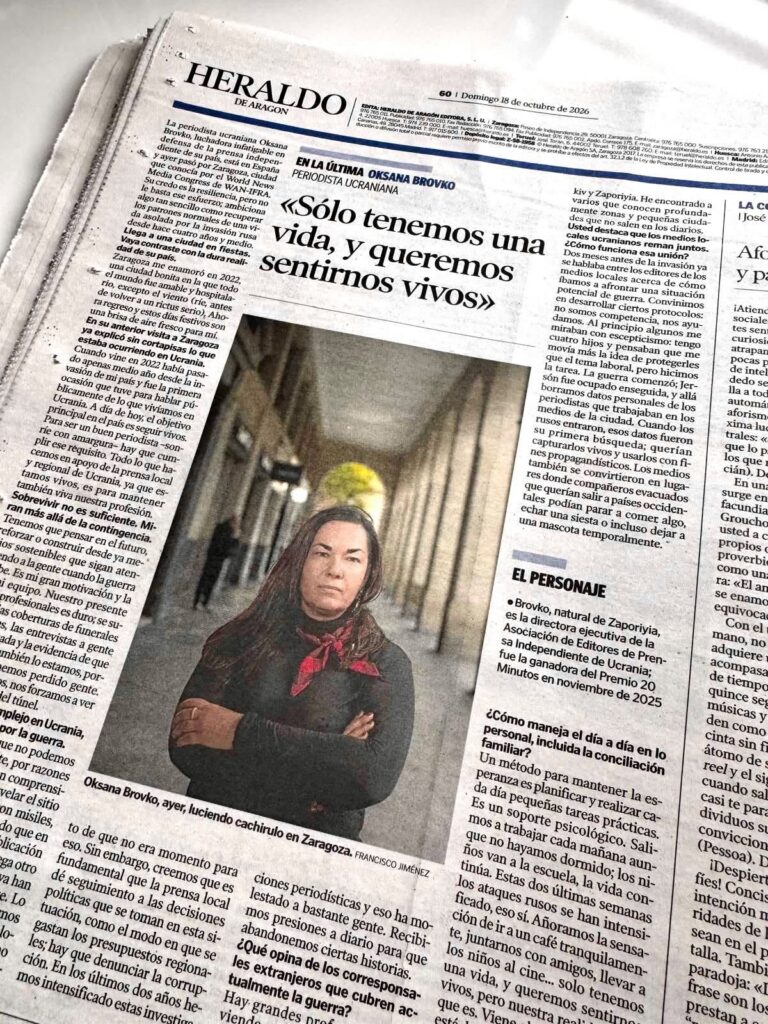
Heraldo de Aragón, October 18, 2026.
This message also applies to the work of Ukrainian media. Newsrooms continue publishing news, supporting communities, scrutinising those in power, and looking after their teams. At the same time, they must prepare for the future.
Ukraine’s regional media demonstrate that journalism can remain independent, essential to local communities, and capable of development even during war. But helping a newsroom survive its next crisis is not enough. What is needed are conditions that allow it to keep working in the long term: sufficient resources, protection of editorial independence, the ability to investigate wrongdoing, and the trust of its audience.
This was the experience Oksana Brovko brought to her Spanish colleagues: an example of resilience, but also a compelling argument for long-term support for independent journalism.