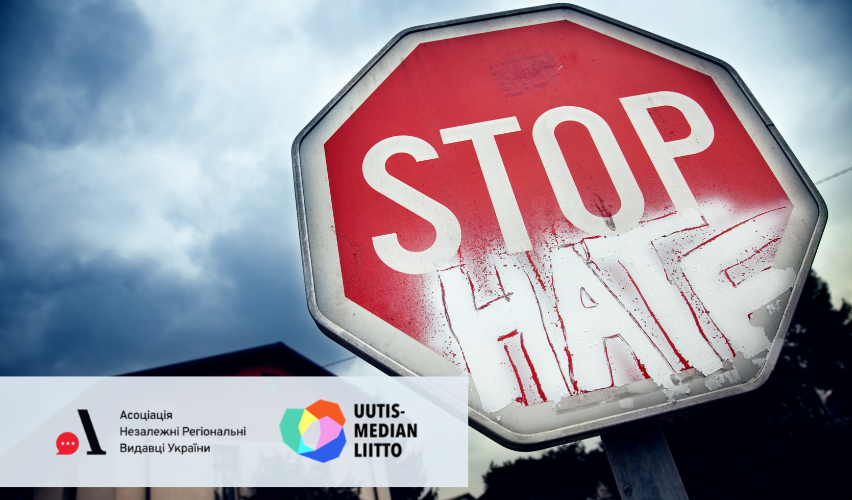
Hate speech and persecution of journalists are challenges that Ukrainian newsrooms have to face on the daily basis. In times of war and high social tension, journalists are the ones who become targets of insults, threats, and attempts to discredit them. They not only cover events, but also protect themselves and their teams from pressure.
How newsrooms can address these challenges was the topic of a webinar held as part of the “Media Bridges: Finland—Ukraine” project organized by the Association of Independent Regional Publishers of Ukraine with the support of News Media Finland. Alyona Bereza, a Ukrainian journalist and founder of NGO “ZHAR” and online‑publication “ZHAR.INFO,” as well as Tytti Oras, a lawyer with the Finnish Journalists’ Union, shared their experiences.
In this article, we will focus on the Ukrainian context: from editorial policies and standards to personal stories and the gender dimension. And soon we’ll talk about the Finnish experience as well.
Hate Speech: International and Ukrainian Standards
The UN defines hate speech as any‑form of communication – whether verbal or nonverbal – that is hostile in nature and aimed against a person or group on the grounds of their identity. The Council of Europe adds: these are not only incitements to violence, but also creation of negative stereotypes, stigmatization, or the justification of discrimination.
In Ukraine, the ban is enshrined in the Law On Media: it explicitly prohibits statements that incite hatred or violence on the grounds of origin, nationality, age, sex, gender identity, or disability status. The Code of Ethics for Ukrainian Journalists specifies: one cannot call a person a criminal prior to the court ruling, discriminate against them, or allude to their physical disabilities.
International best practices offer tools for self-monitoring. The Ethical Journalism Network (EJN) recommends evaluating statements based on the five criteria: who is speaking, for what purpose, what is the audience, what is the context, and is there a risk of inciting violence? The Associated Press recommends avoiding thoughtlessly sharing others’ hateful content – it’s better to recount the event in one’s own words and add an explanation.
Editorial Policies and Standards
News organizations in Ukraine have to develop their own policies to protect themselves and their audience from hate speech. One example is online‑publication “ZHAR.INFO.”
The following rules of accuracy apply here: Every investigation must be based on two independent sources. If there is no confirmation, the story won’t be published. This means that many topics remain “behind the scenes,” but the editorial staff does not compromise on the truth.
The presumption of innocence is another principle. The reports do not refer to a person as a criminal or a murderer until the court decision is made. Even in high-profile cases, the newsroom is cautious: they may provide information about a suspect’s health, but they do not disclose any diagnoses until they have been officially confirmed.
Language matters, too. “We don’t hype things up, and we don’t use clickbait headlines,” says Alyona Bereza. The newsroom uses neutral vocabulary: “shelling” rather than “strikes,” and feminine forms where appropriate. Russia is called a terrorist state, and the war is called a war. This means losing part of the audience that has grown accustomed to “breaking” news, but the editorial staff has consciously chosen the path of responsible journalism.
Personal Stories, Safety, and the Gender Dimension
Editorial policies arise from actual threats. Alyona Bereza survived an attack: she was followed near her home and in her gym; her phone number was posted in an ad on OLX, and she became a victim of SMS‑spamming. “I made a mistake when I posted a photo from my gym workout in real time. Half an hour later, the person who had been planning the attack arrived,” she recalls.
The newsroom has a crisis management policy: response procedures, lawyers’ contact information, communication guidelines. “We never come for investigations alone. It’s always two of us,” says Alyona.
The newsroom records phone calls, it has installed video surveillance in the office, they use work phone numbers instead of personal ones. “Security of an organization is the same thing as security of its team.”
After the attack, Alyona was provided with state-funded security for two months. That helped her stay in the profession. But the psychological pressure took its toll: she was diagnosed with post-traumatic stress disorder. A retreat in Lithuania and counseling sessions with psychotherapists, funded by partners, were helpful.
A survey by the Institute of Mass Information shows that the problem of hate speech in Ukraine is closely intertwined with sexism, Alyona explains. Women’s bodies are systematically used for clickbait, and visual sexism in photo stocks reinforces stereotypes: men are depicted in business news stories, while women are shown in stories about housework or illness. Even successful women are often identified by their partners – as “wives” or “widows.”
Gender inequality is particularly evident in war-related news. The proportion of female experts in online media has been stagnating at just 21% for quite some time. Women who actually participate in combat operations are mentioned in regional news reports in only 1% of cases. Most often, they are portrayed as victims of shelling or as refugees, rather than as female soldiers. In Khmelnytskyi Oblast, the proportion of women featured in news stories has fallen to its lowest level in three years — 21%. This creates a distorted picture of war as a “man’s business” and ignores the contributions of thousands of Ukrainian women. This invisibility of women in the media not only distorts reality but also fuels hate speech: when women are portrayed solely as victims, society begins to view their role in the war as secondary.
Newsrooms that are striving to change the situation are implementing internal policies. “ZHAR.INFO” has a policy regarding journalists’ personal pages: if private posts violate editorial standards, the person simply does not cover that topic. This is not censorship but a way to protect the media’s reputation and avoid double standards. This practice shows that a journalist’s responsibility does not end with pages of a publication; it extends to their public presence on social media.
***
The Ukrainian experience shows: even small newsrooms can create effective policies if they are based on actual threats. It is a combination of professional standards, personal resilience, and solidarity with colleagues. The main tool for protection is publicity: it is precisely what allows journalists to remain in the profession and resist pressure when institutions fail to function.
In the next article, we will discuss Finland’s experience addressing hate speech and harassment.
This article was prepared as part of the “Media Bridges: Finland—Ukraine” Program implemented by the Association of Independent Regional Publishers of Ukraine in partnership with News Media Finland, and funded by the Finnish Ministry of Foreign Affairs