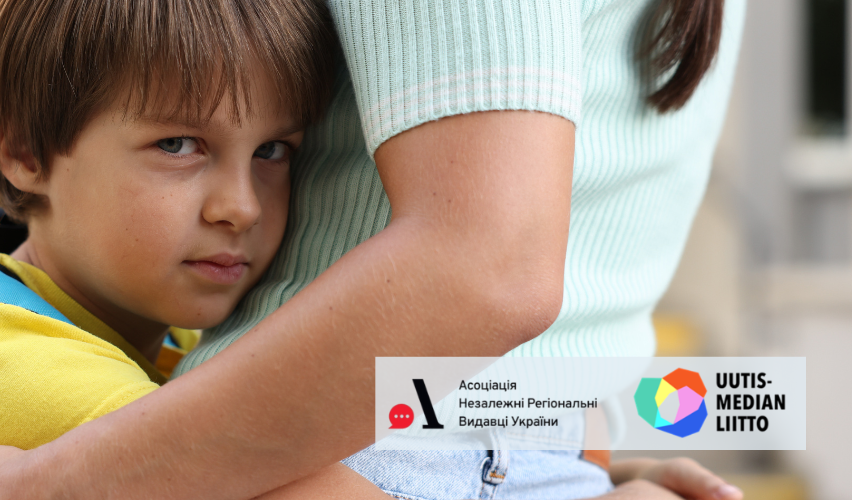
In times of war, the topic of children remains one of the most sensitive issues in media discourse. The way journalists report on stories of minors impacts, on the one hand, public awareness and, on the other, safety and psychological well-being of the children themselves. We spoke with Olena Rozvadovska, co-founder and chair of the board of the “Voices of Children” Charitable Foundation, and Yulia Surkova, a journalist and mentor for educational projects who has been covering stories of children in the war zone since 2014 and has collaborated with UNICEF and international media outlets. We have also compiled recommendations and clarifications from key stakeholders in media (self-)regulation — such as the National Council, the Commission on Journalistic Ethics, and the Education Ombudsperson — which together form a comprehensive framework for ethical coverage of children during wartime.
Children in the Ukrainian Media: Statistics and Image
IMI’s monitoring shows that Ukrainian media cover children, but mostly in terms of statistics and reports. In March 2025, 12 online publications were analyzed: children are most often mentioned in news stories about the war (28% of reports), education (14%), and healthcare (10%). In reports on the war, the focus is on consequences of attacks, evacuations, or the return of abducted children. These are important topics, but they are presented primarily through official data, without comments from the children themselves or from experts. In these stories, children are often portrayed merely as statistics or the subject of decision-making, rather than as full-fledged participants in the events. The monitoring also showed that the media often use stereotypical portrayals: children as “victims of war” or as “symbols of the future.” This approach strips them of their individuality and fails to take their actual experiences into account.

We asked Yulia Surkova, who has been covering stories of children in the war zone since 2014 and collaborates with UNICEF and international media outlets – how, based on her observation, the Ukrainian media report on children. According to Yulia, the media focuses too often on dramatic stories — evacuations, ruins, loss of homes, or injuries. This creates an emotionally powerful but one-sided portrayal of childhood during wartime.
— There are a million stories about children crying as they flee their homes under shelling. But much less is said about how they adapt, what environments support them, and what small joys help them carry on, she says.
Ethical Guidelines: What Regulatory Authorities and Experts Say
The National Council on Television and Radio Broadcasting recommends avoiding glorification of children’s participation in combat operations and refraining from presenting such stories as sensational. It is important that the materials not allow for identification of children who are in the occupied territories or who have experienced occupation, so as not to put them at risk. It is also important to avoid showing the most traumatic images of war (death, torture, physical injuries, close-ups of frightened children), especially during times when children watch television on their own.

It is important not to portray children solely as “symbols of the suffering caused by war,” but rather to highlight examples of resilience and recovery. In stories about children who have left their homes, discrimination or stigmatization must not be tolerated. It is also recommended to encourage children to share their own stories of resilience, but only with their informed consent and with involvement of psychologists. It is important not only to convey the children’s words, but also to show the very process of the journalist’s ethical interaction with them: asking for permission, confirming what was said, being mindful of boundaries.

In its handbook, the Commission on Journalistic Ethics emphasizes that even during wartime, journalists must adhere to basic standards — truthfulness, completeness, balance, and accuracy. These principles are especially important in reporting on children, as they are the most vulnerable group.
The Education Ombudsperson emphasizes the legal aspect: to record children in schools, written consent is required from their parents, and for children aged 14 and older – from the child themselves; consent must be voluntary, informed, and obtained prior to the specific event; separate consent is required for publication of materials, especially online; in the event of a violation of the right to privacy, parents or children may demand withdrawal of the content and compensation for damage.
The experts we interviewed also emphasize that the consent of both the child and the parents is required. Especially when it comes to publishing photos.

Olena Rozvadovska, co-founder and chair of the board of the “Voices of Children” Charitable Foundation:
— The key is the child’s informed consent. What does “informed” mean? We very often do not post photos of the child, even though we have permission from both the parents and the child. After all, parental consent is often not fully informed either.
For example, this kind of manipulation is quite possible. A charitable foundation comes along and says: “You attended our camp, and now we want to hear your story.” And the mother, out of gratitude for the help, will sign any consent form. We never post photos like this, no matter how many consents the parents signed. And we never manipulate this.
The child needs to understand, you need to explain to them: “Look, this is content for the web. It will stay there forever. You have to understand that this will be published, and it will be read by, say, 100,000 readers of a newspaper or other media outlet.” In other words, we really need to give the child a broad understanding of what photography means in the media. And not be afraid if they say “no.” After all, there are ways to take a photo of a child so that they can’t be recognized. And you can always use illustrations instead of photographs. Of course, I understand that everyone is interested in a photo of a child who left Donetsk, but we won’t publish something like that, even if we have the consent. Because it could pose a risk to the child. That’s why it always comes down to journalists’ sense of responsibility and the editorial team’s commitment to ethics rather than clickbait.
The child needs to understand, you need to explain to them: “Look, this is content for the web. It will stay there forever. You have to understand that this will be published, and it will be read by, say, 100,000 readers of a newspaper or other media outlet.” In other words, we really need to give the child a broad understanding of what photography means in the media. And not be afraid if they say “no.”

Yulia Surkova, a journalist and mentor for educational projects; she has been covering stories of children in the war zone for 12 years and collaborates with UNICEF and international media outlets:
— It’s a fairly common mistake for journalists not to obtain written or at least verbal consent from the child’s parents, guardians, or those responsible for the child before conducting interviews or taking photos or videos.
In addition to the fact that this is a legal requirement (under both international and Ukrainian law), I also believe that consent is a sign of respect for the child. The child and their family must be informed that they have the right to refuse this interview.
For example, this summer in Kyiv, on the left bank, while residential buildings were being shelled, I saw international news agencies interviewing a child who didn’t even have an adult at their side.
I understand why this happens: journalists who write about people with traumatic experiences go through traumatic experiences themselves. Sometimes a journalist who came to film an attack scene found themselves caught in the attack, stayed up all night, and is working with their last ounce of energy. Perhaps that’s why people sometimes don’t have the energy to think about all these rules. Nevertheless, requirements of the law must be complied with.
UNICEF offers detailed guidelines for journalists covering topics related to children and youth. Their goal is to strike a balance between the public interest and rights of the child. It also emphasizes respect for dignity and privacy, avoidance of harm and stigmatization, the requirement to obtain informed consent, contextual accuracy, and fact-checking. Among other things, journalists should always be guided by the principle of “the best interests of the child.”

UNICEF emphasizes that interviews with children should be conducted with the utmost care: journalists should avoid questions that may cause pain or re-traumatization, refrain from staging stories, and always obtain informed consent from the child or the child’s legal guardian. It is important to create a safe environment — limit the number of interviewers, explain the purpose of the conversation in clear language, and ensure that the child feels at ease and is not under any pressure.

UNICEF also advises journalists to avoid categorizations and descriptions that could make a child a target of discrimination or exclusion, to always ensure accuracy of the context, and to carefully verify facts. If a child fell victim of sexual abuse, is HIV-positive, participated in combat, or experienced displacement, their name and image must be changed or concealed. Information may be disclosed only when it is in the child’s best interests and the child wishes to speak out or participate in programs. If there is a risk of a threat, journalists should focus not on the story of a single child, but on the overall situation in which children find themselves.

We asked our interviewees for practical advice on working with children. The first thing Yulia noted was that a balance between public significance and privacy can be found by shifting focus.
Practical Tips and Algorithms for Working with Children
Yulia Surkova also advises journalists to give the child time and not to rush the interview, to arrange the conversation in a comfortable setting, to avoid questions that induce guilt, and not to make promises that the journalist cannot keep (such as “everything will be okay,” “the war will end soon,” and so on).
An interview should start with safe topics — favorite toys, pets, drawings:
— It is often very difficult for children to recall their experiences of occupation or shelling. So there’s no need to ask what exactly happened to the child. Instead, you can ask: “And who was with you when you were taking shelter from the Russian airstrike in Mariupol at the theater?” Or “Who was with you when you found yourselves under occupation in Kherson.”
I never start by asking a child questions. I ask them to show me their favorite toy. Or if children have cats or dogs — that’s always the best topic for them to talk about, and it’s when they really open up.
It’s best to start not with a question, but simply by asking the child to tell you a little about themselves and their hobbies, or to show you their drawings, their cat, or their favorite teddy bear. This will help start a conversation; the child will get used to you, and a sense of trust will develop.
– That’s exactly how the UNICEF series ‘A Toy from Home’ came about, where children talked about the things they took with them during the evacuation, says Yulia. – These stories revealed not only pain, but also symbols of home and warm memories.

Olena Rozvadovska adds that the “Voices of Children” Foundation has developed an algorithm: an interview takes place in the presence of a psychologist or a trusted person who can interrupt or rephrase a question if the child becomes uncomfortable. The algorithm depends on age: a 7-year-old child needs a parent or close adult present, whereas a 17-year-old can decide for themselves whether to give permission for publication.
– You just have to be considerate and understand your responsibilities, she concludes.

Interviewing children who have experienced traumatic stress requires particular sensitivity and preparation. Before conducting an interview, the journalist should find out as much as possible about the incident by speaking with parents, lawyers, teachers, or medical professionals, and they should also educate themselves — learning about characteristics of mental health disorders and stress reactions. It is important to ask family members which topics might be too painful for the child to discuss, and to take this into account during the interview. A child and their parents have the right to choose a familiar and safe place to talk.
Communicate without condescension, respecting the child’s feelings and the way they describe their experience, since their reactions may differ from what you expect. Memories may be incomplete or confused — this isn’t a fantasy but rather a result of stress or age-related factors, so you shouldn’t pressure them or force them to recall events. Questions should not contain hidden accusations, as this may cause feelings of guilt or humiliation.
Talking about traumatic experience may trigger strong emotions even years later, so it’s a good idea to be prepared to invite loved ones or a professional to help the child cope with their reaction. The length of the interview should be age-appropriate: up to the age of 9 — about 30 minutes; ages 10 to 14 — 45 minutes; for teenagers — up to an hour.
And most importantly: parental consent does not exempt a journalist from responsibility — they must act professionally, make appropriate decisions, and adhere to ethical standards.
Journalists’ Mistakes: a View from the Experts
One of the key problems is an adult-centered and sensationalist view of children’s experiences.
– Children often become not subjects of the story, but tools for amplifying emotional impact of the content, says Olena Rozvadovska. She highlights several of the most common mistakes: re-traumatization due to excessive detail, portraying the child solely as a victim, violations of privacy and consent, moralizing and judgment, and use of children as an emotional argument.
Children’s stories shouldn’t be presented as sensational, says Yulia Surkova:
— During wartime, journalists often cover stories about children as “breaking news.” And for me, that’s the biggest problem of all, because stories about children aren’t “breaking news”; they’re stories that take time. Time is needed for the child to get used to the reporter they are talking to. And so that the child can recover from the traumatic event that’s reported in the media.
Children’s stories aren’t breaking news.
Sometimes journalists themselves need time to formulate appropriate, tactful questions that do not offend or re-traumatize the child. Therefore, unfortunately, this principle of super-operative approach, which works for other stories, is not suitable for a child’s story.
Whether in Kyiv or in the east, after heavy shelling I often see the same mistake: when journalists start recording and questioning the child right there, amid the ruins of the house where they lived just a few hours earlier. And they ask inappropriate questions like: “How did you feel when the missile hit, when your mom was injured?” This question is prohibited by all ethical standards because it re-traumatizes the child, throwing them back into the moment of the trauma. But, unfortunately, all through the past 12 years, I’ve heard both foreign and Ukrainian colleagues ask it to children.
Questions such as: “How did you feel when the missile hit, when your mom was injured?” are prohibited by all ethical standards because it re-traumatizes the child, throwing them back into the moment of the trauma.
Normalizing Childhood and the Role of Regional Media
From a psychological perspective, normalizing childhood does not mean denying trauma; it means restoring the child’s right to be a child, rather than merely a bearer of wartime experiences. Journalists can contribute to this normalization, says Olena Rozvadovska, if they show not only the pain but also life: what the child likes to do, what their dreams are, and their small victories. It is important to shift the focus from the event itself to the recovery process — who is supporting the child, what environments help the child adapt, and what roles schools, psychologists, and the family play.
– Anxiety or learning difficulties aren’t a ‘flaw,’ but a natural reaction to abnormal circumstances, she says.
Every child is bigger than their trauma. And even bigger than the war she’s living through, says Yulia Surkova. The “Toy from Home” series for UNICEF, which has already been mentioned, clearly demonstrates that good content is where the child is not a victim, but a person with a voice of their own, dreams, and small victories. Here, children talked about the things they had taken with them during the evacuation, and these stories revealed not only pain but also symbols of home and warm memories.

Local stories are no less important than national or international ones.
– I can’t categorize children’s stories as local or non-local, says Olena Rozvadovska. — These are all stories of children of Ukraine, and they are absolutely essential to international discussions.
According to her, regional media are closer to children and can show their lives in schools, villages, and communities, as well as success stories of local professionals and organizations. They often serve as sources for national and international media, shedding light on issues that go unnoticed on a global scale.
We see examples of such stories in various publications. For example, Frontliner, in the story “When Laughter Echoes After Explosions: A New Life for Children of War” portrayed children not as victims, but as active participants in the recovery process — at a camp where they receive psychological support and the opportunity to feel like children. Regional media produce many important stories. Among success stories, Olena Rozvadovska mentions the following: “Suspilne Chernivtsi” reported on children from frontline areas who had lost their homes; “Obyektiv Media” in Kharkiv wrote about sleep problems among children who had left the country; and Varosh in Zakarpattia shared the story of Sofia, who maintains her connection to Ukraine through her dreams and daily routines.
***
Ethical reporting on childhood during wartime is a matter of professional standards, safety, and dignity. Journalists, educators, and regulatory agencies must work together to ensure that no story told about a child causes harm to that child’s life and future.
Journalism can be not only informative but also therapeutic, helping to ensure a normal childhood. It can explain children’s reactions as normal, ease the pressure on families, demonstrate the healing process, and give children a voice without coercion.
In this context, all levels of the media — from national to regional ones — are important. Local journalists who work closely with communities are able to capture details of children’s lives that paint a broader picture for the world. And national and international media outlets can amplify these stories, making them part of the global discussion on children’s rights and ethics during wartime.
Thus, the task of journalists is to consciously balance the topics covered in order to portray childhood during wartime as multifaceted, rather than merely traumatic. This is the path toward a society that views children not as symbols or statistics, but as individuals with a present and a future.
Useful resources:
- An 8-lecture video course on “A Safe Space for Children’s Voices in the Media”
- Children are Not Just Little Adults. A Guide for Journalists on Conducting Interviews with Children from the “Voices of Children” Charitable Foundation
- UNICEF Guidelines for Journalists Covering Issues Affecting Children and Youth
- Children in Ukraine. 2.5 years of full-scale war. A report from the “Voices of Children” Charitable Foundation
This publication was produced as part of the “Media Bridges: Finland—Ukraine” Project implemented by the Association of Independent Regional Publishers of Ukraine in partnership with News Media Finland and funded by the Finnish Ministry of Foreign Affairs