


About ethics, loss, dignity, and the strength of Kherson residents — in a conversation with Zarina Zabrisky.
American journalist Zarina Zabrisky works in Kherson — a frontline city that faces shelling every day. She documents war crimes, films, writes articles, and conducts interviews. Earlier, we wrote about Zarina’s work on the documentary “Kherson: Human Safari,” which premiered on November 11 on MEGOGO, Freedom, Dom, and Current Time. Now we bring you the continuation of that conversation — about the journalist’s daily work in Kherson, the ethical boundaries, the stories that stay forever, and what helps her hold on.
Related: “We walked through fire”: how journalists work in Kherson
— Zarina, a few days ago you posted a recording from a corridor. What is it like to work in such conditions? What helps you keep your focus when the shelling never stops?
— In Kherson, everyone is used to shelling and attacks — they happen every hour, day and night. Even street dogs know they must hide when they hear explosions or buzzing. Children distinguish types of weapons by sound. It is an abnormal situation, but people adapt and become desensitized to danger when it is constant.
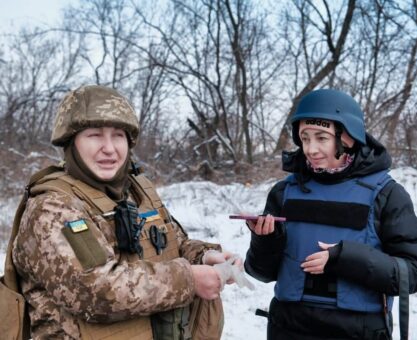
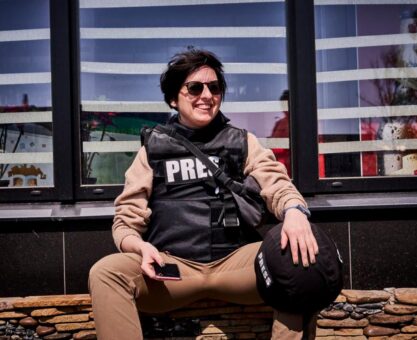
Being a reporter in a frontline city is essential and intense work. We have an incredible journalistic community in Kherson, and I am grateful to be part of it. As journalists, we investigate, verify, and provide facts to inform society about important events and issues. Our work involves gathering information from sources, documenting and directly observing, and then creating accurate, clear, and unbiased materials. Above all, a reporter’s duty is to seek truth and accountability.
A war correspondent does all of this under dangerous conditions, documenting the human and moral cost of war so that the truth reaches the public and is preserved for future courts and history. All risks are part of the profession. Some professions involve greater risk than others; but life itself is a risk.
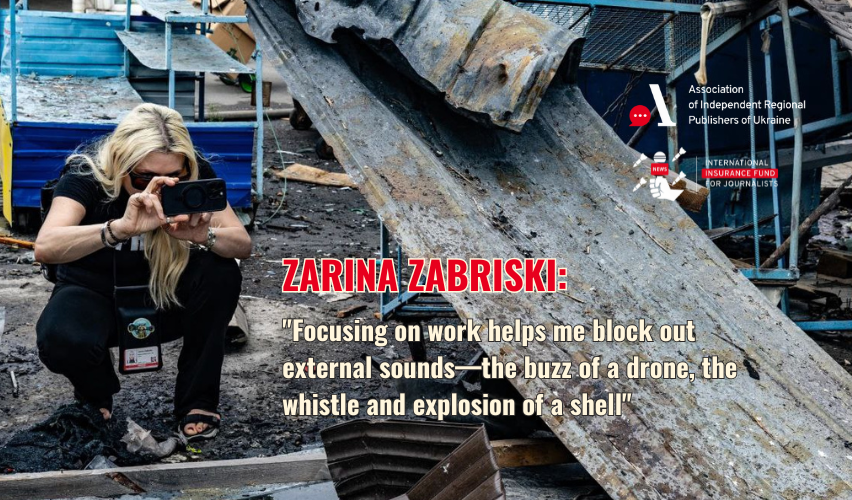
Staying focused on work helps me block out external sounds — whether a dog barking, a drone buzzing, or the whistle and blast of a shell. Sometimes I get distracted if I want to film a particularly intense attack on my street while I’m writing.
— What does your workday in Kherson look like now? What changes with your presence — as a journalist — in a city where danger has become background noise?
— People in Kherson wake up several times a night from nearby, loud explosions. Like other residents, I check Telegram channels to learn more. I like “Kherson Non Fake” — it’s accurate and informative. In the morning, I contact friends and colleagues to make sure everyone is okay. Often — they’re not. Broken windows are commonplace in Kherson.
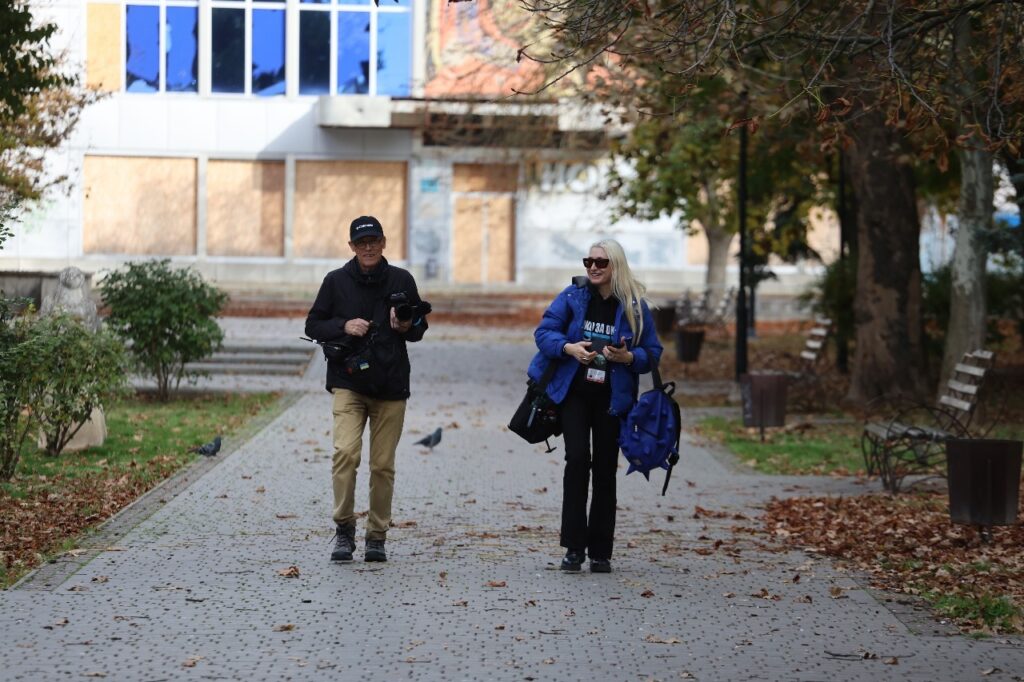
After breakfast, I often go to sites of destruction to film and report, sometimes together with colleagues from local media. During the day, I work on my second documentary film — conducting interviews and filming with our cinematographer Oleksandr Andriushchenko. He is an excellent photographer and videographer and works for the Kherson publication Vhoru. We made the first film together and work very well as a team, running from Russian drones and “chasing beauty in ugliness,” as he puts it.
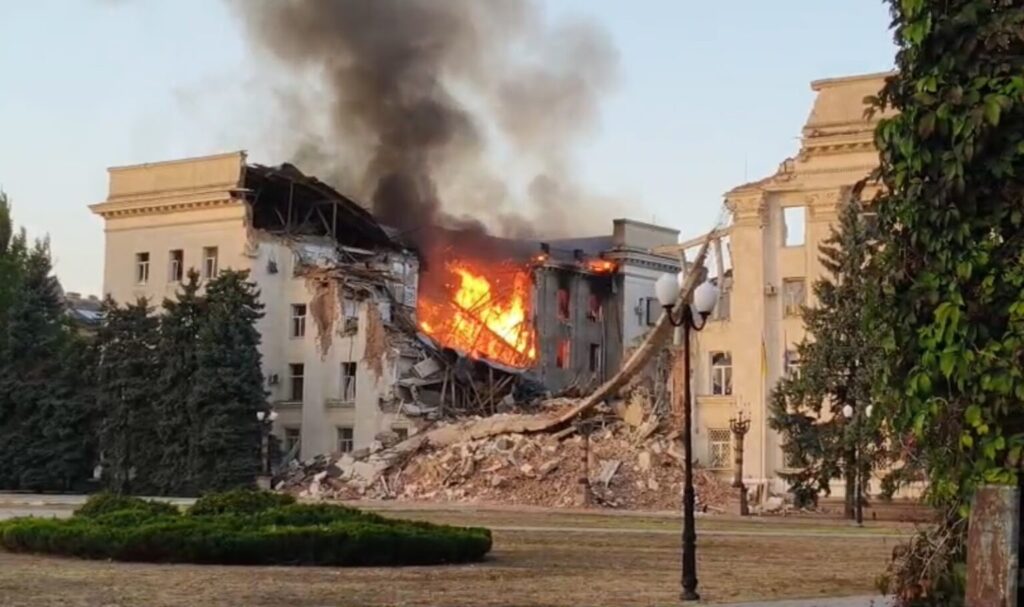
When I have time, I attend yoga classes, and after dark I write articles, edit videos, and record podcasts or do TV interviews from home — to the sound of artillery. I keep the “windows” open, although there is hardly any glass left — only plywood, so that the shock wave goes through instead of breaking the frames. Usually, it helps. When the walls begin to shake, I move to the corridor. If the shelling is very close — I go down to the first floor.
Stories That Stay Forever
— Was there a report or a story you remember especially — not because of the topic, but because of how everything unfolded?
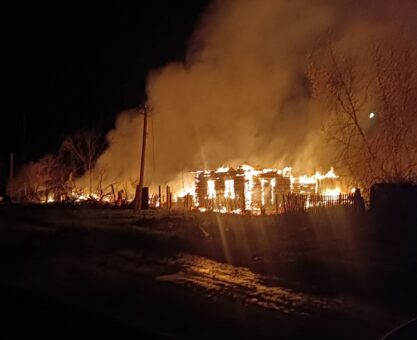
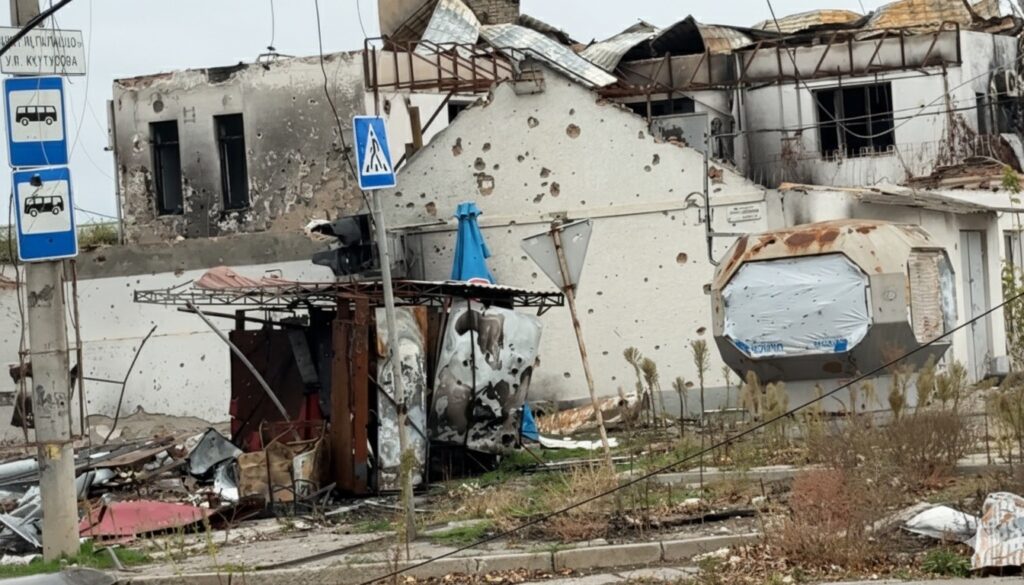
— There are many such stories. One of the recent ones that shook the world is the story of Grandma Lora from Antonivka. I came there to film a drone-hunter unit for my second documentary. The place is destroyed by Russians and looks like a set for a Hollywood war movie: charred, overturned cars; blackened high-rises; torn wires trembling in the wind; mines and shattered glass all over the road; wild dogs howling among split trees. Drones didn’t arrive that day — it was drizzling.
A tiny elderly woman with silver-white hair and bright blue eyes, wearing a starched white blouse, was walking down the devastated road with a long stick — I interviewed her. She turned out to be over eighty and herded twenty goats. Her home had been destroyed, but she refused to leave — because of her goats.
“Everyone has hope,” she said. “Even if it’s scary.”
I recorded a video interview. About three weeks later, around midnight, as I was about to go to sleep, I saw that very video on the popular Telegram channel Kherson Non Fake, which we all check for updates. Grandma Lora had been killed by a drone. Not just killed — torn to pieces. Along with two white goats — the mother and the kid.
I was furious. And I still am. I wrote about it on X (Twitter), and obviously many felt the same. This story went around the world, gathering millions of views and widespread attention.
— Have there been situations where usual journalistic tools — a camera, a recorder, questions — did not work? What did you do then?
— Sometimes you just need to remember everything or quickly take notes, and then record as much detail as possible. Writing always helps.
Ethics, Dignity, and Recovery
— Have there been situations where you chose not to publish material or not to include certain footage or testimony — for reasons of safety, ethics, or an inner sense of boundaries?
— This happens five times out of ten, or even more frequently. My rule is similar to the Hippocratic Oath: respect confidentiality, do no harm, share knowledge responsibly. In a war zone, near the front line, you must consider every fact, every photo, every sentence. And of course, I always send my materials to press officers to ensure I haven’t made a mistake and am not putting anyone at risk. This isn’t censorship — it’s common sense. Journalists must document war crimes, not contribute to them.
— Are there topics that are especially difficult for you to write about or film? What makes them difficult?
— Children. The suffering of children, or sometimes when they play while shells are flying — that’s painful. I don’t focus too much on this topic. For example, recently I filmed Halloween in a bomb shelter or a children’s theater performance.
One girl told me she lives well but soon has to move — first to Odesa, then to Poland and Germany. She may never see her home again. Another girl, the lead actress, was calm and positive, gave a good interview, and at the end said: “I no longer have my dog and cat. They were killed.” By Russians.
Running under fire is easier than filming such interviews.
— What helps you hold on after difficult shootings or conversations? How do you recover?
— I am always inspired by the people of Kherson. They survived nine months of brutal occupation, lost homes, jobs, loved ones — to shelling, “human safari” drones, or after the Kakhovka Dam destruction, and the situation worsens every day. They go to markets covered by anti-drone tunnels. And yet they help each other. They keep streets clean, plant gardens, feed stray animals. What are my difficult shoots compared to that? It would be shameful to pity myself. I can leave at any moment.
But the body, of course, doesn’t like stress. So I do yoga, lift weights, walk when it’s safe (not as often as I’d like), or dance at home. I also enjoy a glass of cognac before sleep.
— Do you have an internal rule for when to continue working and when to stop? How do you sense it?
— I am grateful for the opportunity to share the concept of reputational security, introduced by Peter Pomerantsev, a researcher of Russian propaganda. Reputational security for a country at war is the protection of its sovereignty through visibility and international awareness. When the world understands a nation’s story and significance, aggressors find it harder to erase or distort its identity. The stronger the reputation and recognition of a country, the higher the level of deterrence from destruction, as public outcry abroad can influence political and military restraint through its impact on elected politicians. For example, when Notre-Dame burned, the whole world was shocked and came to help.
— What does dignity mean to you in the work of a journalist — especially in conditions like those in Kherson?
— Dignity is an important value for me in journalism and beyond, in Kherson or anywhere. My father used to say: “There are things decent people simply do not do. Period.” A pretty standard set of values, nothing heroic. Just being a decent human being.
Important: Journalist Insurance Program
We remind you that the Association of Independent Regional Publishers of Ukraine has extended the insurance program for Ukrainian journalists, fixers, camera operators, photographers, and editors working in high-risk zones. The initiative is part of the International Insurance Fund for Journalists (IIFJ), implemented in partnership with Ukrainian and European organizations.
Related: Attention, colleagues! Registration open for insurance for Ukrainian journalists
New insurance conditions:
- Up to USD 100,000 in coverage
- No limits on the number of insured days or team members
- Priority for those who completed safety or first-aid training
- Eligible applicants include media workers operating in the Kherson, Zaporizhzhia, Sumy, Mykolaiv, Donetsk, Luhansk, Odesa, Kharkiv, Dnipropetrovsk regions, and border areas of Kyiv and Chernihiv regions
Registration opened on November 1. Details are available on the IIFJ website. Applications can be submitted here.

We remind you that the IIFJ project and the series of safety trainings are implemented by the Association of Independent Regional Publishers of Ukraine together with partners. The initiative is part of the Voices of Ukraine program, coordinated by the European Centre for Press and Media Freedom (ECPMF). Voices of Ukraine is carried out within the Hannah Arendt Initiative and funded by the German Federal Foreign Office.