


The frontline reports by Slidstvo.Info journalist Anna Kaliuzhna are stories of risk, loss, and human resilience.
We continue to tell stories about the work of journalists in frontline and border regions. We have previously published conversations with American journalist Zarina Zabrisky, who works in Kherson; as well as with war correspondent Oleksandr Kachura, videographer Vladyslav Safronov, and journalists Natalia Bilokudria, Serhii Horbatenko, and Yevhen Khrypun. Today, we present an interview with Slidstvo.Info journalist Anna Kaliuzhna.
Related: Journalism Under Fire: Daily Work in Kherson
For Anna, every reporting trip is a test of concentration and endurance. In places where danger is constant, she must listen to every sound so as not to miss the moment of a strike. Sometimes, after filming, memory erases details — and only watching the footage brings them back.
Working Under Constant Risk
— Anna, you often work in places where danger is the constant backdrop. How does this affect your concentration and the way you work?
— In dangerous places, my attention really becomes focused on not missing the moment of a weapon strike, and so on. There are times when I don’t remember certain details from the shoot and recall them only when I rewatch the video.
— What does your typical working day in the risk zone look like? What changes when a journalist is present?
— These days, almost all work at the front and in frontline regions happens in shelters. The main danger is being detected. There is no natural “cover,” like tree lines (“greenery”), from enemy scouts. So we try to minimize the time spent in the open. Though early in the war — even a year and a half ago — we could still walk through the tree lines to film what villages like Klishchiivka or Robotyne looked like “at zero.”
The military worries about journalists, so they try to protect us, and you have to persuade them for a long time to reach an important but dangerous location.
Local residents are fearless because they adapt to danger. But they can also be somewhat aggressive, because they fear that filming is an extra factor that could cost them their home, or they are simply and rightfully angry at the whole world, and the journalist standing next to them becomes the only person to whom they can voice that pain and anger.
Reports That Left the Strongest Mark
When asked about the reports that stayed with her the most, Anna names several places and years: Marinka (June 2023), Robotyne (March 2024), and the forest near Lypci (October 2024).
In Robotyne, Anna went to the zero line with a cameraman, a press officer, and reconnaissance soldier Max “Thor” Otinov. Six kilometers under the constant buzzing of drones, a primitive signal interceptor that had to be turned off because it was screeching nonstop.
“I could hardly breathe, my insides felt like they were trying to escape. I looked down from the hill and couldn’t believe that in six hours I had crossed twelve kilometers,” the journalist recalls.
That day, the group rescued a soldier in a state of shock — initially mistaking him for an enemy saboteur and leading him out as a “prisoner.” Three weeks later, Thor was killed and awarded the title Hero of Ukraine, posthumously.
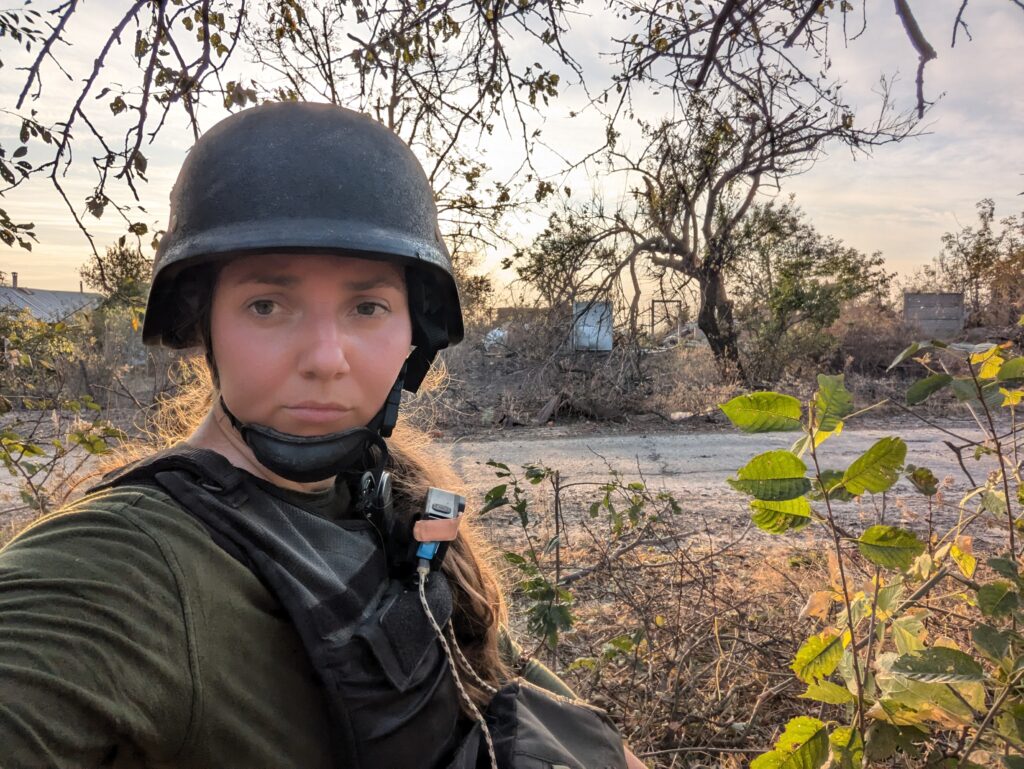
Autumn 2024 — the forest near Lypci. Anna ran with the soldiers through a burnt forest carrying 17 kilograms of equipment. Her backpack caught on branches; she fell and got up again, trying to keep a distance from the soldier running ahead.
“The forest around was scorched, and drones buzzed unpleasantly. But we made it,” she says.
But the most dangerous — and at the same time the most powerful — experience was Marinka in June 2023. There, the journalists ended up just 25 meters from Russian positions.
Anna recounts:
— It had been a month since my surgery for thyroid cancer. But I had to go work. The counteroffensive in Zaporizhzhia, in Donetsk. I couldn’t miss it. I had been trying to arrange this shoot for six months. The brigade stationed in Marinka didn’t understand why no one praised them the way they praised Bakhmut — even though Bakhmut had fallen, and they were still holding the line.
I explained that we had to get inside to show what they wanted people to know. You can’t convey it from the outskirts, from a fallback position.
We were with cameraman Andrii Toliarenko and press officer Yaroslav Chepurnyi. Around 3 a.m. Sergeant Slava starts telling me I’m not allowed to film everything. I argue, explain that we have the brigade commander’s permission — we met him beforehand to discuss why I needed to go specifically to Marinka. I had no strength left. Andrii and I had slept for one hour. The entire previous day, we filmed our successful assault on the Klishchiivka forest with the 80th Brigade. Then we packed our things in the apartment in Kramatorsk, moved to the Druzhba Hotel in Pokrovsk. Slept for an hour. God, I had no strength for any of this.
And then the paratroopers come on the radio: “We hear vehicle movement at nine.” One of the biggest Russian assaults of the month begins. We are 700 meters from zero. A tank is firing at us. And something else. Explosions across all of Marinka. The paratroopers at zero are fighting back.
Slava, Pasha, and Vlad — three commanders — are coordinating actions over the radio. They’re also yelling at the artillerymen. The artillery is slow to carry out commands. Our guys are choking; they need support. The tank is firing at them with direct hits; enemy infantry is creeping forward in the chaos. The battle goes on. We’re filming everything — no one objects anymore.
Reports start coming in from the positions about the wounded and killed. The commanders are clutching their heads. The “live” deaths and the cigarette smoke make me nauseous. My head is spinning. There is no bathroom. We can’t go outside. The battle ends. Our forces repel the attack. The Russians suffer heavy losses. But we have losses too.
In the evening, we go nearby to film the local church, which, in the rays of the setting sun, looks like ancient ruins.
The thought scares me — that these ruins look as beautiful as the ruins of Greek temples I saw half a year before February 2022.
I know why: because I had never seen Marinka before all this. I have no emotional attachment to a whole church. With Kostiantynivka and Pokrovsk, it’s different now.
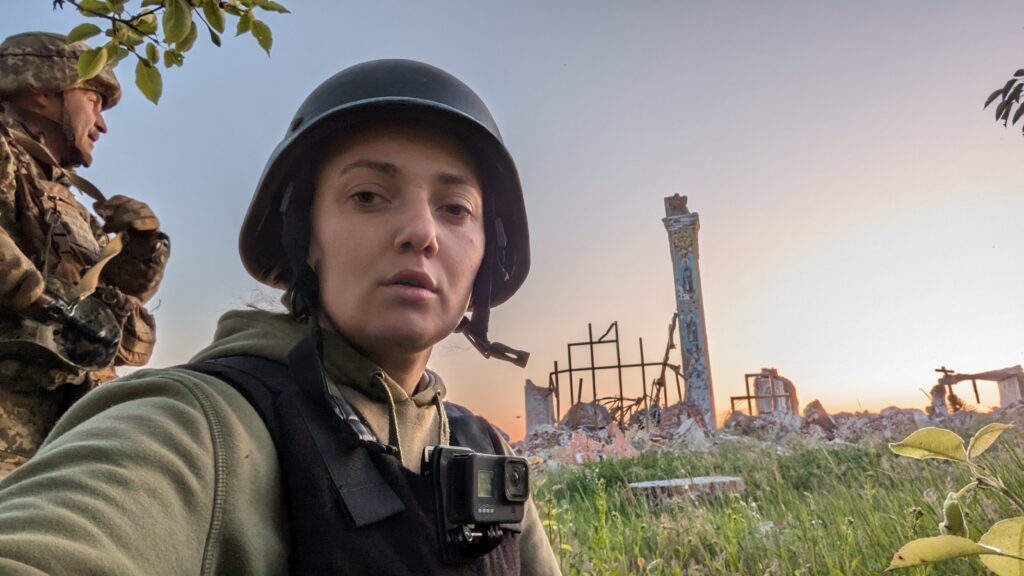
In the evening, I walk with company commander Vlad and Yaroslav. I really wanted to get to the zero line with the guys. Vlad needs to organize an evacuation of “the fallen.” He agrees to take us. The last 200 meters we have to run. Twilight. Vlad runs ahead and shouts, “Mine! Mine!” I dodge the mines and catch myself thinking I’m inside some kind of surreal film. Is this really happening to me?
The paratroopers at zero are shocked that we ran to them.
We are 25 meters from the Russians. They are just one house away from us. This was the closest I have ever worked.
The emotions of the men at zero, after they saw us and talked to us following a brutal battle, were worth that “surrealism” — which was actually just reality.
Journalistic Ethics and Dignity in War
— Have there been times when you deliberately chose not to publish a story or show certain footage due to safety or ethical reasons?
— Yes. I never included stories from Kherson residents about how they engaged in partisan activities — for safety reasons. Never. I don’t know how long this war will last or whether these people might end up under temporary occupation again. For ethical reasons, I didn’t publish the moment I described about our soldier in Robotyne, whom we escorted out. In general, there have been more such moments.
— Do you have internal guidelines — when to keep working and when to pause?
— Do you mean safety or moral guidelines? In terms of safety, I probably do, because I’m still alive, even though I’ve been at the zero line — near Lypci, in Kupiansk, Marinka, Robotyne. In Kherson, Bakhmut, Chasiv Yar, New York, and Pokrovsk. As for moral guidelines, unfortunately, my productivity has dropped compared to the past three years of work.
— Which topics are especially difficult for you to cover? What makes them so hard?
— Listening to the testimonies of people who survived Russian captivity. It is the most horrific experience a person can go through.
— Have there been cases when the usual journalistic tools — camera, recorder, questions — simply didn’t work? How did you handle it?
— Yes. An infantryman from the Khartia Brigade — I decided not to record him because he had lived through terrifying trauma for two years. I simply listened to him for two hours.
— What helps you recover after difficult shoots or conversations?
— Love, wine, family, and the films I love.
— How do you understand dignity in the work of a journalist in conditions of war or danger?
— Not considering yourself more important than the people you’re filming. Not trying to impose an irrelevant agenda on society (such as elections) just to justify a pre-war lifestyle.
— If you recall one of your stories or projects created in risky conditions, what was most important for you as an author and as a person?
— Allowing soldiers to say what is important to them.
Ensure You Are Insured
The Association of Independent Regional Press Publishers of Ukraine (AIRPPU) offers journalists working in dangerous regions the opportunity to obtain life and health insurance. This is part of the International Insurance Fund for Journalists (IIFJ) initiative, implemented in partnership with Ukrainian and European organizations.
Journalists from Kherson, Zaporizhzhia, Sumy, Mykolaiv, Donetsk, Luhansk, Odesa, Kharkiv, and Dnipropetrovsk regions, as well as border areas of Kyiv and Chernihiv regions, can apply.
The project is implemented by the Association of Independent Regional Press Publishers of Ukraine (AIRPPU) together with partners. The initiative is part of the Voices of Ukraine program, coordinated by the European Centre for Press and Media Freedom (ECPMF). Voices of Ukraine is carried out within the Hannah-Arendt-Initiative and funded by the German Federal Foreign Office.