


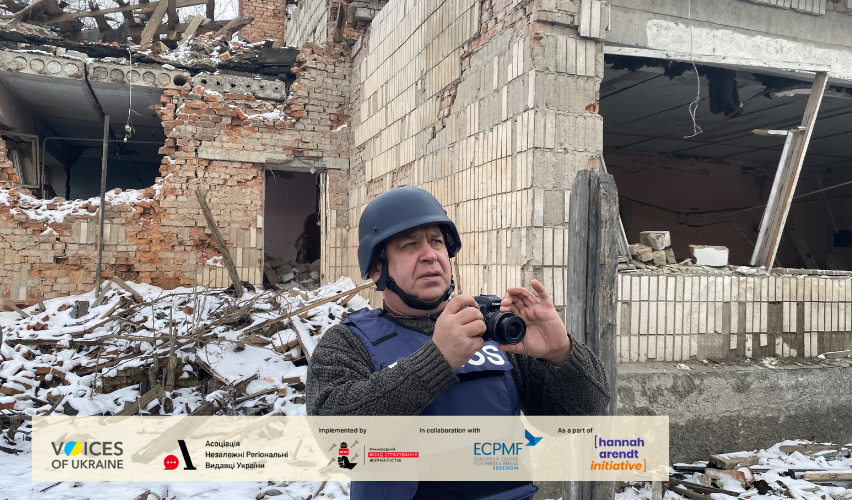
Oleksii Pasiuha, editor and journalist of the Vorskla newspaper from Velyka Pysarivka (Sumy region), talks about how the logic of (in)security has changed with the emergence of drones, why some materials remain only in the archive, how the team supports one another, and what a journalist’s dignity means during war.
Working as a journalist in Ukraine today, especially in border and frontline regions, means facing danger every day and constantly making moral choices. Oleksii Pasiuha, editor and journalist of the Vorskla newspaper from Velyka Pysarivka (Sumy region), talks about how the logic of (in)security has changed with the emergence of drones, why some materials remain only in the archive, how the team supports one another, and what a journalist’s dignity means during war.
“They appear out of nowhere and can attack at any moment”
The most difficult challenges for journalists in border areas are safety and the need to remain constantly focused. The Vorskla editorial team did not stop publishing and delivering the newspaper to readers even in the first weeks of the full-scale war, printing it on a home printer. This small team (five people work here) therefore has enormous experience.
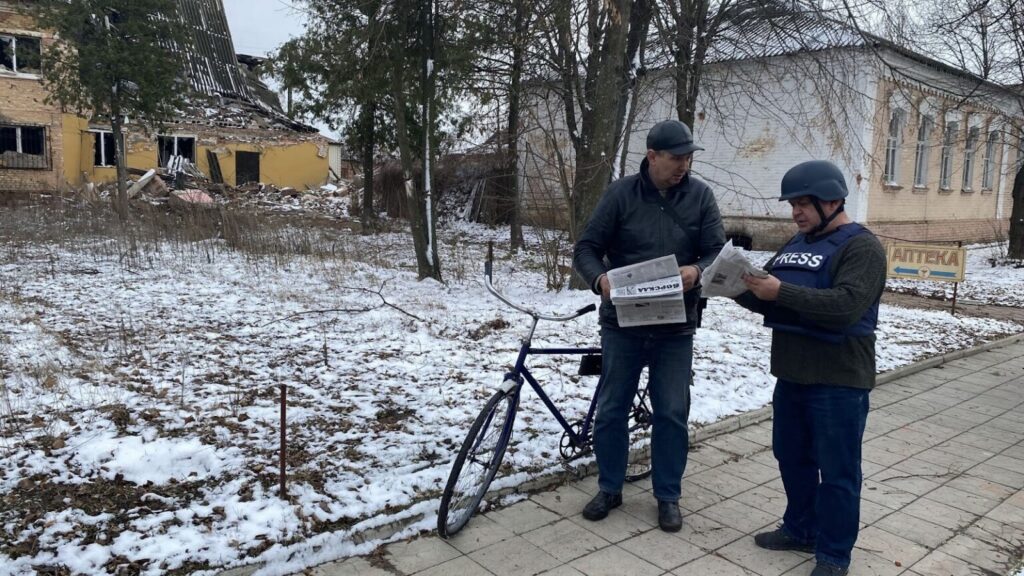
Oleksii recalls that until the summer of 2024, danger felt more “predictable”: artillery shelling, guided aerial bombs, tanks, helicopters… Despite the proximity to the border, there was a sense of certain logic — it was possible to hide or anticipate risks.
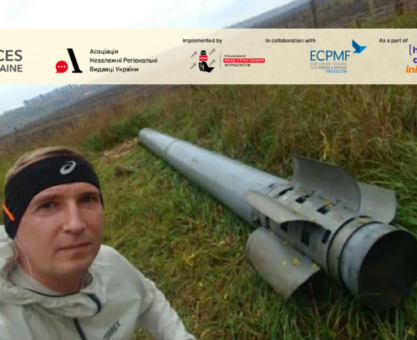
— Everything changed radically with the appearance of drones. They appear out of nowhere and can attack at any moment, — the journalist says. At first it seemed that drones targeted only large objects, but since 2025 they have started striking everything that moves — from military equipment to cyclists and civilian cars. This forced the editorial team to change its approach to work: trips are now planned depending on the weather, and they try to stay closer to trees, although even this does not guarantee safety.
They began striking everything that moves — from military equipment to cyclists and civilian cars.
“Sometimes the decision is made literally within a few minutes”
Before each trip, the team checks the situation in the community. They communicate with local volunteers who live in the combat zone to learn about night shelling or changes in the enemy’s behavior.
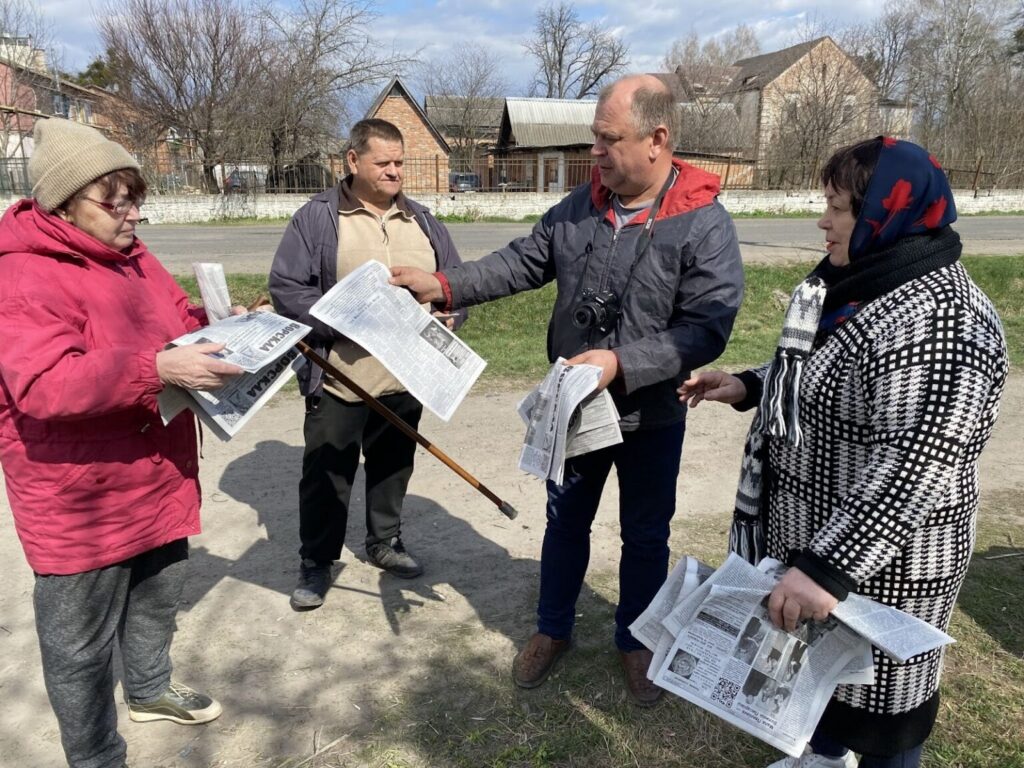
— Were there shellings at night, what is the situation in the morning, has the enemy “worked off” — these are simple but critically important things, — Oleksii explains. Technical aspects are also important: whether there will be communication, whether it will be possible to transmit information, whether there are spare tires. Once the editorial car punctured two tires on fragments; another time, a tire was cut by spikes scattered by a drone. Now they travel with three spare tires.
— There’s simply no fourth one, — Oleksii laughs. — Sometimes the decision to go or not to go is made literally within a few minutes. Not because of deadlines, but after weighing the risks.
“The news will be forgotten. A life cannot be brought back”
Over time, journalists have developed their own “signals” for when it is worth pausing in their work. One of them is an internal feeling of haste. Another is the desire to go to the site of shelling just for photos, despite an obvious deterioration of the situation:
— The clearest one is when you start rushing without real need. It means the tension is already too high and you stop realistically assessing the situation. Another signal is when you catch yourself thinking that you need to go because something has hit and there will be photos, even though at the same time you understand that the situation is getting worse. In border areas, this is always the moment when you need to stop and think.
…When you start rushing without real need. It means the tension is already too high and you stop realistically assessing the situation.
The ability to stop and take a breath when things go off plan sometimes literally saves lives:
— Every Thursday we deliver the newspaper around the community, which is in a combat zone. There is a clear schedule — so that we manage to pass the newspaper on to those who take it to other settlements. Once, because of a blackout, the newspaper arrived late from the printing house, and we were about an hour behind schedule. Exactly during that hour, a guided aerial bomb hit a shop in Spirne. Two saleswomen were killed. And we were supposed to be there at that time…
That is why we constantly try to keep a balance between work and pauses. The news or the most interesting shot of the week will be forgotten. A life cannot be brought back.
Anxiety disciplines, gratitude restores a sense of meaning
It is impossible to completely get rid of anxiety, but it also helps one remain more attentive.
— We do not pretend that everything is fine. If it’s scary or hard, we talk about it, — the journalist says.
Humor plays an important role in the newsroom: it helps relieve tension and support one another. Routine work also helps — texts, layout, calls, preparing issues. This restores a sense of stability that existed in peacetime. After difficult trips, even ordinary newspaper delivery helps:
— When you hear words of thanks or see that people are waiting for the newspaper and that it is truly needed, it restores a sense of meaning, — Oleksii says.
Family support matters a lot; conversations with his small granddaughter are Oleksii’s main place of recovery. Conversations with friends at the front also help — through the prism of their experience, his own difficulties look different.
— Being in nature is a great pleasure, — the journalist shares. — This year, for the first time in a long while, I managed to go mushroom picking a few times. In our home forests there were always many mushrooms. But you can’t go there now — they’re stuffed with explosives. And the enemy is nearby, shelling. But now we managed to go, even if not to our native forest, and we gathered mushrooms. We sent some to my son at the front and to my daughter in Kharkiv, and still had some left for ourselves.
“The hardest thing is to write about the deaths of people and the destruction of what was part of your own memory”
The editorial team deliberately does not publish materials or footage that could harm people: civilians, military personnel, or rescuers. They do not show precise locations, do not geotag photos, and do not rush to publish information immediately after strikes.
— As for photos or videos themselves, we work in a region that is well visible from the air. The enemy knows where and how accurately they hit even without our publications. Moreover, their videos often appear on enemy Telegram channels earlier than we have verified information. So for us the question is not “to show or not to show,” but what and why we show.
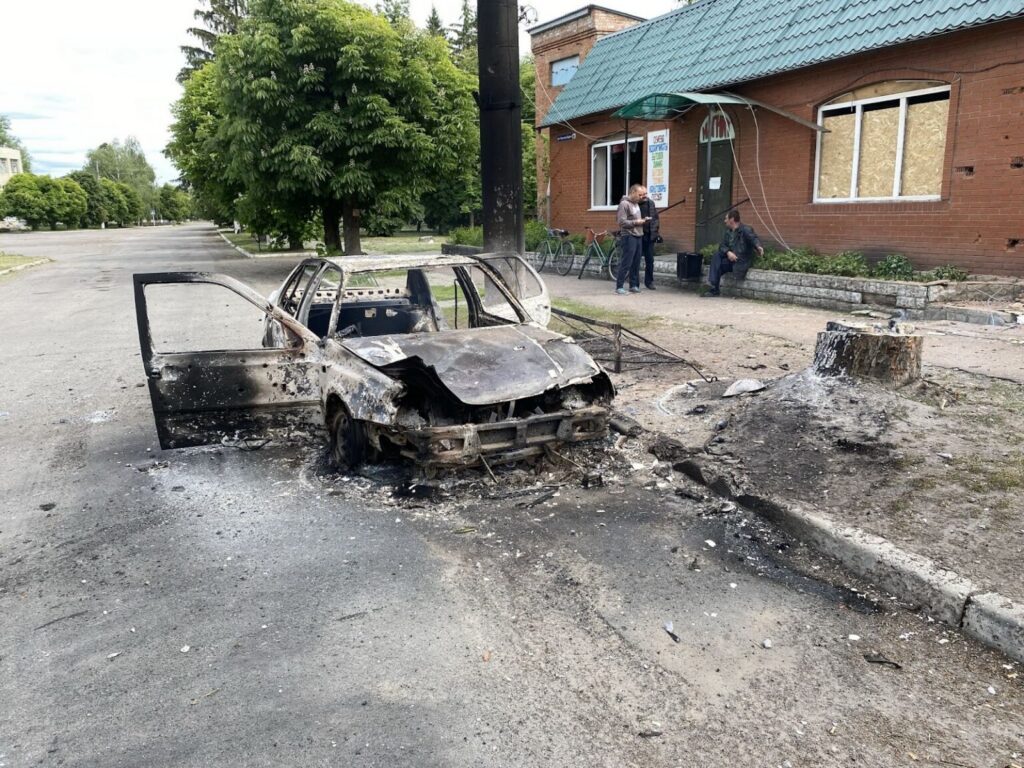
The most difficult everyday challenges lie in the field of ethics:
— There were situations when we filmed material exclusively to document crimes, but consciously did not publish it. One such case was a strike on a military vehicle near a pharmacy, where soldiers had arrived from the front line. We documented the incident for the archive and for evidence, but these frames did not enter the public space.
There are things that must not become content.
They also do not film funerals of fallen soldiers unless relatives explicitly ask for it.
— And we never publish videos of emotional moments of farewell, tears of loved ones, or the body of a warrior. Perhaps someone considers this wrong from the point of view of “completeness of the picture.” But for us this is a matter of respect and a boundary we are not ready to cross.
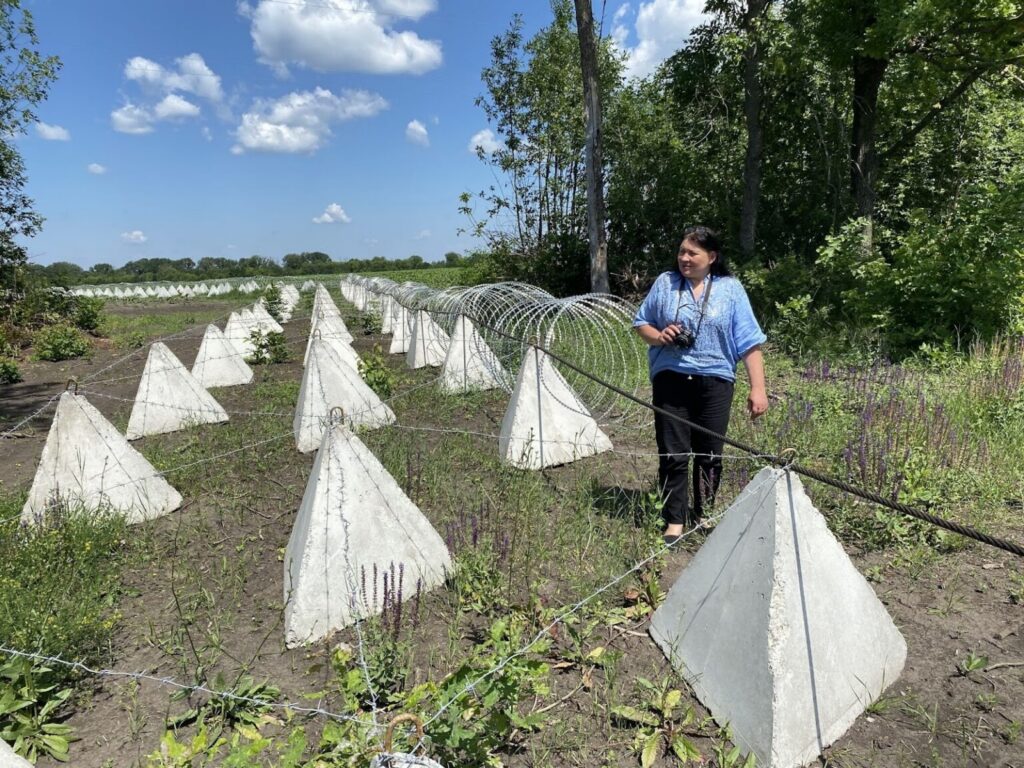
It is even harder to speak about losses when the fallen person is someone you know or a neighbor. It feels like the destruction of something that was part of your own memory. For Oleksii, such a story was that of fellow countryman Oleksandr Skoryk: after the ATO, he went back to the front, but went missing. The newspaper wrote about him with hope that he was in captivity:
— But at the same time there was an understanding that the section of the front where he disappeared was completely destroyed by explosions, essentially ploughed over. Most likely, the body was never found.
On safety skills and teamwork
Oleksii Pasiuha emphasizes: in border areas, there are no trips “just to take a look.” Journalists do not stay longer than necessary and try not to draw attention without an urgent need.
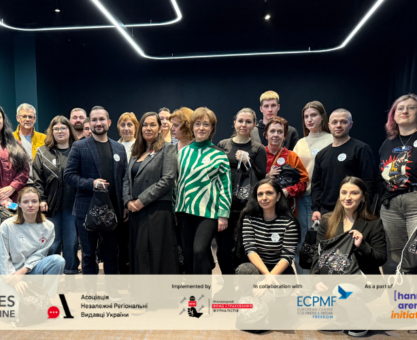
— First aid is not “just in case,” it is a real necessity, — he says, recalling safety trainings organized by AIRPPU. In a small newsroom, everyone must know the basics: what to do in case of injury, how to act before medics arrive. That is why the team regularly organizes training for colleagues and is convinced that such courses should be taken at least twice a year.
A team is critically important for a journalist. Even if physically they are alone on an assignment, there is always someone in contact who knows their route and can raise the alarm.
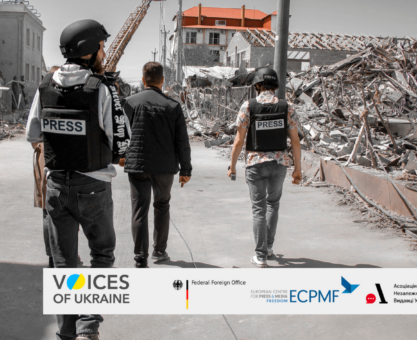
— A partner during trips has become mandatory, — Oleksii says. One drives the car, the other listens to the sky. This is not only a matter of safety, but also of professional work: shooting from two angles, helping with equipment, orienting oneself on site.
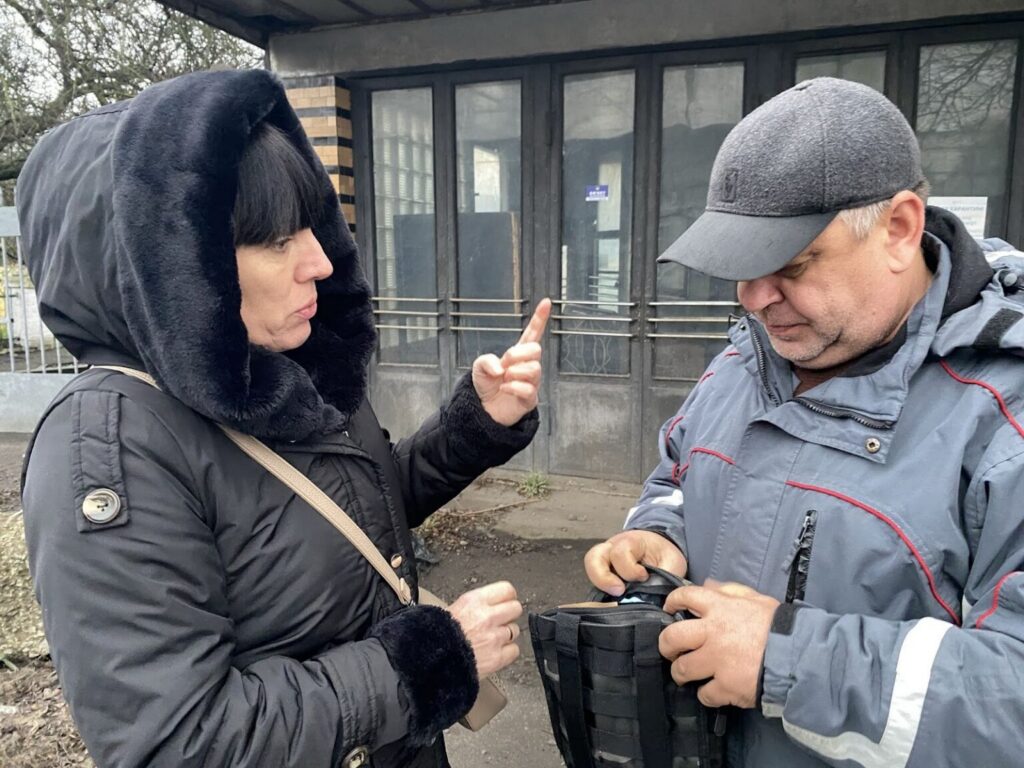
A partner during trips has become mandatory.
Colleagues, take care of your safety
The Association of Independent Regional Press Publishers of Ukraine (AIRPPU) offers journalists working in dangerous regions the opportunity to obtain life and health insurance. This is part of the International Insurance Fund for Journalists (IIFJ) initiative, implemented in partnership with Ukrainian and European organizations.
The terms of free insurance are outlined here.
Media workers operating in Kherson, Zaporizhzhia, Sumy, Mykolaiv, Donetsk, Luhansk, Odesa, Kharkiv, and Dnipropetrovsk regions, as well as border districts of Kyiv and Chernihiv regions, may apply.
The International Insurance Fund for Journalists project, organized by the Association of Independent Regional Press Publishers of Ukraine, is part of the Voices of Ukraine program, which is included in the SAFE program coordinated by the European Centre for Press and Media Freedom. The Voices of Ukraine project is implemented within the Hannah Arendt Initiative.
Within this project, we are preparing a series of conversations about the work of journalists in frontline and border regions. Previously, we have already published conversations with Zarina Zabrisky (Parts One and Two), Oleksandr Kachura, Vladyslav Safronov, Natalia Bilokudria, Serhii Horbatenko, Yevhen Khrypun, Anna Kaliuzhna, Polina Kulish, Nadia Sukha, Nadiia Karpova, Oleksandr Solomko, and Diana Butsko.