


“When this war ends, the history of this country will not be written only by generals and politicians. It will also be written by journalists in small towns who did not switch off the lights, even when everything around them was falling into darkness.” – Oksana Brovko
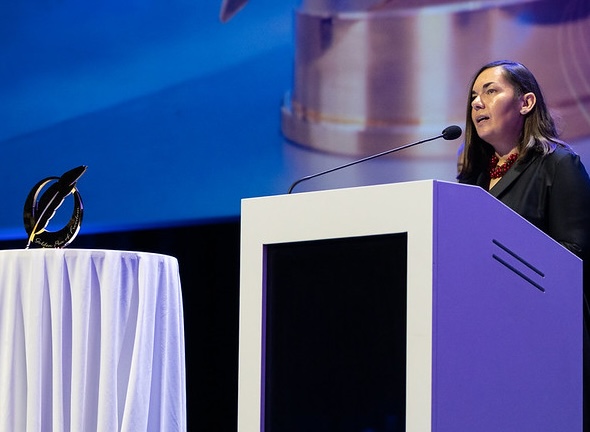
On the main photo: Oksana Brovko giving her Golden Pen of Freedom Award speech on behalf of the Association of Independent Regional Press Publishers of Ukraine (AIRPPU) during the World News Media Congress 2025 in May.
This article by Dean Roper first appeared on WAN-IFRA
Today marks four years of war in Ukraine, with seemingly no clear path to peace on the near horizon. Yet in the face of enormous pressures and challenges, Ukrainian journalists, newsrooms and their publications continue to report on the war, to fight for survival, and secure their independence.
Oksana Brovko, CEO of AIRPPU (Association of Independent Regional Press Publishers of Ukraine) who accepted WAN-IFRA’s Golden Pen of Freedom Award this past May, has played a prominent role in supporting local, independent media in Ukraine during the ongoing war.
We reached out to Oksana to share her thoughts and reflect on the situation there after four years of conflict.
First of all, how are you?
I am still alive and still have capacity to plan the future. Four years ago, I was operating on instinct – evacuating colleagues, securing newsrooms, coordinating support in real time while missiles were falling. Everything was urgent. It was “survive today” mode.
Today the pressure is different. It is slower, heavier, more structural. We are no longer only defending territory. We are defending institutions – regional media, local democracy, public trust. What worries me most now is not only the explosions. It is the normalisation of war. The way sirens become background noise, destruction becomes statistics and societies both inside and outside Ukraine begin to adapt to abnormality. Normalisation is dangerous. Because when war becomes routine, urgency fades. When urgency fades, support weakens. When support weakens, institutions erode.
I really hope my single small step brings all of us closer to victory. Day by day. When this war ends, the history of this country will not be written only by generals and politicians. It will also be written by journalists in small towns who did not switch off the lights, even when everything around them was falling into darkness.
After four years of war, what stands out most to you when you reflect on the first days of the Russian invasion compared to now?
In the first days, everything was binary – life or death, here or gone. Newsrooms became coordination centres. Journalists evacuated families and in between – they reported. Now the pressure is more complex. We face financial exhaustion of regional media, staff burnout after years of trauma, legal and security risks, constant disinformation pressure. The war moved from emergency to long-term structural pressure.
The question is no longer “Can we survive today?” It is “Can we remain independent for the next few years?”
In what ways has the relationship between journalists and the Ukrainian public evolved over these four years?
It has deepened and matured. People at the frontline needed information to survive – where to shelter, where to evacuate, where to have bread or clean water. Sometimes they can receive it only from the printed newspapers, which are delivered to them with rescue teams, in support of militaries, via the anti drone roads. That created direct, tangible connections between journalists and their communities. In regions farther from the eastern and southern borders, the expectations evolved. Communities now look to their local media for answers about reconstruction, infrastructure adaptation, housing for displaced families, integration of veterans, and the allocation of public funds. The relationship is not only about emergency information. It is about accountability, transparency, and rebuilding social trust under wartime conditions.
What has the Stronger Together initiative meant for your work and other journalists in the country?
For me personally, this is a space where there is always someone nearby who reminds me to breathe, to sleep, to drink water. And we try to create that same space for more than 100 colleagues from local media who are part of the Stronger Together project – it gave breathing space. It allowed editors to stop thinking only about survival and start thinking about development again: to invest in investigative skills, to strengthen editorial policies, to develop communities around their media. To build partnerships instead of asking for emergency help every few weeks.
It also changed something psychological. When a small newsroom in a frontline region knows that colleagues in other countries stand behind them, not symbolically but practically, it reduces isolation. It reminds journalists that their work matters beyond their town, beyond their country.
Stronger Together in numbers is 22 local newsrooms in our Institutional Support stream, which develop their structure using the best practice sharing and mentoring cases. These are 18 regional media in the Investigative stream, which built their investigative teams from zero and already produced almost 100 anti corruption stories for their local readers. This is a great team of female media leaders in our WIN Accelerator programme who are straightening their media and 4 strong partnerships between Ukrainian and Norwegian local media in our Norwegian Partnership Programme. This is already the system which delivers the oxygen to Ukrainian regions.
Read also: From Survival to Growth: Stories of Three Newsrooms
In a post about the lack of electricity for journalists and newsrooms, you said this, “For Ukrainian media, resilience today depends on very concrete, very practical support. If you can do at least something – do it.” What does that look like in practice?
For Ukrainian media today, resilience can be as simple as a charging station that allows a newsroom in Kherson to publish during a blackout. It can be covering the cost for the drone detector which our editors use while they deliver the newspapers to the killed zones to their readers. It can mean donation to buy a laptop which was destroyed during shelling.
It can also mean something less visible but equally critical: funding salaries so journalists are not forced to leave the profession, covering legal defence when an investigative newsroom faces pressure, or inviting a team from a frontline to your peaceful newsroom to share the professional experience.
Each action matters. Small and bigger. You do not have to solve the war. But you can decide that one independent newsroom will not go silent because it lacks electricity, equipment, or financial stability.
How difficult is it today to get verified information across the country?
It is significantly more complex today than at the beginning of 2022. In the first months of the full-scale invasion, Russian propaganda was often crude and easy to identify. The narratives were repetitive, the manipulation obvious.
Now the landscape is far more sophisticated. AI-generated content, coordinated Telegram networks, short-form emotional videos on TikTok – all of this distorts reality at scale and at speed. The volume of disinformation alone makes verification harder. Journalists are not only fact-checking individual claims, they are navigating an ecosystem deliberately designed to overwhelm. That is why the strategic response cannot rely only on debunking. We cannot fact-check fast enough to match the production of manipulation.
The long-term solution is strengthening critical thinking. When a person sees an emotional headline, the first instinct should be to ask: why is it framed this way? Who benefits from my reaction? What is the intention behind it?
The future of information security lies not only in stronger journalism, but in stronger information consumption.
How hopeful are you that some resolution comes soon?
Hope alone is not sufficient. What matters is structural security and long-term institutional resilience. We are realistic. We understand the scale of the challenge. But we are not fatigued in our commitment. The more important question for the international community is this: are your media systems resilient enough for a sustained crisis? Ukraine is not an exception. It is a warning and a lesson. If democratic societies do not invest in independent journalism before the crisis arrives, they will pay a much higher price when it does.
As one of my colleagues once told me, a good journalist is a living journalist. I would add: a nation that wins is a nation that remains alive – alive in its institutions, its truth, and its ability to endure.