


Documenting Russian crimes has become the journalist’s main professional purpose.
We continue to share stories about the work of journalists in frontline and border regions. Earlier, we published conversations with American journalist Zarina Zabrisky (Parts One and Two), Oleksandr Kachura, Vladyslav Safronov, Natalia Bilokudria, Serhii Horbatenko, Yevhen Khrypun, Anna Kaliuzhna, Polina Kulish, Nadia Sukha, Nadiia Karpova, Oleksandr Solomko, and Diana Butsko. Today, we speak with journalist Serhii Horbatenko.
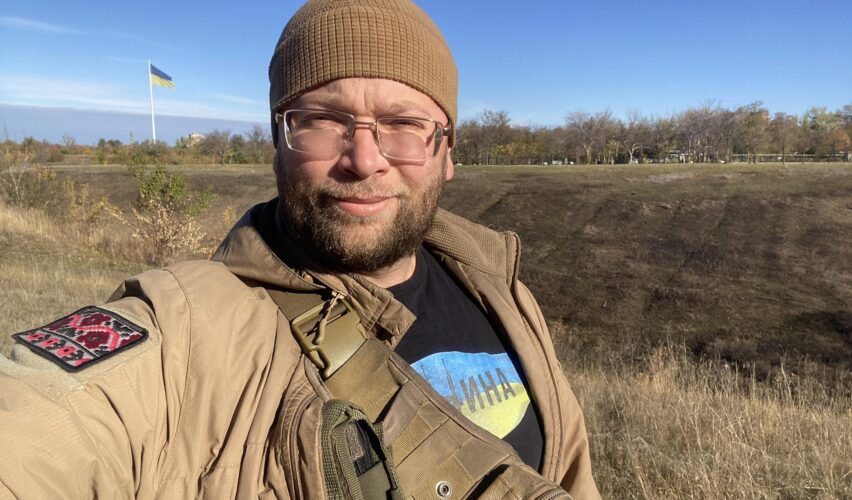
Serhii is 41. He was born in Bakhmut. Over the years, he has worked for television in Sloviansk and for Hromadske TV Donbas. Since autumn 2014, he has been collaborating with the Ukrainian service of Radio Svoboda (Radio Liberty).
He currently lives and works in Kramatorsk.
“My duty is to show what is happening near the front line. The consequences of Russian aggression: people suffering, people dying, children dying, homes destroyed. I see my mission as working on my native Donetsk land for as long as possible and showing the world the war crimes committed by Russians.”
This position is neither empty words nor mere pathos. It is work on the front line, where shrapnel, a drone, or artillery fire may end your life every minute.
“Everyone Is Alive!”
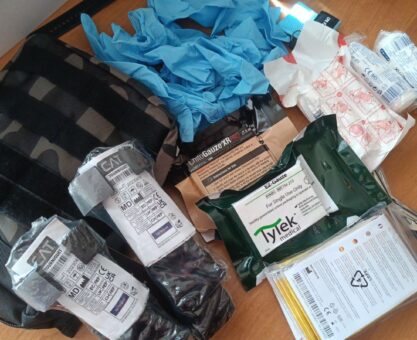
Serhii strictly follows safety rules. Every trip requires full protective gear: a bulletproof vest, helmet, and medical kit — though even that does not guarantee safety.
“On 20 November 2025, we headed by evacuation vehicle to Lyman, planning to pick people up from several addresses. Besides me, the crew included U.S. citizen Devon Masser from the humanitarian organization Plain Compassion Crisis Response and two police officers from the White Angel unit. The armored car was driven by a volunteer from the United States.”
The first trip went without incident, but during the second one, a Russian drone operator set up an ambush. Unfortunately, a successful one.
“At a right-angle turn, where the car slowed down as much as possible, a Russian FPV drone appeared above us. It rose sharply and struck the vehicle on the driver’s side.”
For several seconds, it was unclear whether everyone was alive. But all of them managed to jump out of the vehicle, which burned down completely.
“The volunteer was seriously injured — shrapnel hit his face and eyes. I was sitting in the farthest corner from the point of impact, and suffered barotrauma,” Serhii recalls.
Despite the ordeal, he returned to work quickly. He says that as long as he is not serving in the army, he must show the world the consequences of the war crimes committed by the Russian Federation in Ukraine.
The Boy Who Dreamed of a Tablet
Serhii is the author of hundreds of reports and photo stories, most of them from the Donetsk region. Among the many stories he has witnessed, one stands out — the story of a boy from Bakhmut.
“When Russian troops entered the city and began shelling residential areas massively, I worked with volunteer friends evacuating people from the most dangerous districts. We met a family who refused to leave Bakhmut. They delivered humanitarian aid and helped those who couldn’t get out on their own. A 12-year-old boy was with them…”
Serhii remembers asking the boy about his dream.
“He told me: ‘I dream of a tablet. At the nearby Invincibility Point, you can study remotely, but the phone screen is too small to properly see what the teachers are showing. A tablet would be much more convenient…’”
Serhii shared the story in one of his reports, and very quickly, a man named Dmytro from the city of Dnipro responded.
“He sent me a package. The box was filled with sweets — and a tablet. We came and delivered it to the boy. I think this is one of the rare stories where you show not only the consequences of war — grief, evil, tears — but also that people have not forgotten how to do good. I hope the boy and his family are doing well…”
Journalist Insurance: Why It Cannot Wait
For Serhii Horbatenko, work and life have long merged into one. He did not leave Donbas, did not abandon journalism, did not change his line of work. Despite the danger, he continues to film and tell the world what he witnesses every day.
For media workers like Serhii, the issue of insurance becomes especially important.
The Association of Independent Regional Press Publishers of Ukraine (AIRPPU) offers journalists working in dangerous regions the opportunity to obtain life and health insurance. This is part of the International Insurance Fund for Journalists (IIFJ) initiative, implemented in partnership with Ukrainian and European organizations.
Conditions for free insurance are available here.
Applications can be submitted here.
Media workers eligible to apply include those working in Kherson, Zaporizhzhia, Sumy, Mykolaiv, Donetsk, Luhansk, Odesa, Kharkiv, Dnipropetrovsk regions, as well as border areas of Kyiv and Chernihiv regions.
***
The project is implemented by the Association of Independent Regional Press Publishers of Ukraine (AIRPPU) together with partners. The initiative is part of the Voices of Ukraine program, coordinated by the European Centre for Press and Media Freedom (ECPMF). Voices of Ukraine is carried out within the framework of the Hannah-Arendt-Initiative and funded by the German Federal Foreign Office.