In the modern information landscape, where artificial intelligence is changing rules of the game every day, fact-checking is becoming a key tool for self-regulation. Jenny Virtanen, head of the digital data department at YLE, spoke about the challenges and practices of verification in Finland.
Jenny Virtanen has extensive experience in the Finnish media: from covering local news and the economy to serving as the Brussels correspondent for the largest newspaper, Helsingin Sanomat. Now she heads the digital data department at YLE — a public broadcaster that has been in existence for over a century and remains independent of political influence and commercial advertising.
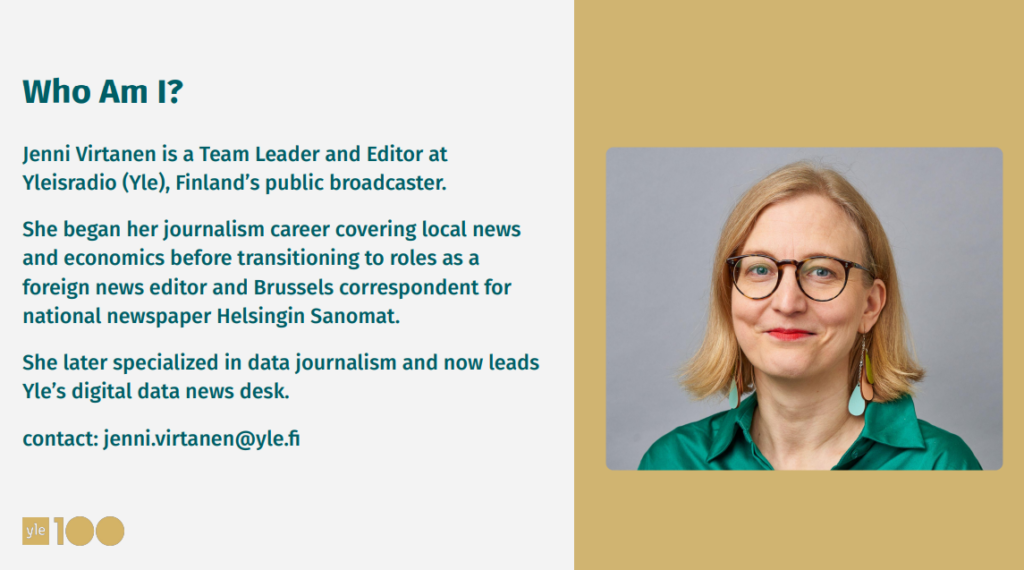
The high level of trust in the media in Finland requires newsrooms to exercise particular diligence. That is why YLE set up a dedicated fact-checking team last year that works with open data, geolocation, satellite imagery, big data, and social media. Its strength lies in a combination of journalistic and technical expertise.
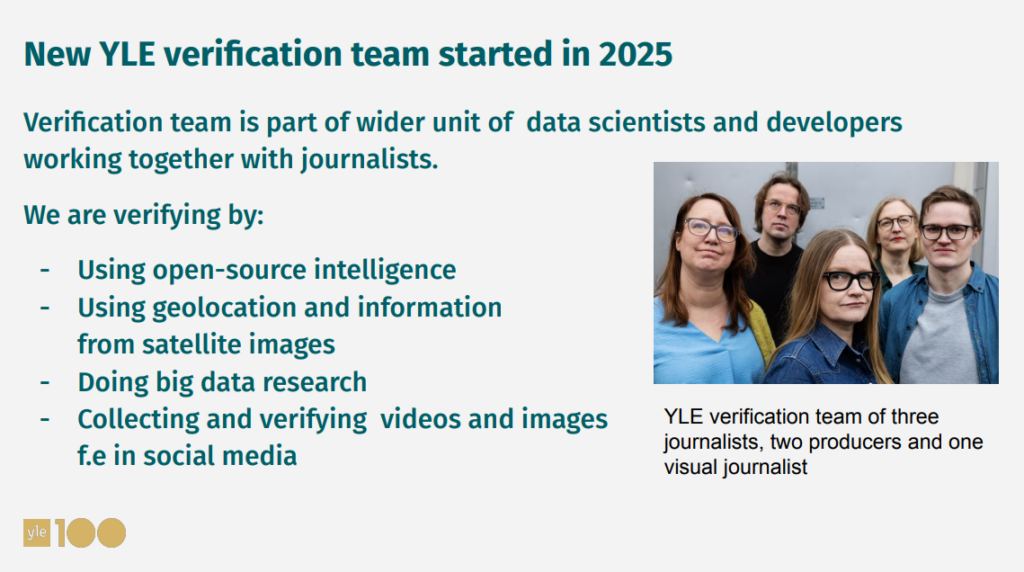
The Challenges of the Age of Artificial Intelligence
Images and videos have always been susceptible to manipulation, but with the advent of AI, the scale of this problem has grown exponentially. Jenny pointed out that more than 20% of the videos recommended by YouTube are already created by artificial intelligence, and even professional journalists may inadvertently share them without realizing it. This applies not only to videos, but also to audio files, photos, and even 3D content.
Journalists should seek out original sources, think critically, consult experts, and use a variety of tools.
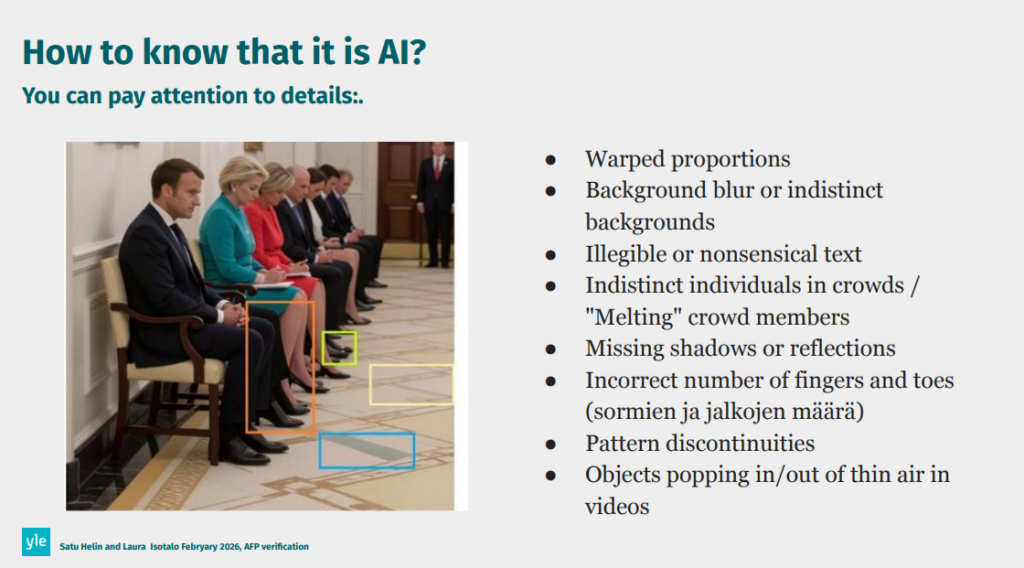
Sure, there are basic visual cues that help identify images created by artificial intelligence.
Basic visual cues for recognizing AI-generated images:
- distorted proportions,
- blurry or out-of-focus background,
- text that is illogical or illegible,
- figures fading into the crowd,
- absence of shadows or reflections,
- incorrect number of fingers,
- gaps in patterns,
- objects that appear out of nowhere in the video
They are helpful, but they do not guarantee accuracy.
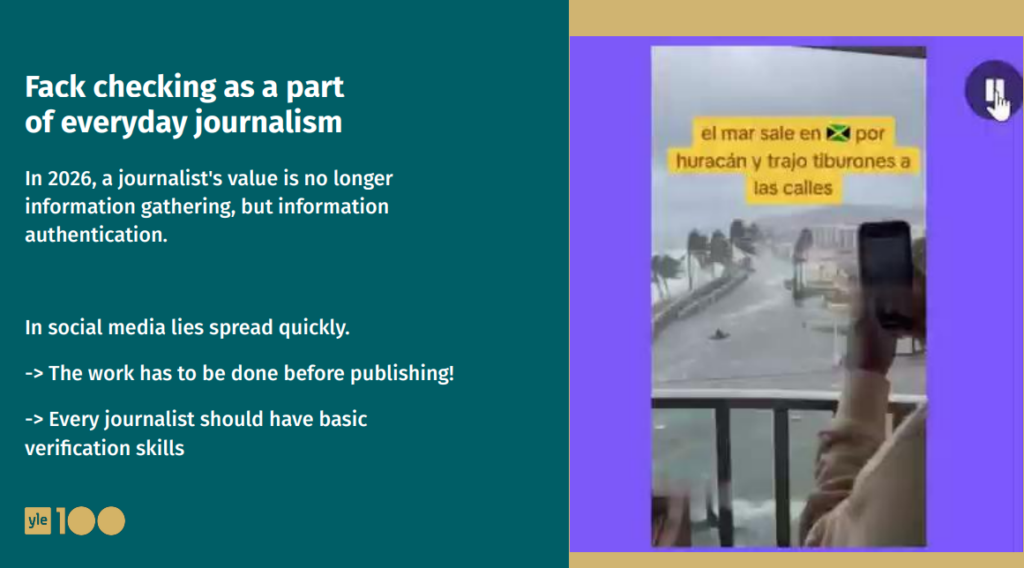
Thus fact-checking is no longer just responsibility of specialized teams. Every journalist must possess basic fact-checking skills, because the value of modern journalism lies not only — and not so much — in gathering information, but in verifying its authenticity. False information spreads instantly on social media, so it must be verified before it is published.
Examples of Disinformation and Engaging with the Audience
Jenny quoted a number of examples. During Storm Melissa in 2023, the YLE editorial team uncovered several typical examples of fake news: old videos passed off as new, footage from other disasters presented as current events, and AI-generated videos. All of those could create a false impression of the scale of the event.
Yulia Kotlyar, editor of the publication “Odessa Life,” recounted an incident in Odessa in which atmospheric photos of a blackout, created by AI, were widely shared on social media. People in Odessa could tell right away that it wasn’t true, because the architecture and camera angles didn’t match reality, but many users “didn’t care” — they shared the content anyway because they liked it. This indifference on the part of society makes journalists’ work more difficult. Knowledge of local landscapes and characteristics is becoming critically important for verification, as it is more difficult for foreign newsrooms to identify fake news without context.
Jenny also cited a case where Iranian media circulated doctored images that were meant to look like real photos of a ship. In fact, those images were altered using AI: the ship’s details were inaccurate, and shadows and reflections looked unnatural. The YLE editorial team created special visual sections to highlight these inconsistencies and explain to the audience why these photos are not real. This approach also helped teach viewers to critically evaluate visual content disseminated for propaganda purposes.
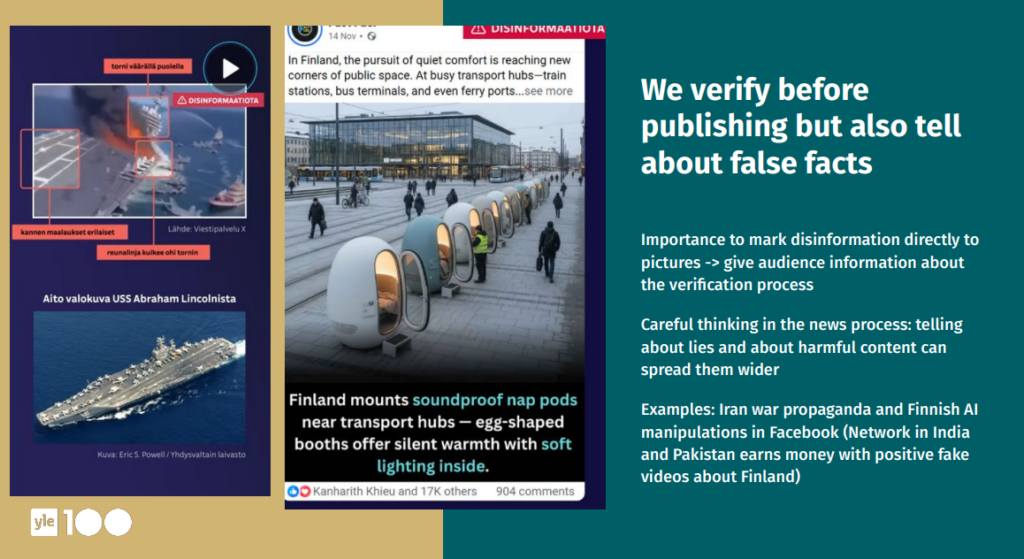
Another example is “positive” fake news about Finland. Social media users in India and Pakistan created beautiful photos and videos that were shared on Facebook. It was a business strategy: the platform rewarded content that was rapidly gaining popularity, even if it had nothing to do with reality.
YLE also monitors propaganda on social media: from campaigns that influence voting in the Eurovision Song Contest to manipulation in news coverage of conflicts. Special attention is paid to topics that could affect security — after all, a single misleading image in a military context can cause panic.
Social Media Algorithms and the Role of AI in Research
Social media platforms wield enormous power, yet their algorithms remain unaccessible. This example from TikTok illustrates a dangerous trend: at first, the 13-year-old girl saw neutral content, but the algorithms gradually began showing her increasingly depressing videos. We can see just how quickly a platform can change a user’s information environment.
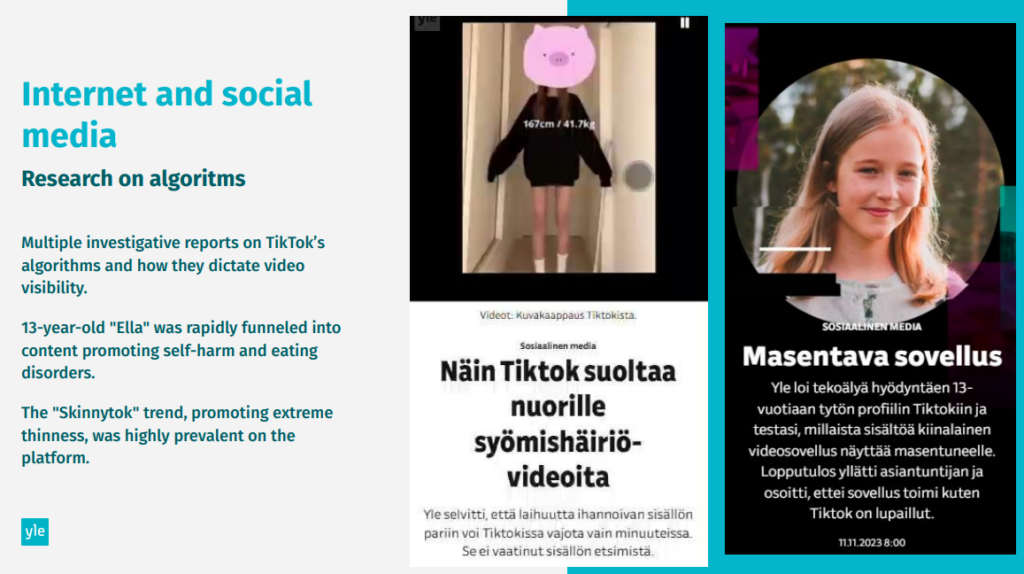
The “skinny talk” trend — which promotes extreme thinness — sparked serious debate in Nordic countries. Politicians are discussing the possibility of banning social media for children under 15, as the impact of such content on adolescents’ mental health can be devastating.
At the same time, AI can also be useful: fake profiles created by journalists on Tinder showed that the platform creates different information “worlds” for men and women. This made it possible to study the algorithms that are usually not available for analysis.
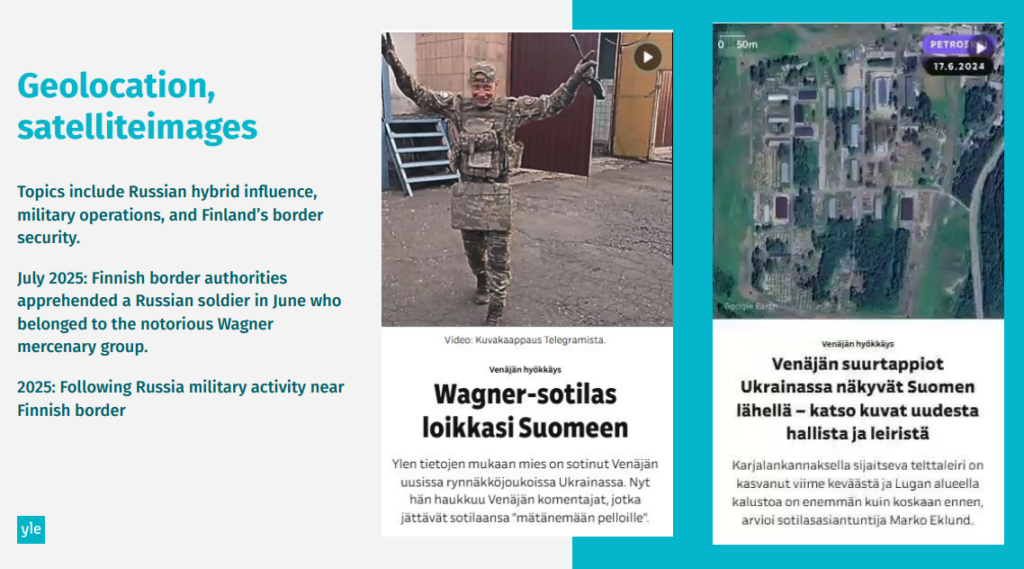
Or here’s another example using satellite images: how the editorial staff is monitoring Russia’s military activity near the Finnish border. Specifically, in 2025, a Wagner Group member was observed crossing into Finland through the forest. Such studies combine geolocation, open-source information, and satellite data to verify the facts.
Operating Standards and Tools
YLE has clear guidelines: every news story goes through specific verification steps, even if those steps aren’t mentioned in the story. If the editorial staff is not 100 percent certain, it openly informs the audience of this.
Editors and producers are accountable for the publication. If sources require special attention, the decision is made by the editor-in-chief.
The YLE team uses a variety of tools in their work. Here they are:
- reverse image search, which allows one to find original sources of photos;
- satellite images from Planet and Google Earth, which help verify geolocation;
- “What’s My Name?” service to search for people in public databases;
- Big Data for analyzing large amounts of information;
- OSINT tools that enable collection of data from open sources.
However, Jenny emphasized that no single tool is a one-size-fits-all solution: different methods work better in different situations, so it’s important to have a wide range of tools at your disposal and to constantly adapt to changes.
***
Fact-checking in today’s world is an ongoing process of verifying, labeling, and explaining. It is a balance between providing information and the risk of spreading false news, between the right to know and the need to maintain security. And although technology is changing at an incredibly fast pace, the mission of journalists remains the same: to provide the public with reliable information.
Next, we’ll discuss Ukraine’s experience with fact-checking — stay tuned for updates.
This material was prepared based on a workshop held as part of the “Media Bridges: Finland—Ukraine” Program implemented by the Association of Independent Regional Publishers of Ukraine in partnership with News Media Finland, and funded by the Finnish Ministry of Foreign Affairs