


What does it mean to be a trusted voice of war? To travel to dangerous areas in order to show the truth of what is happening, often at the risk of one’s own life?
This is the story of a journalist for whom documenting firsthand testimonies matters deeply — working in places where danger has become part of everyday reality, and where bearing witness is both a responsibility and a risk.
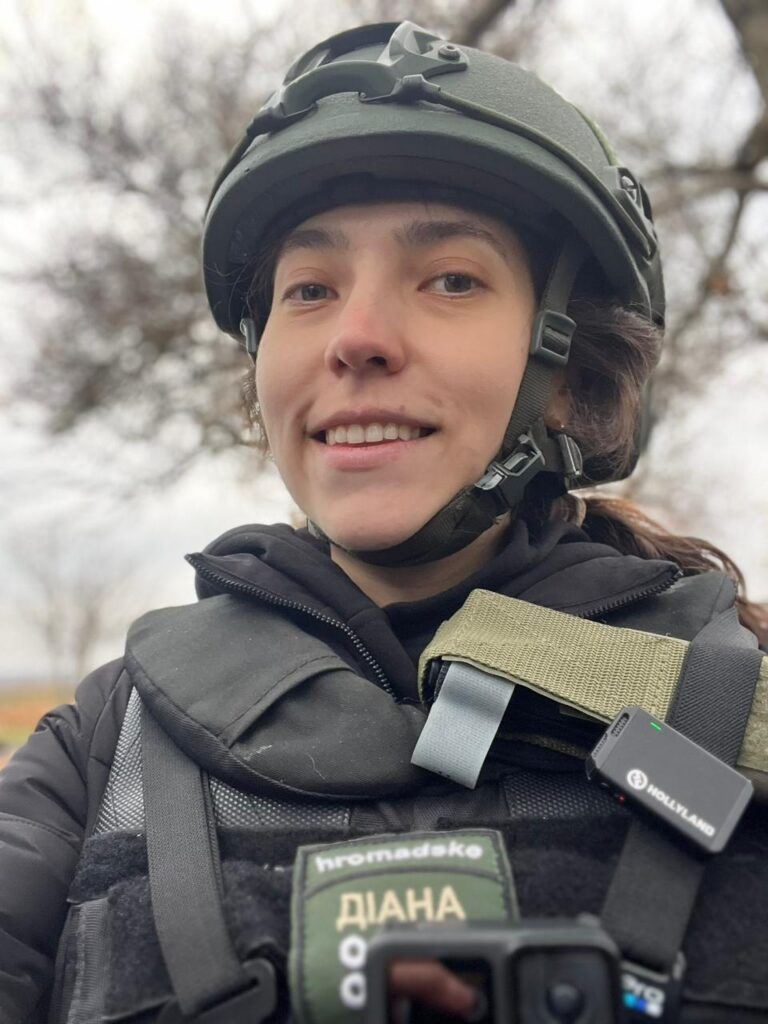
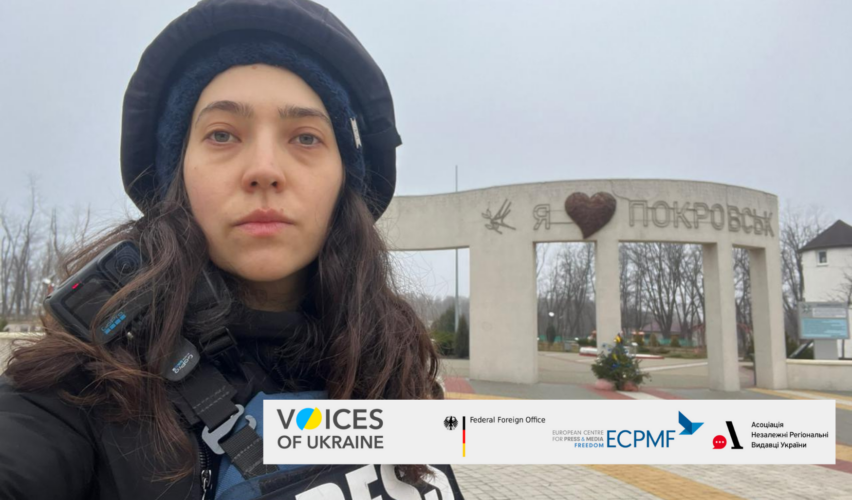
Meet the protagonist of this story— Diana Butsko, a journalist from hromadske.
She is also included in the list of journalists most trusted by Ukrainians, according to research by the Institute of Mass Information.
Diana works as part of a team with 22-year-old cameraman Vladyslav Safronov, whom we recently featured in a separate story. Both are covered by the Journalists’ Insurance Programme of the International Insurance Fund for Journalists, an initiative implemented by the Association of Independent Regional Press Publishers of Ukraine in cooperation with partners.
The First Draft of History
Diana has been working in journalism since 2017. Over the years, she has tried various formats — from news reporting and radio to long-form text journalism and video. It was at hromadske, she says, that she found the space to work with living, firsthand testimonies of history.
— «They say journalism is the first draft of history, and we write it as it is felt and lived by the participants of these historic events — when emotions and thoughts are at their most raw and vivid. We go to meet defenders who are protecting Ukraine on the front lines, to local residents who have just survived occupation, to partisans who do not let the Russians sleep peacefully», she explains when describing her work.
In addition to her journalistic education, Diana holds a Master’s degree in Political Science from Southern Illinois University. This academic background has likely shaped her distinctive approach to covering politics and war — analytical, structured, and grounded in an understanding of deeper processes.
Ultimately, we encourage readers to watch Diana Butsko’s reports and experience the depth and sensitivity of the stories she creates.
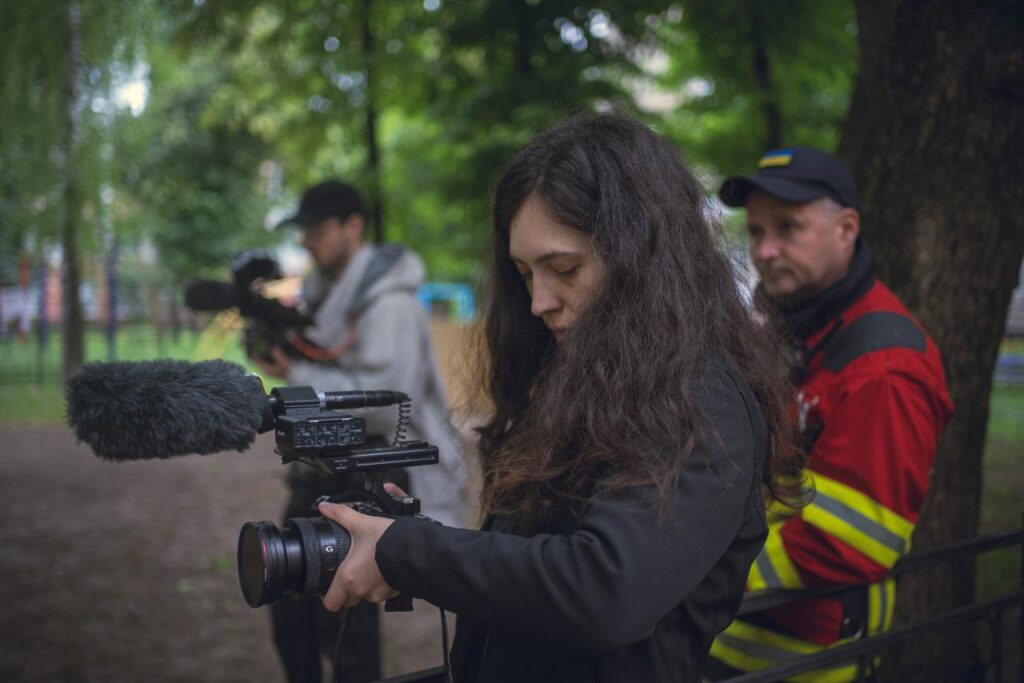
Diana joined the coverage of the full-scale war in the summer of 2022, when she began working with hromadske. The primary focus of her reporting has been frontline regions — first and foremost Donetsk region, as well as Kherson, Kupiansk, Dobropillia, and other locations.
«We work with the military, show the situation along different fronts, and report on the humanitarian conditions in frontline towns — places where it has become extremely dangerous», she says.
Working in a Constant Risk Environment
Not only has the geography of journalists’ assignments changed, but so has the nature of the risks. Whereas earlier the primary threat came from artillery, today, according to Diana, drones pose the greatest danger.
«They have significantly complicated our work. We now rarely go to infantry positions. More often, we work from headquarters, show the battlefield from a distance, but reach the front line itself far less frequently. Drones have made it extremely difficult to get close to the front. As a result, the Ukrainian infantry soldier is gradually disappearing from the media landscape. And yet it is precisely the infantry who bear the greatest responsibility and risk. We hardly see them anymore — and that is my personal pain», Diana emphasizes.
Work in frontline areas has changed fundamentally. Soldiers, civilians, and journalists alike are constantly forced to adapt to new challenges.
«Take Kherson, for example — it is a space of constant threat. We live in times when traffic lights are becoming anti-drone tools. Highways and key roads are covered with protective netting, access points are controlled, and the military responds swiftly to emerging dangers. This has helped prevent the mass destruction of civilian vehicles on the Mykolaiv–Kherson highway», the journalist continues.
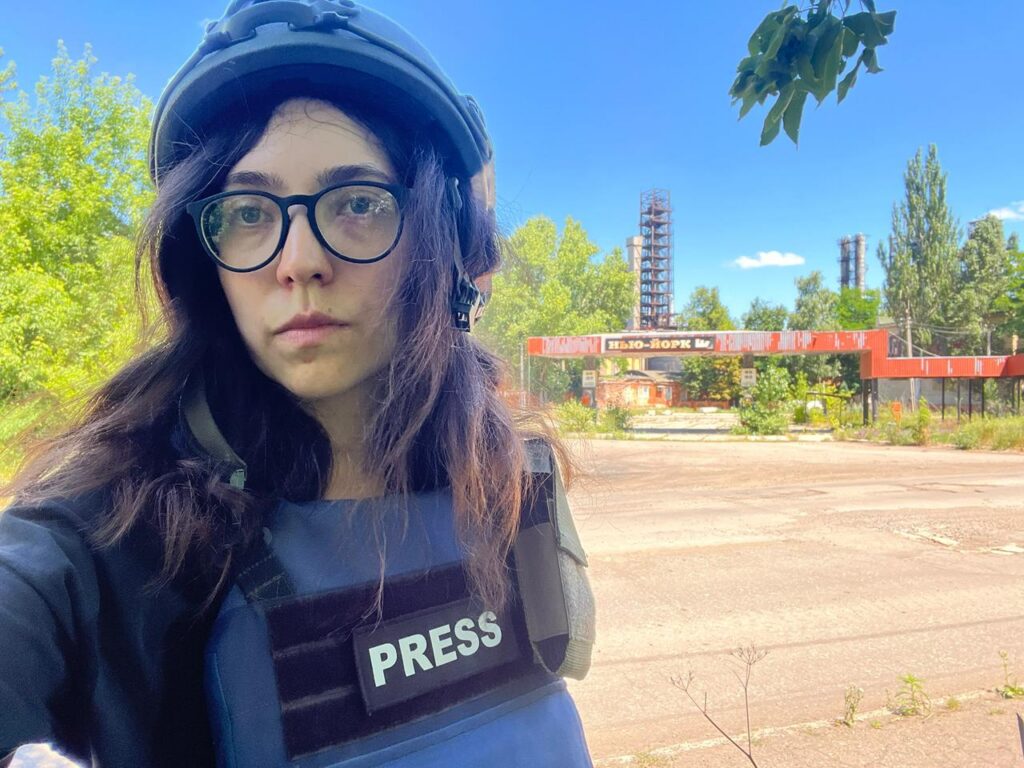
Together with cameraman Vladyslav Safronov, Diana travels to the front line. They move through dangerous areas side by side and return together — with video footage, people’s stories, and lived experience that is deeply understood by those who live close to the line of contact.
East, South, North — they have worked everywhere. However, over the past six months, field trips have increasingly had to be shortened due to hostile “safaris” targeting not only civilians but journalists as well.
«It is difficult to say where it is most dangerous to work. We were probably among the last journalists who managed to enter Kupiansk — even if only its outskirts. While leaving the city, we narrowly avoided a drone that was lying in wait on the road under camouflage nets. There is a fight for every building, for every basement», the journalist says.
Bearing Witness So That Stories Do Not Disappear
During their work, Diana and her colleague Vladyslav — like other members of the team — are covered by insurance provided by the International Journalists’ Insurance Fund. This support is critically important, the journalist emphasizes.
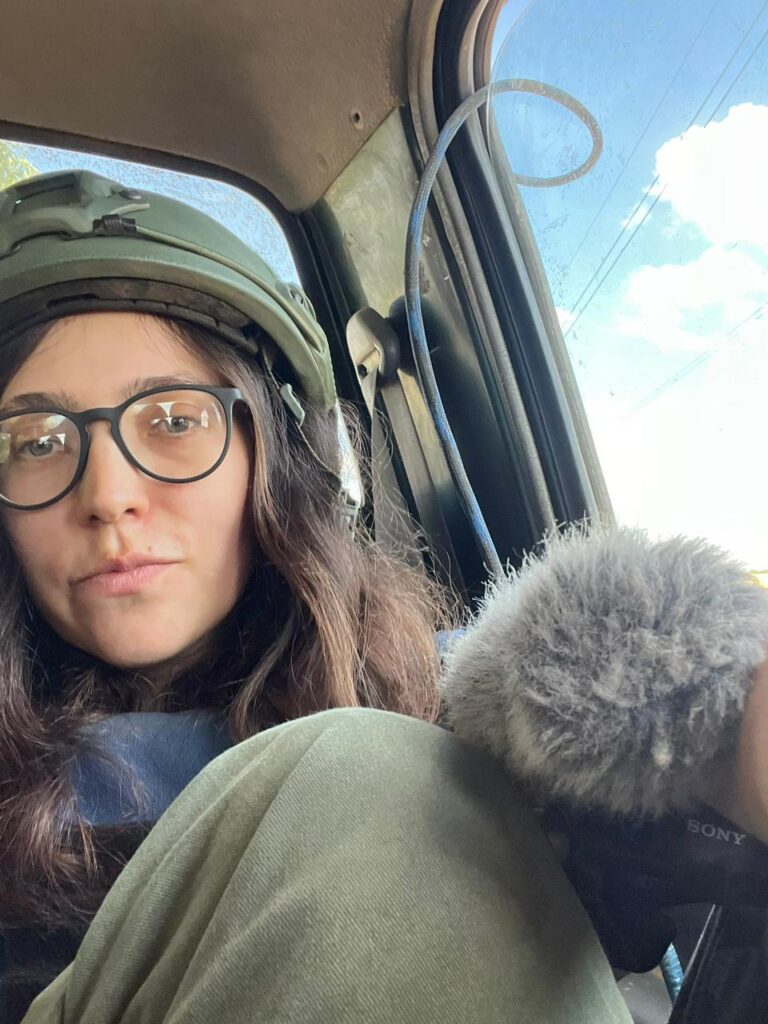
«Insurance for a journalist is like body armor or a tourniquet — things without which I would never advise going to dangerous areas. Every field trip is dangerous. Anywhere you travel within less than twenty kilometers, you will almost certainly encounter a drone — and that is terrifying. In those moments, your heart tightens, adrenaline kicks in. And despite everything, you have to focus in order to keep working. It is precisely this sense of protection that makes it easier, psychologically, to switch into work mode», Diana says.
Unfortunately, the issue of the so-called “grey zone” remains complex — and it is expanding. This territory is not limited to areas of active fighting. Drone terror is spreading to cities where the front line may remain unchanged for years, yet war reaches civilians every single day. Working in such conditions is extremely difficult. Everywhere the Russians can reach, they turn the land into scorched earth.
This is why, for Diana, journalism is not only a profession but also a personal responsibility — to document a reality that can so easily disappear from view.
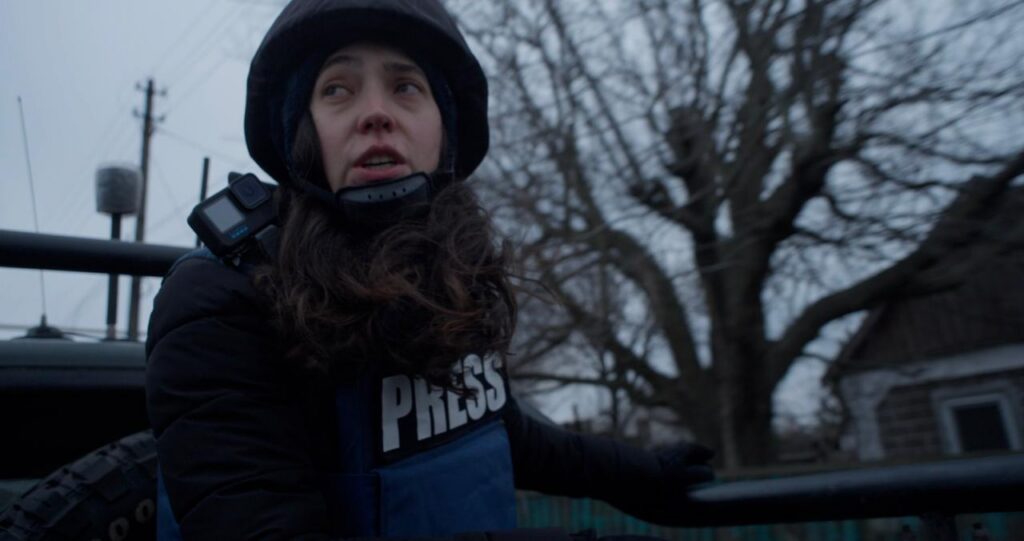
She is grateful to her hromadske team for the fact that, together, they continue to be the voice of those who are shaping history.
Despite exhaustion, fear, and constant danger, Diana Butsko and her colleague Vladyslav Safronov keep working, fully aware of the value of every captured frame. Their photographs and videos become evidence, history, and memory. Reliable protection and support are essential conditions that make it possible for journalists to continue their work.
***
The project is implemented by the Association of Independent Regional Press Publishers of Ukraine (AIRPPU) together with partners. The initiative is part of the Voices of Ukraine program, coordinated by the European Centre for Press and Media Freedom (ECPMF). Voices of Ukraine is carried out within the framework of the Hannah-Arendt-Initiative and funded by the German Federal Foreign Office.