


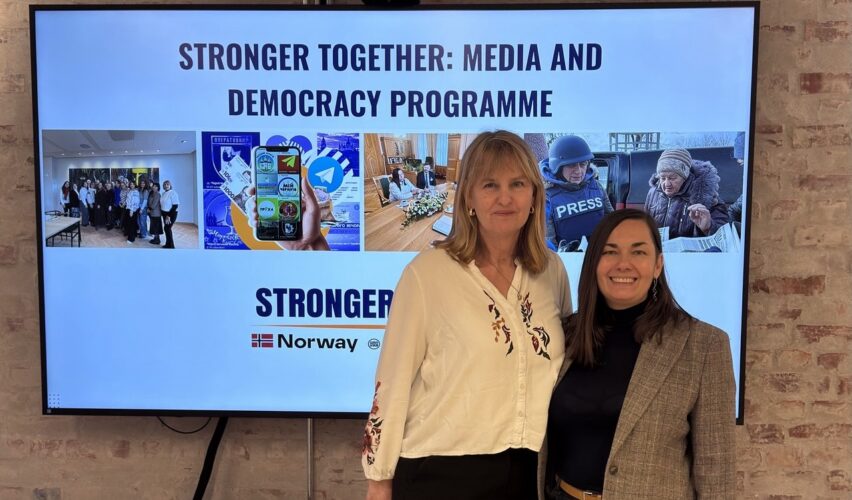
Oksana Brovko, CEO of the Association of Independent Regional Press Publishers of Ukraine, delivered this speech in Oslo during the launch of the Norwegian Partnership Programme — a joint initiative of Ukrainian and Norwegian media within the Stronger Together program. It highlights the conditions in which Ukrainian regional media operate today and explains why supporting them is not only about Ukraine but also about the resilience of democracy as a whole.
When people talk about war, they usually talk about missiles, drones and frontlines.
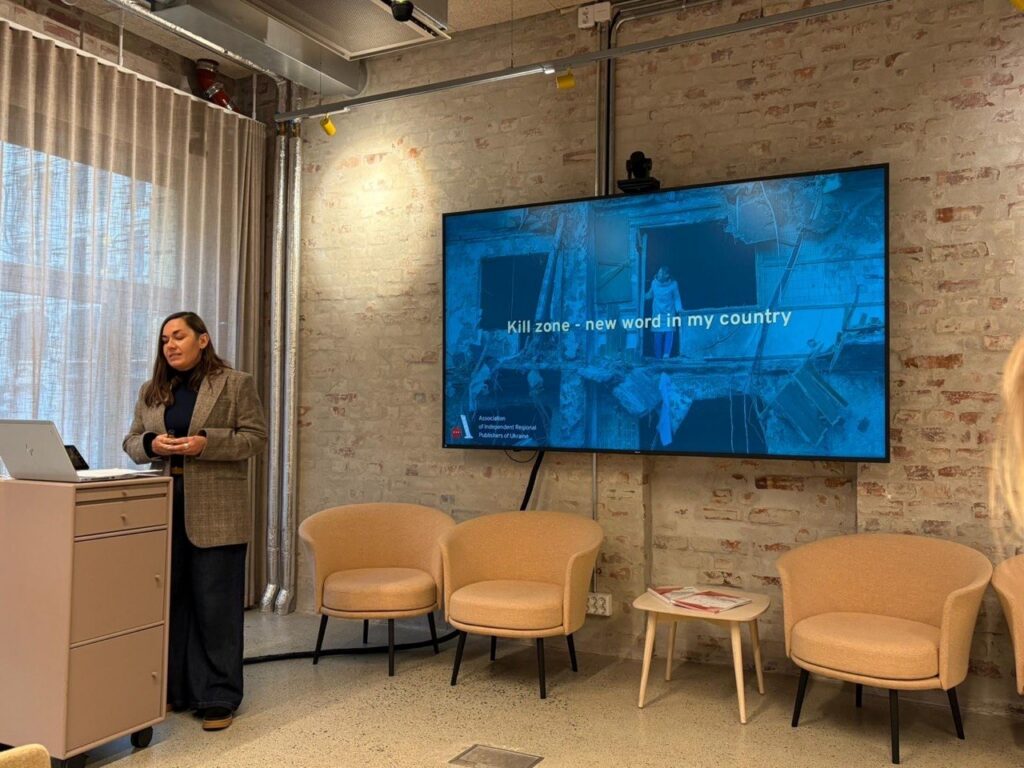
In Ukraine today, there is a new phrase that people use more and more.
Kill zone.
This phrase describes areas constantly under threat from drones, artillery or missile strikes.
And unfortunately, this is the environment where many journalists work now.
Kherson, Sumy, Zaporizhzhya, Dnipro, Kharkiv — grey zones displaced by kill zones.
Sometimes the first item in a journalist’s equipment list is not a notebook and even not a bulletproof vest. Very often, the anti-drone devices.
In most Ukrainian newsrooms today, electricity and the internet are not guaranteed. Generators and charging stations have become more important than printing presses.
It is no longer surprising to see job announcements for editors because the previous one has gone to the frontline.
And more and more often, the editor leaving for the army is a woman.
Women today hold many leadership roles in Ukrainian regional media.
And increasingly, they leave journalism to defend the country not with words, but with weapons.
This is the environment in which local journalism in Ukraine operates today.
125 journalists have been killed. 15 of them — during reporting.
337 media outlets have closed.
But the pressure on media is not only physical.
In occupied territories, the control of information is systematic and highly organized.
More than 40 TV channels and more than 80 radio stations operate under the occupation authorities.
Broadcasting covers almost the entire territory.
And the occupation authorities control around 80 percent of the outdoor advertising market.
Media in these territories are coordinated through centralized propaganda structures that define editorial policy and distribute narratives designed to justify the war against Ukraine.
This shows something important.
Information control is not accidental. It is infrastructure.
When independent media disappear, propaganda becomes the only information system.
This is part of a much larger information war.
Russia invests enormous resources in propaganda and disinformation.
For example, Russia spends more than one billion euros annually on propaganda infrastructure.
By comparison, core European monitoring programmes for countering disinformation operate with budgets of around 10 to 12 million euros per year.
This difference shows how strategically important information warfare has become.
But today I would like to focus not only on propaganda.
I want to focus on the reality of regional media that continue to work in free Ukrainian territories.
Today, regional media operate under five levels of pressure.
First — physical pressure.
Newsrooms are destroyed or damaged.
Journalists are mobilized to the armed forces.
Air raid alerts interrupt work multiple times every day.
Second — financial pressure.
Local advertising markets have collapsed.
Many local businesses — which previously were advertisers for the regional media — have disappeared or relocated.
As a result, many newsrooms now depend heavily on international support simply to survive.
Third — psychological pressure.
Journalists report on destruction, trauma and loss in their communities.
At the same time, they experience these losses themselves — among colleagues, friends and family.
Burnout is becoming a serious challenge across the media sector.
Fourth — editorial pressure and influence.
Some journalists report attempts by local authorities or political actors, local businesses to influence on editorial content and decisions.
And finally, the fifth layer of pressure is what we call stable instability.
Regional media operate in an environment where long-term planning is nearly impossible.
Editorial priorities change constantly.
Crises emerge suddenly.
Newsrooms must adapt very quickly.
At the same time, the role of regional media has expanded.
We are no longer only information providers.
We are watchdogs of reconstruction.
We monitor public spending.
We investigate corruption risks at the local level.
In many communities, regional media are now among the most important democratic institutions still functioning.
So the question is simple.
What does the media sector need now?
The answer is structural resilience.
First, regional media need predictable long-term support.
Short and uncertain funding cycles make strategic planning almost impossible.
Second, we need investment in newsroom capacity.
Quality content, investigative teams, safety training, emergency budgets, and revenue models are just as important for us as for other media in a peaceful world.
Third, local and regional newsrooms need resources for watchdog journalism.
Local journalists will play a crucial role in monitoring reconstruction, public spending and corruption risks in thousands of communities.
And finally, strong international partnerships are vital.
Professional cooperation between Ukrainian and International media strengthens standards, skills and institutional resilience for both sides.
This is why supporting regional media in Ukraine is not only about helping Ukraine.
It is about protecting democratic stability.
Because where independent journalism survives, democratic institutions have a chance to survive as well.
What are we at the Association doing for survival?
To protect our media teams, reporting from the frontline, we organized and run insurance programme and regular safety trainings.
Self-regulation in media is crucial for press freedom, especially during wartime. That is why we are developing it together with our partners from the Finnish Media Association.
Emergency challengers unfortunately are still in our everyday life. But we happy to have such a partner as Amedia foundation, which helps our local and regional newsrooms to continue their work in emergencies.
As well as the Ukrainian Media Fund, organized by the Nordic partners, and managing by the MBL, almost fifth year provide regular support for Ukrainian regional journalists and newsrooms and react very fast on the most urgent needs of the local media.
In a meantime, we are not only in “survival mode”, we also developing and supporting the business ideas of the media outlets. Innovative Media Ukraine is one of such our projects, supporting by MDIF.
Over the past year we have worked together with many partners to strengthen regional media. The main project we build and have now is the Stronger Together Programme, implementing with WAN-IFRA as a lead partner and MBL as norwegian partner.
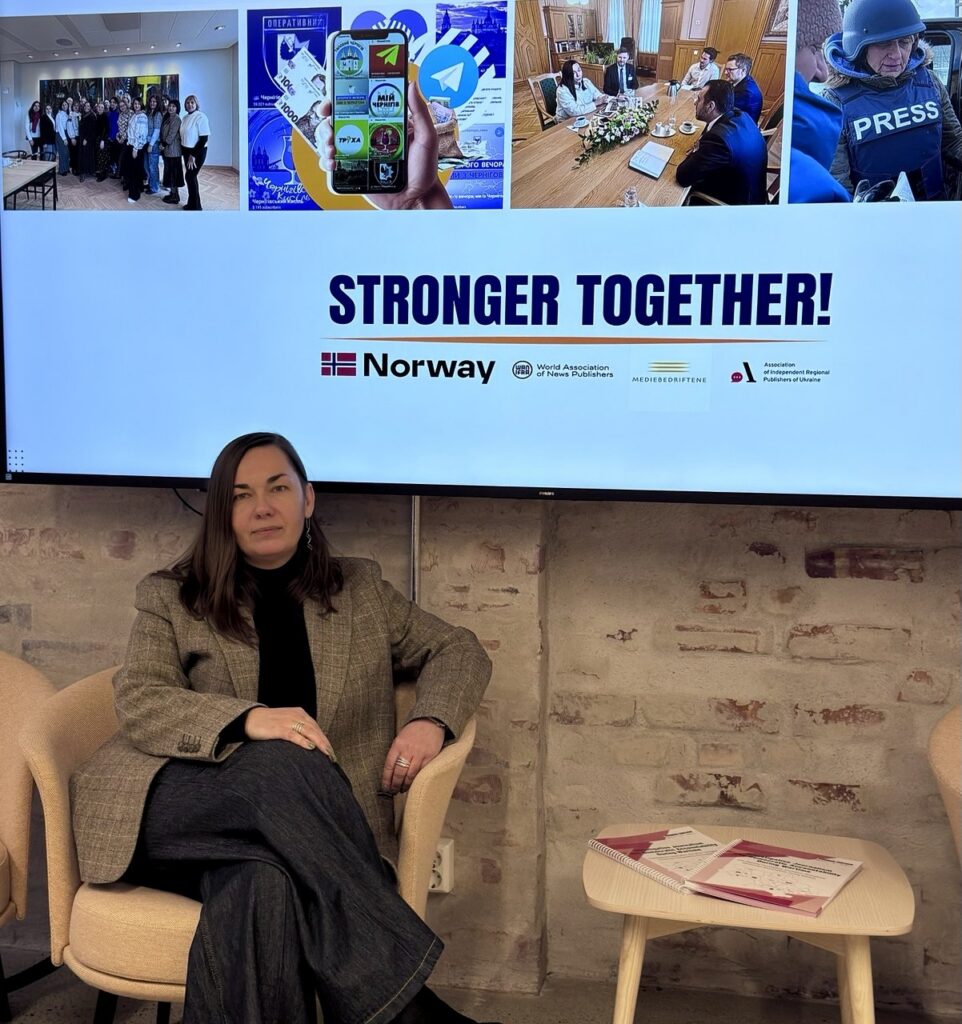
In its first year:
40 regional and local media supported.
187 journalists, editors and media managers were directly involved in our programme events.
Up to 1000 participations in workshops, study tours and training programmes took place.
The programme included professional workshops, bootcamps and individual mentoring support.
We focused on 3 main streams: the first one is strengthening the sustainability of local media.
22 local media outlets received support for organizational and financial development.
Despite wartime conditions, 800K copies of local newspapers were produced.
The social media reach of participating outlets increased by around 90%.
Another key component of the programme was investigative journalism.
18 regional media outlets participated in investigative reporting stream.
Together, they produced more than 100+ anti-corruption investigations.
These investigations have already contributed to more than a dozen criminal proceedings.
These investigations were not produced in national capitals.
They were produced in small towns and communities across Ukraine.
For example:
Journalists from the Crimean Centre for Investigative Journalism uncovered evidence of the illegal deportation of patients from a psychiatric institution to Russia.
Another investigation revealed a scheme involving companies linked to russian security services operating in European markets.
This investigation expanded into a cross-border collaboration with journalists from Lithuania and Latvia.
The newspaper Molodyi Bukovynets investigated corruption in the construction of public shelters in Chernivtsi.
After publication, authorities launched inspections and opened a criminal case.
Journalists from Vgoru exposed collaboration networks in the cultural sector in the occupied Kherson region.
Their investigation also led to criminal proceedings.
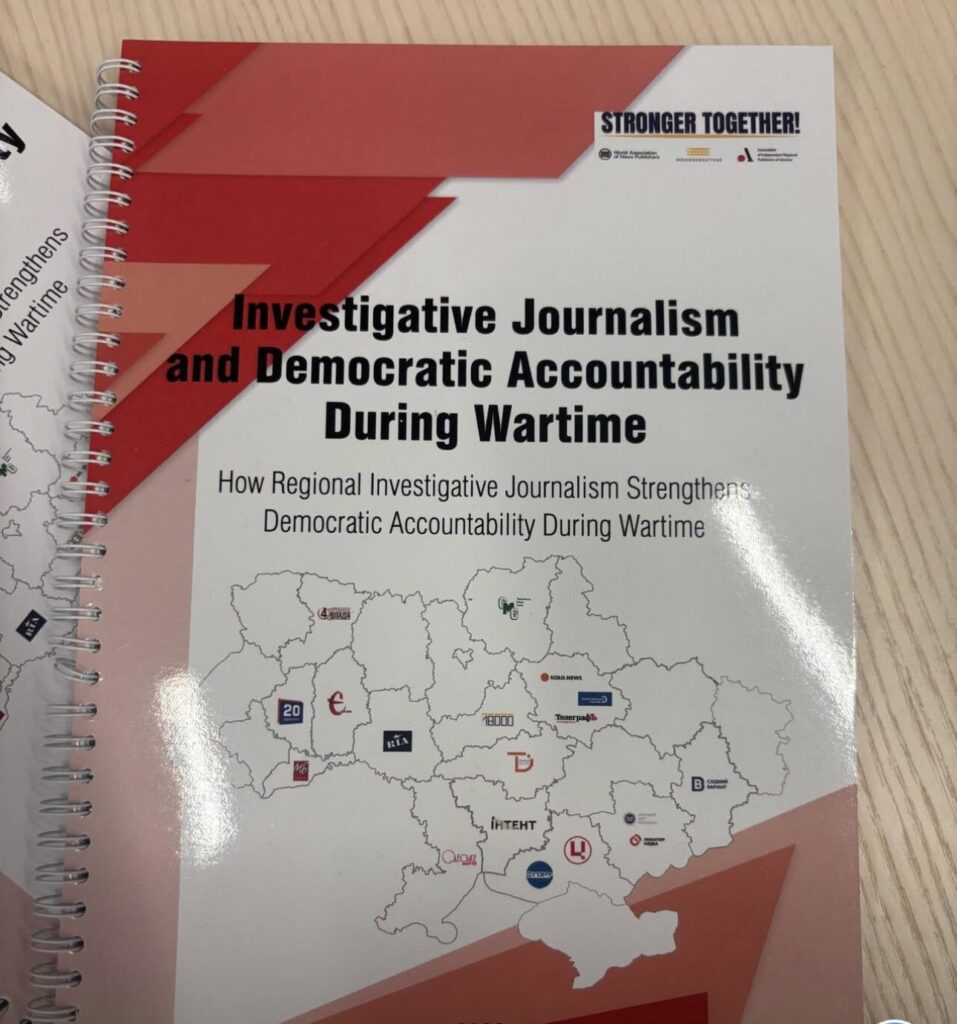
These examples show that regional investigative journalism produces real impact. And I am happy to introduce you a coffee book with the best investigations which were prepared by the programme’s participants during the last year.
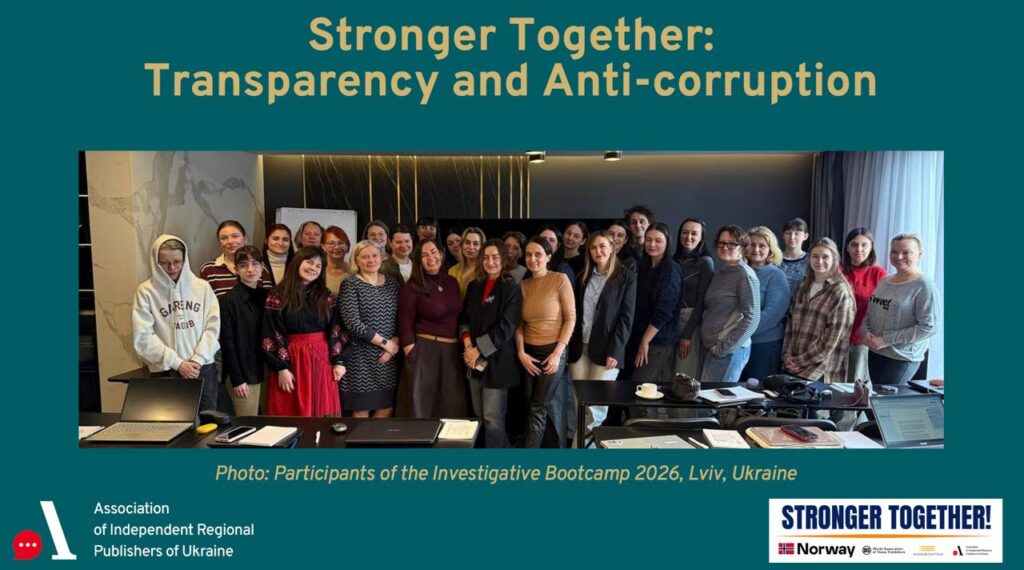
This is the faces of the 18 investigative teams, who developing, sometimes from the 0 level, the investigations in Ukrainian regions.
You see – how many female investigators are on this picture? This is our Y2 team of journalists, who are working on the developing investigative journalists in their small regions.
Very logycal is the next component of the programme which focuses on leadership and professional networks for female key-managers, where we have 16 women from local media.
The partnerships are extremely important. That is why today we officialy started the Norwegian Partnership Programme — one more Stronger Together programme for 4 ukrainian and Norwegian local media.
Because in times of crisis, isolation is one of the greatest risks for independent journalism.
Partnerships break that isolation.
They create networks of trust, shared knowledge and long-term cooperation. I would like to thank our Norwegian partners who are ready to walk this journey with us.
This is Andrij Dubchak, editor of the media Frontliner. This media is a partner in our institutional support programme. That is an anti-drone network. It protects cars at the frontline and nearest roads from the drones. Under this network, our editors deliver their newspapers to the local readers. This is the sole way to deliver the truth if you don’t have internet.
These nets protect us physically.
But there is another network — the network of partnerships.
One protects people.
The other protects journalism.
And both are necessary for the truth to survive.
And when both exist, the truth continues to reach society.
Voices cannot be occupied.
Thank you.