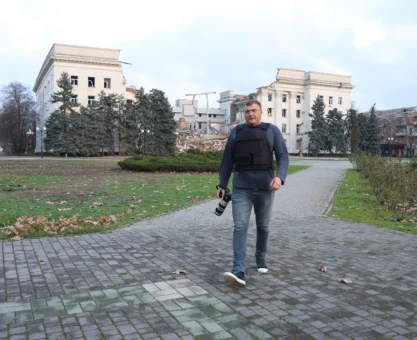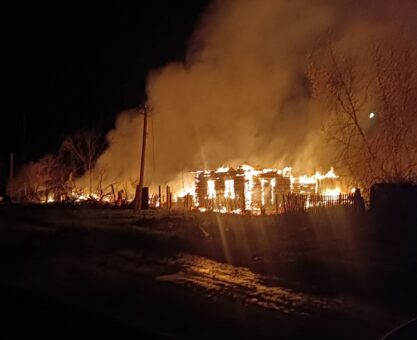



Imagine this: you are filming the aftermath of an enemy strike. Or you are on assignment in a frontline area. You are recording video, documenting the consequences. Injured people are nearby. And you have only seconds to decide — to panic or to act.
In moments like these, what saves lives is a well-practised algorithm and first aid skills honed to the point of automatic response.
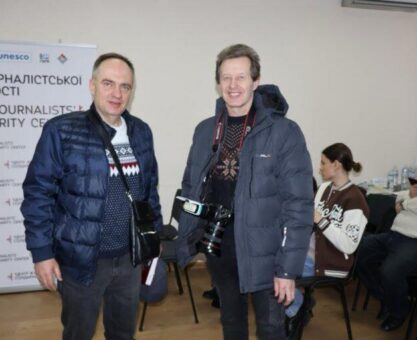
Please agree: it is crucial for media professionals to undergo safety training on a regular basis, as their daily work involves heightened risk. That is why, on 3–4 November, the Association of Independent Regional Press Publishers of Ukraineheld its tenth safety training for journalists as part of the implementation of the International Insurance Fund for Journalists, with the support of European Centre for Press and Media Freedom (ECPMF) and Stichting Hulpacties DVHN, FrD en LC.
Physical and psychological resilience
«For us, safety trainings are not just education — they are an investment in the lives and health of media professionals», stresses Oksana Brovko, CEO of the Association. — «During practical sessions, journalists practise skills that can save lives in critical moments — their own, those of colleagues, or of people nearby. We care not only about physical safety, but also about psychological resilience, because constant stress, burnout, and trauma often develop into serious mental health issues.
A trained media professional is someone who does their job well while also knowing how to act in extreme situations and how to protect themselves and their team. Ultimately, our mission is to preserve the lives of those who risk them every day in the name of truth».
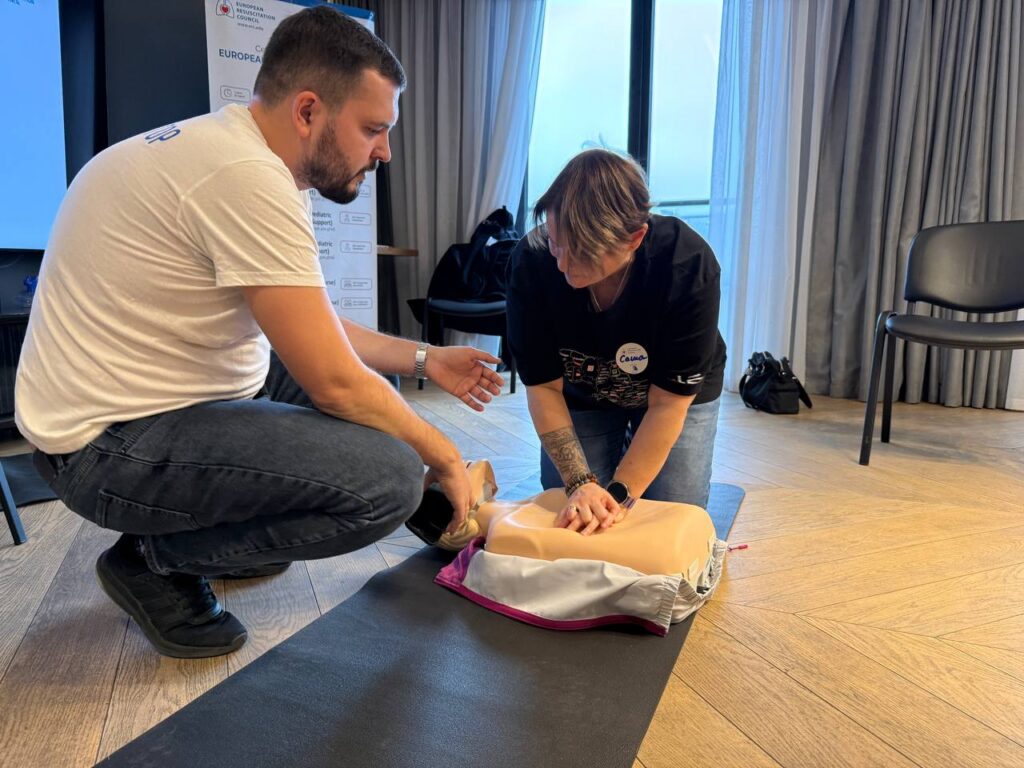
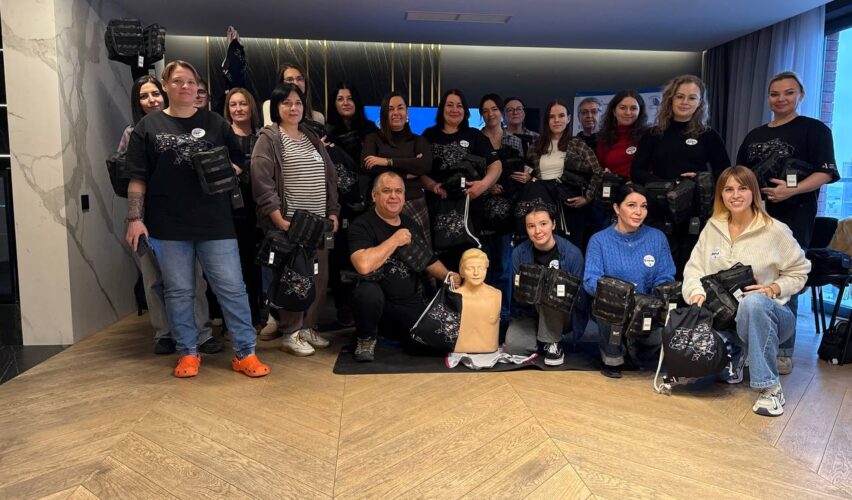
The tenth training became a logical continuation of the Association’s systematic work on safety. This time, 20 media professionals from different regions of the country took part in the programme. Given today’s realities, there is currently no truly safe place in Ukraine. Among the participants were journalists who regularly travel to sites of attacks, work in high-risk areas, document the consequences of shelling on a daily basis, and record war crimes.
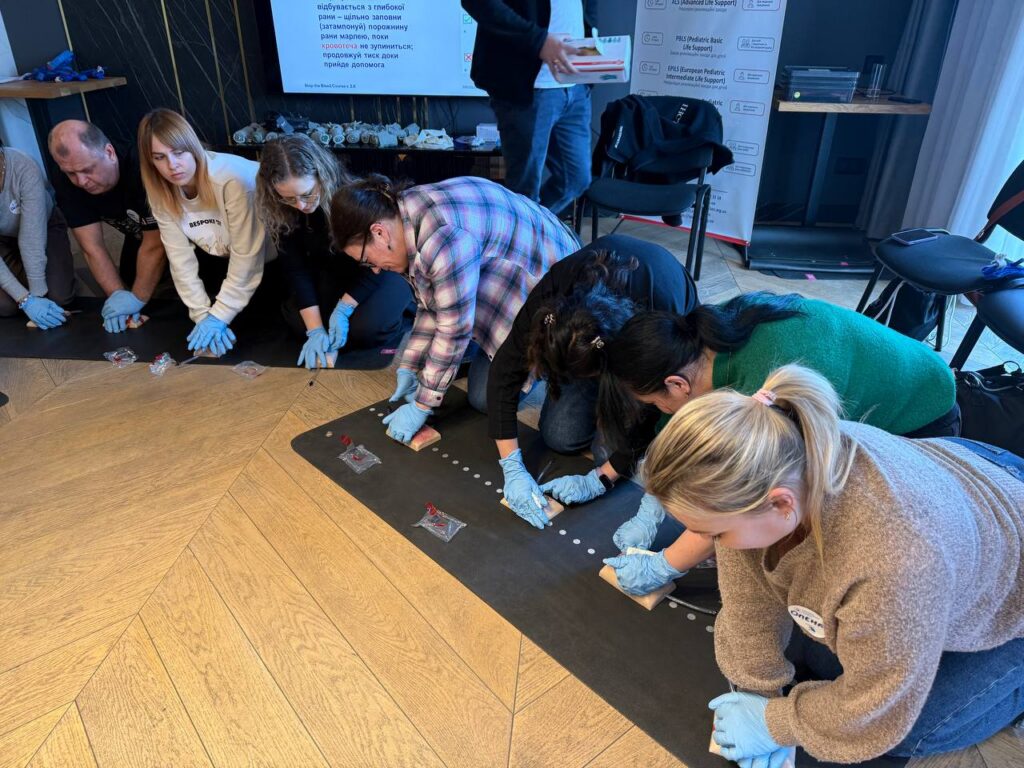
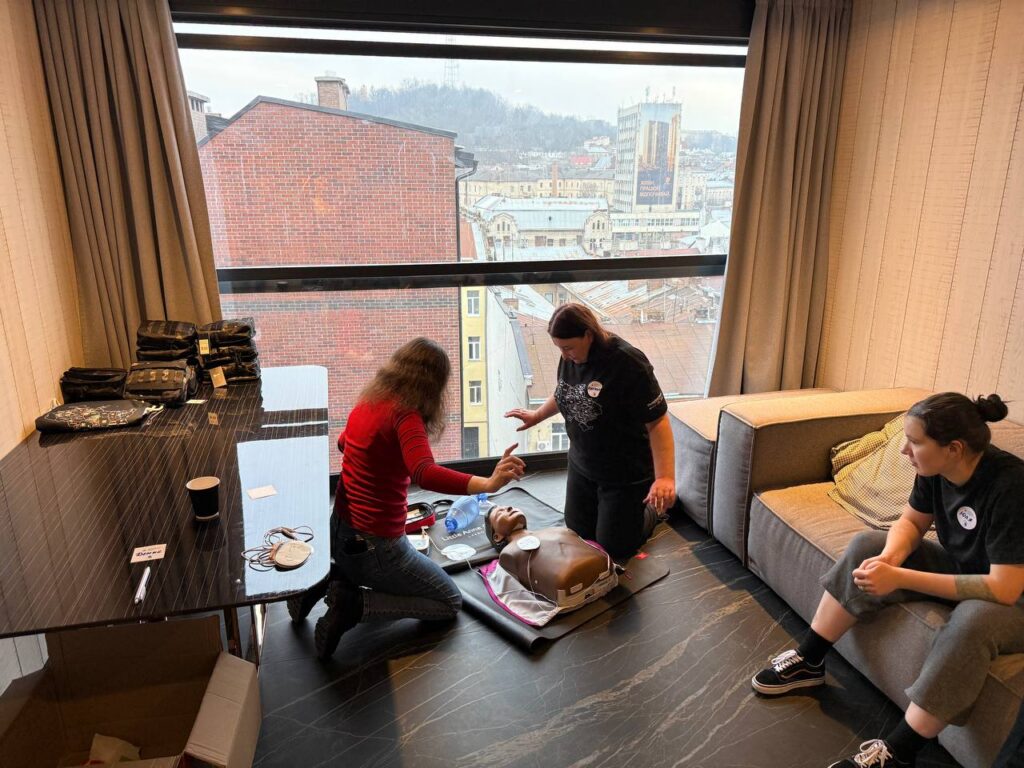
During the intensive programme, participants practised emergency response algorithms, first aid, control of massive bleeding, and stabilisation of casualties before medical professionals arrive.
How essential these skills are in practice is evident from the journalists’ own stories — at times, they are the first to provide assistance to people after shelling.
How media professionals save lives
— This is already my third safety training with the Association of Independent Regional Press Publishers of Ukraine, and I am very grateful for this opportunity. Velyka Pysarivka is located just five kilometres from the Russian border, and the region is shelled regularly. That is why life-saving skills are absolutely essential, says Oleksii Pasiuha, editor-in-chief of the border media Vorskla. — At the beginning of October, there was an incident where the knowledge I had gained proved crucial. We were delivering newspapers when a local woman stepped on a “petal” mine and sustained a severe injury. Unfortunately, in our area, medics do not come out, and neither do emergency services or the police. People are forced to save themselves.
Locals tried to help, but without success. We arrived at the scene at that very moment and managed to stop the bleeding by applying a tourniquet. I am really glad that I can once again “refresh” my knowledge and practise these skills — so that I know exactly how to act when it truly matters».
The importance of such trainings is also emphasised by Oleksandra Fedorenko, social media editor at the Chernihiv Media Group.
— This was not my first safety training organised by the Association. And I, too, have had a situation in my life where the knowledge I gained proved essential. It happened in 2023, when a Russian missile hit the local drama theatre, and my apartment building is nearby. Glass shattered everywhere, and my flat was damaged. I was trying to get down to the basement when I saw a neighbour covered in blood on the way.
I know for certain that if I had not taken safety training before, I would have panicked and frozen. Instead, I immediately started acting according to the protocol. The woman’s condition was of moderate severity. I called an ambulance and clearly described everything I was seeing. I stayed with her until the medics arrived. She survived and is doing well now. And I am very glad that I was able to help, — Oleksandra stresses.
Learn Every Six Months
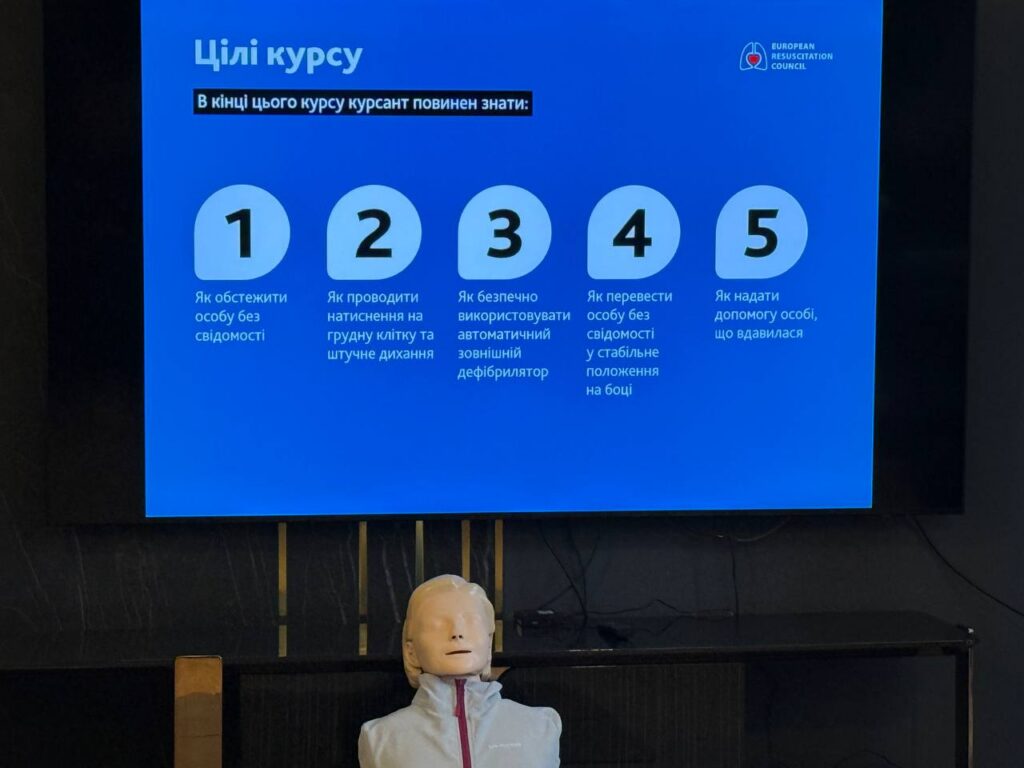
The training for media professionals was delivered by certified instructors from the All-Ukrainian Resuscitation Council, the national representative of the European Resuscitation Council (ERC) and the European Society for Emergency Medicine (EUSEM).
Instructor of the European Resuscitation Council and the All-Ukrainian Resuscitation Council, Oleksandr Bushtyn, emphasises that the basic principles of first aid are universal, but the focus for journalists is specific.
— In general, first aid is standardised and unified, regardless of profession, — he says. — However, media professionals face a higher risk of injury, especially during trips to frontline areas. That is why we place a strong emphasis specifically on bleeding control».
According to him, the course is designed in such a way that the maximum amount of time is devoted to hands-on practice.
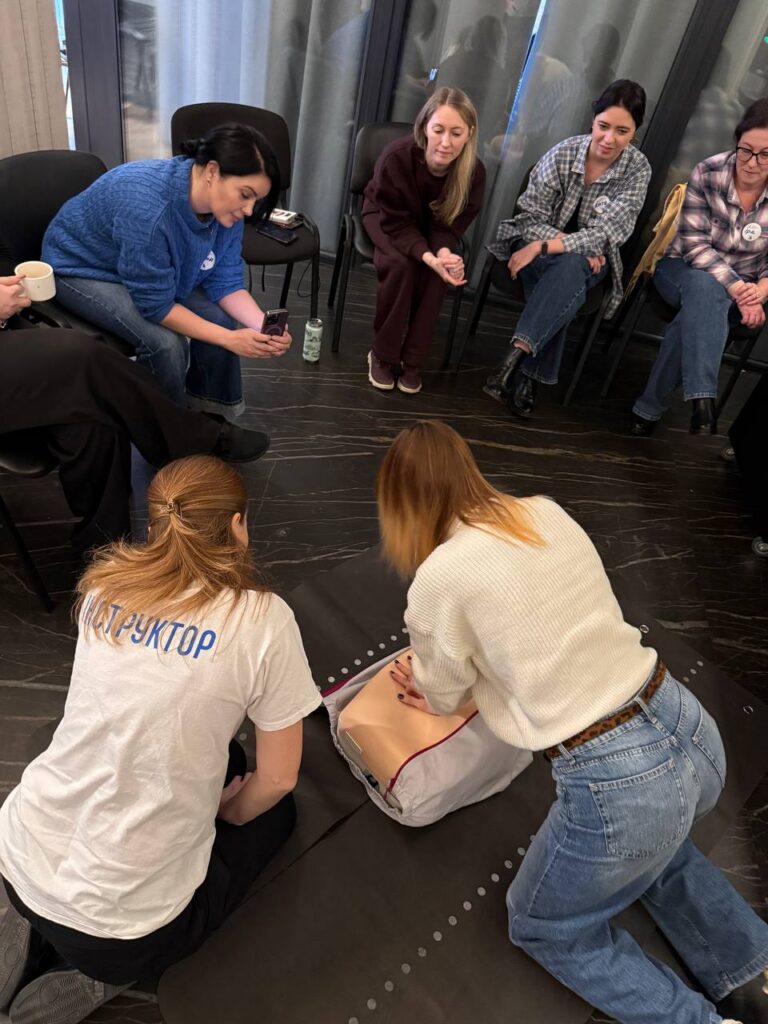
— When people try everything with their hands, it becomes much easier. The hardest part of first aid — especially if you have never done it before — is stepping forward and acting on a real person for the first time. People get anxious and freeze, — Oleksandr explains. — We aim to help participants refine these skills to the point of automatic response, so they work not with their heads, but with their hands. That is why it is crucial to undergo such safety trainings regularly — at least once or twice a year, or even more often. The certificate we issue after completing the training is valid for two years».
All the techniques practised during the training are based on the latest protocols of the European Resuscitation Council, the instructor says. These protocols are updated every five years.
«The previous update was in 2020, and this year new standards were introduced — and we are already training people according to them», he adds.
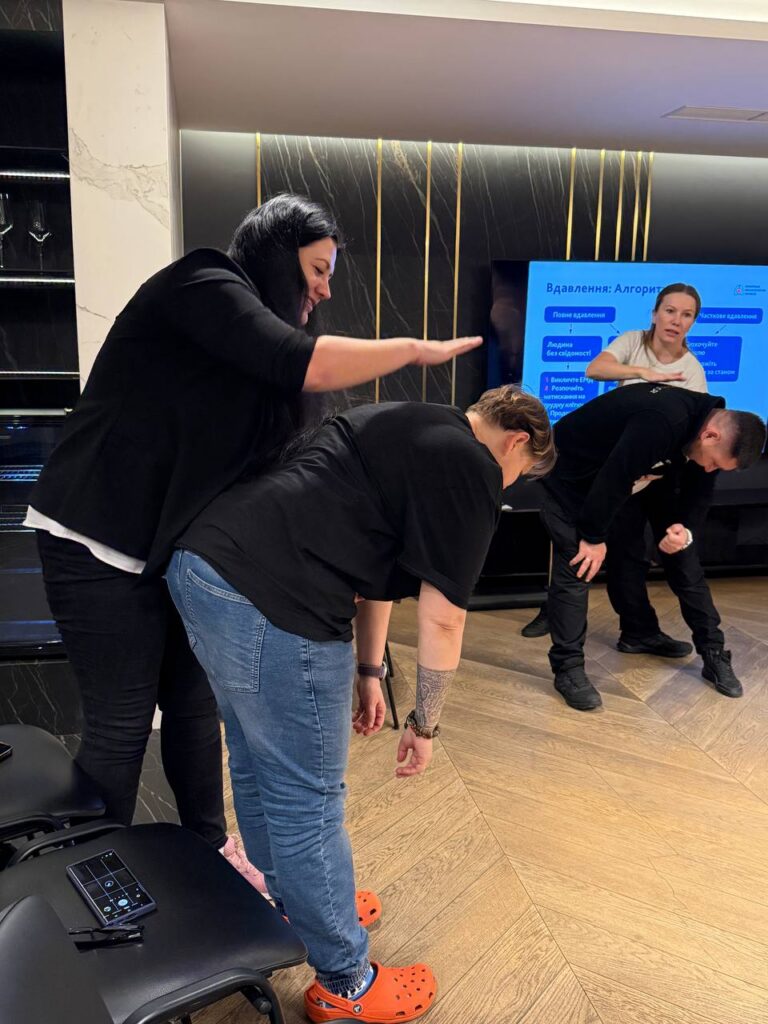
The instructors work not only with civilian journalists, but also with military personnel, and travel to de-occupied cities.
— We are involved in training the military at training centres, we work with mobilised service members, and we also operate in de-occupied cities — Kramatorsk, Izium, and Kherson. If there is a need and we are asked to come, we do, — the instructor adds.
A tourniquet always within reach
During the training, all participants received three professional, high-quality medical kits for their media outlet. Instructor Oleksandr Bushtyn stresses that a tourniquet is something a person should always have with them — especially media professionals.
— We insist that at the very least, a tourniquet should always be within reach. A tourniquet is a tool that allows you to quickly and effectively stop bleeding on yourself, — he emphasises.
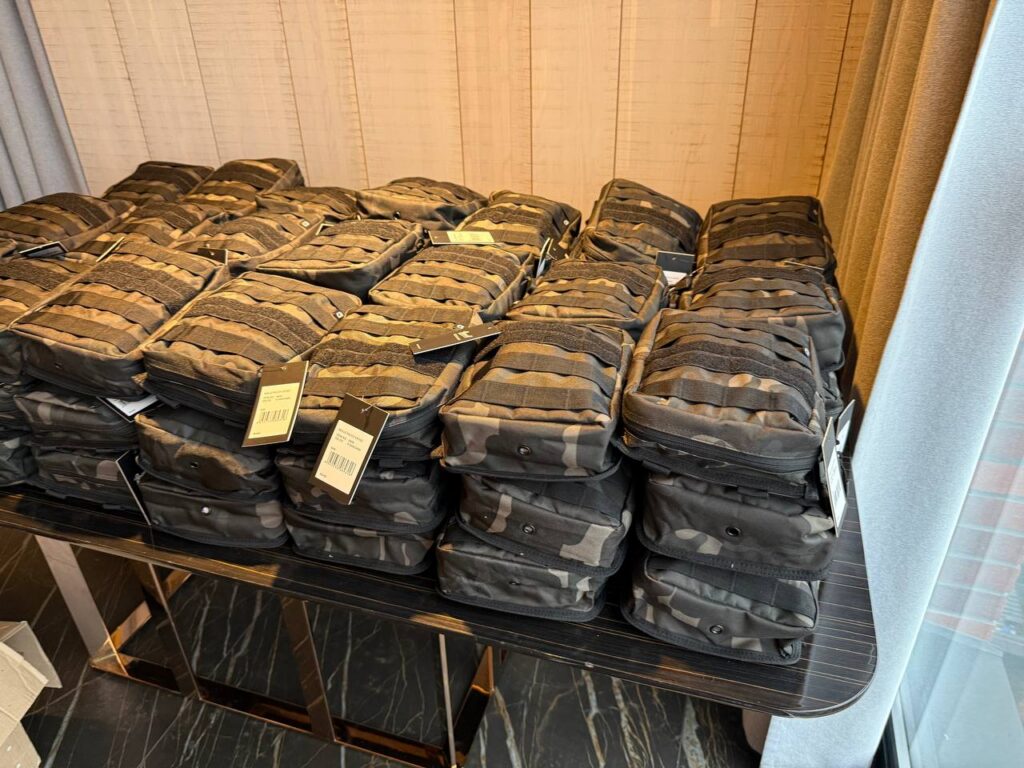
The first aid kits distributed to media professionals contain high-quality, certified tourniquets.
— We provide CAT-type tourniquets, which are recognised as among the best in the world. Each kit includes two tourniquets. These are reliable, high-quality tools for providing first aid, — Oleksandr explains.
However, it is not enough to simply have a first aid kit — it is essential to understand how to use every item inside it.
— We explain to our trainees what should be in a first aid kit, what its contents are, and how to use each element. In other words, everyone is properly trained, the instructor says.
The most important thing, he emphasises, is to understand that many deaths could be prevented if someone nearby knew basic response algorithms.
— There is such a concept as a “preventable death” — a death that could have been avoided. If no action is taken, if resuscitation is not performed and bleeding is not stopped, a person simply bleeds out and dies before medics or rescuers can arrive. These are skills that everyone should have in order to provide assistance before medical professionals arrive. Because the only thing worse than death is a death that could have been prevented, — Oleksandr stresses.

What you need to know
Overall, there are many first aid training courses available. However, it is particularly important that the Association, together with its partners, organises such training specifically for media professionals. Hands-on practice allows journalists not only to reinforce theoretical knowledge, but also to experience working under stress — which is crucial preparation for operating in high-risk environments.
So, what do you need to know in order to save a life? In reality, there can be countless scenarios, and the sequence of actions depends both on the security situation and on the specific incident and circumstances.
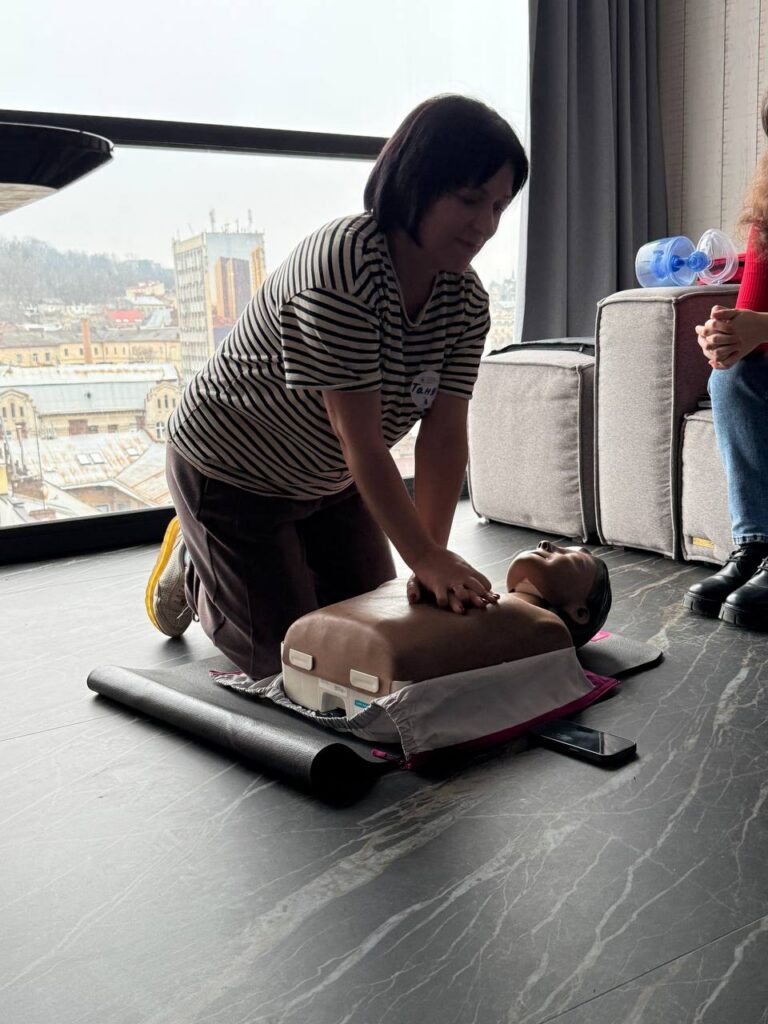
Let us outline the core first aid skills that everyone should possess:
- Bleeding control: the ability to apply a tourniquet, use haemostatic agents, and perform wound packing.
- Cardiopulmonary resuscitation (CPR): skills in performing chest compressions and rescue breathing.
- Airway management: the ability to recognise and relieve airway obstruction.
- Assessment of consciousness and breathing: the ability to quickly assess a person’s condition and determine the necessary actions.
- Bandaging and immobilisation: the ability to correctly apply dressings and immobilise limbs in the event of fractures.
In summary, safety training for journalists is not merely education — it is an investment in the lives and health of media professionals.
The team of the Association of Independent Regional Press Publishers of Ukraine plans to continue organising similar initiatives.
If you are planning an assignment to dangerous areas, be sure to arrange insurance coverage. APPLY FOR INSURANCE
***
The project is implemented by the Association of Independent Regional Press Publishers of Ukraine (AIRPPU) together with partners. The initiative is part of the Voices of Ukraine program, coordinated by the European Centre for Press and Media Freedom (ECPMF). Voices of Ukraine is carried out within the framework of the Hannah-Arendt-Initiative and funded by the German Federal Foreign Office.

The tenth safety training was held with the support of the European Centre for Press and Media Freedom (ECPMF)and Stichting Hulpacties DVHN, FrD en LC.