


“What struck me most was seeing a rescuer who had been working at a destroyed high-rise building — he couldn’t hold it in anymore, leaned against a tree, and cried.”
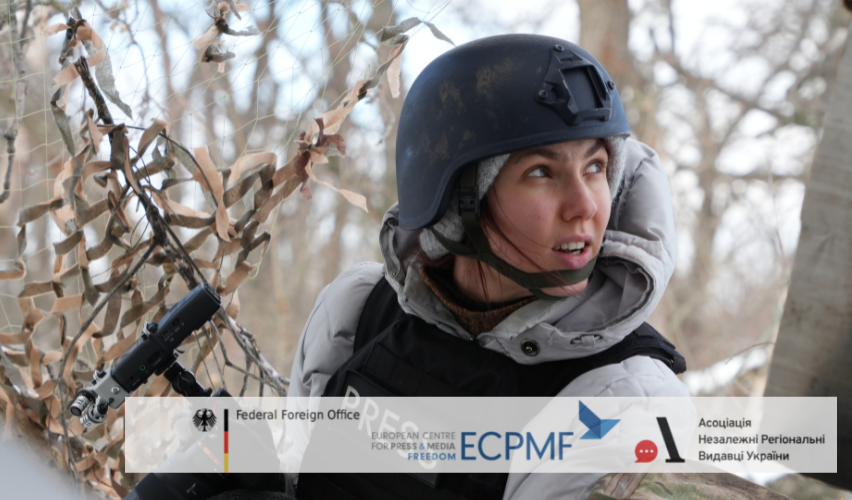
“Hello. Good afternoon. My name is Polina, I’m the editor of the multimedia department…” — our conversation with the editor of Kharkiv-based independent outlet Gwara Media began quite routinely. But within seconds, we were already talking about shelling, double-tap strikes, shelters, helmets, body armour, and drone detectors.
For journalists in Kharkiv, these topics have long become part of everyday life — yet they are acutely aware of all the risks they face.
“Since the start of the full-scale invasion, the media outlet has changed: instead of a platform about innovation and culture, we now have a news feed, fact-checking, frontline reporting, and systematic documentation of war crimes. The newsroom has about 30 people, most of them women — managers, editors, journalists. The average age of the team is 25,” says Polina Kulish, who is 23.
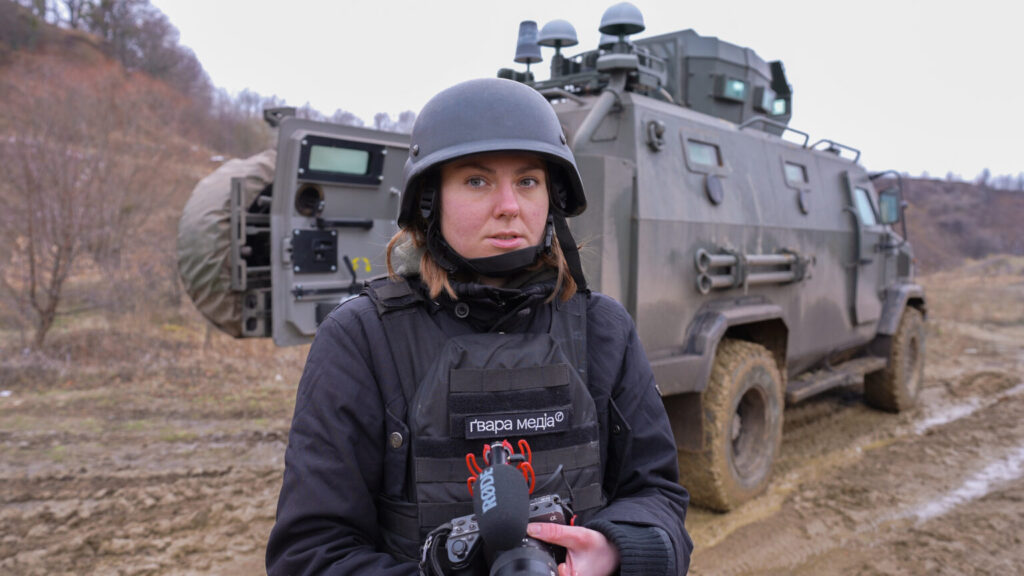
Despite their young age, the entire team takes safety issues very seriously.
“Crisis Shifts” as a Way to Survive
When shelling occurs, Gwara Media operates according to a predefined protocol.
“The key principle is not to go to the strike site until the attack is over. It sounds obvious, but this rule is often what separates a report from a tragedy.”
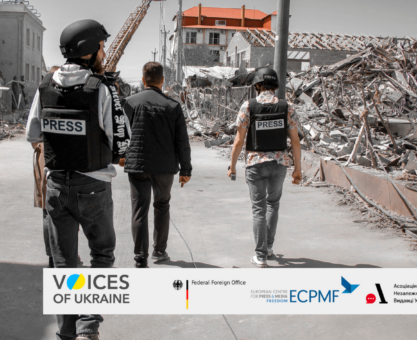
Deployments are organised as crisis shifts. A pair of people is on duty in rotation, and at least two always go to a shelling site: a journalist who shoots short vertical videos for social media and collects comments, and a multimedia producer who takes photos and videos for the archive — especially if the event is large-scale and resonant.
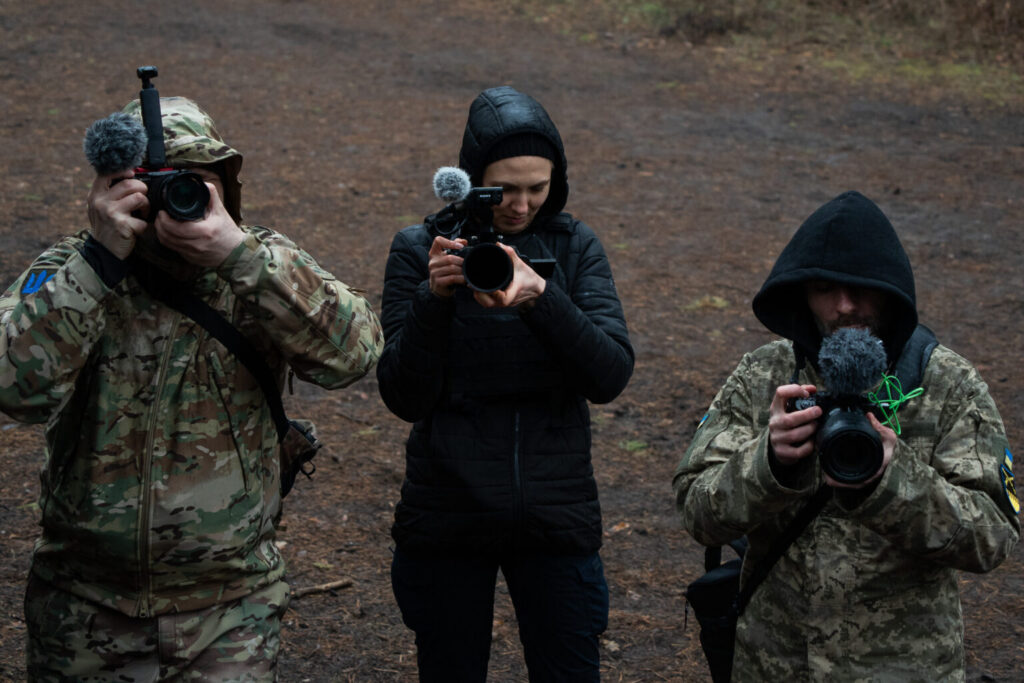
“‘Going to a shelling site’ is not just about arriving and filming. It’s logistics, equipment, communication, risk assessment, and understanding that the situation can change in a second. At night, if there are casualties or significant destruction, a driver joins the team; helmets and body armour are mandatory. They may also return in the morning, when it’s light and the scale of destruction is visible, to document the consequences in more detail.”
This is important because documenting war crimes requires repeated recording, details, and context. But every additional trip means additional risk. That is why the safety protocol here is not just an option — it is part of the newsroom’s culture.
The “Wait Until the Attack Is Over” Rule Does Not Guarantee Safety
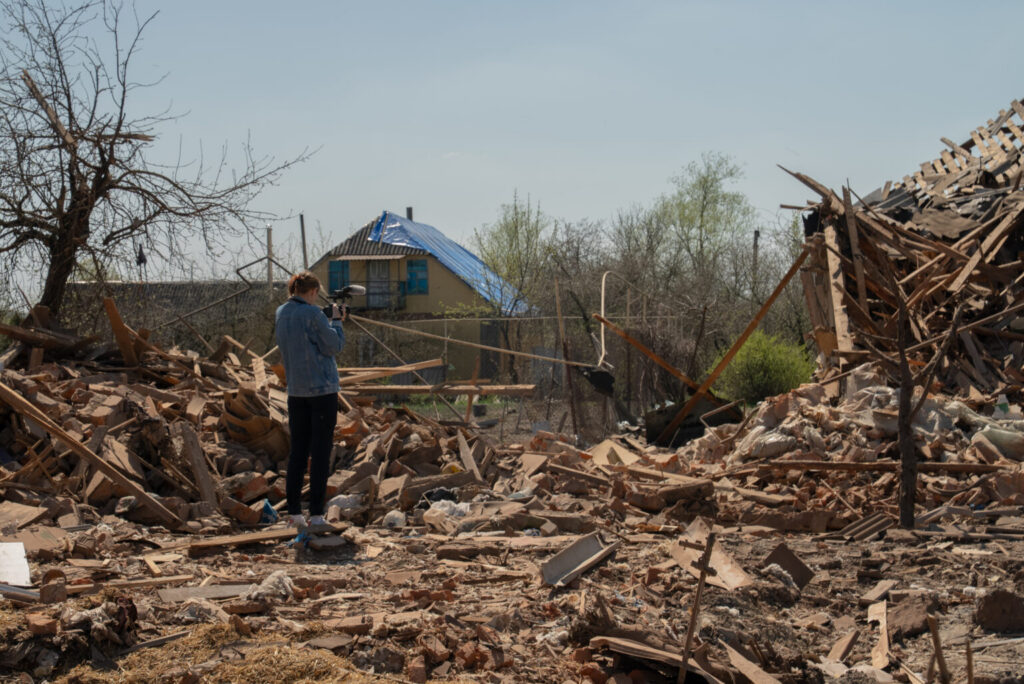
Even when journalists arrive after an attack has ended, risks remain. Polina recalls the strike on the Epicentr hypermarket:
“The team was on site, wearing protective gear, when a warning came through: ‘Something else is flying.’ They had to spread out and urgently look for shelter. That’s why safety algorithms include not only ‘don’t go during an attack,’ but also constant monitoring of alerts and being ready to stop work instantly.”
It is essential to know the routes to the nearest shelters and to strictly follow discipline — “no heroics,” even if the story is “hot,” the editor stresses. According to Polina, no one in their newsroom has been physically injured so far. At the same time, she knows of a journalist from another Kharkiv outlet who was wounded.
Footage You Can’t “Edit Out” of Your Memory
Talking about journalists’ safety is not only about body armour. It is also about how deeply war embeds itself in the mind. Polina talks about a trip her colleagues Viktoriia Mankovska and Denys Klymenko made to the site of a strike in Hroza, Kupiansk district:
“It was extremely hard work — morally very hard. Many dead, the smell, relatives in shock, tears, screams. Such trips can break even experienced professionals.”
To reduce the psychological burden, the newsroom uses rotation in crisis shifts so that the same people are not present at every tragedy.
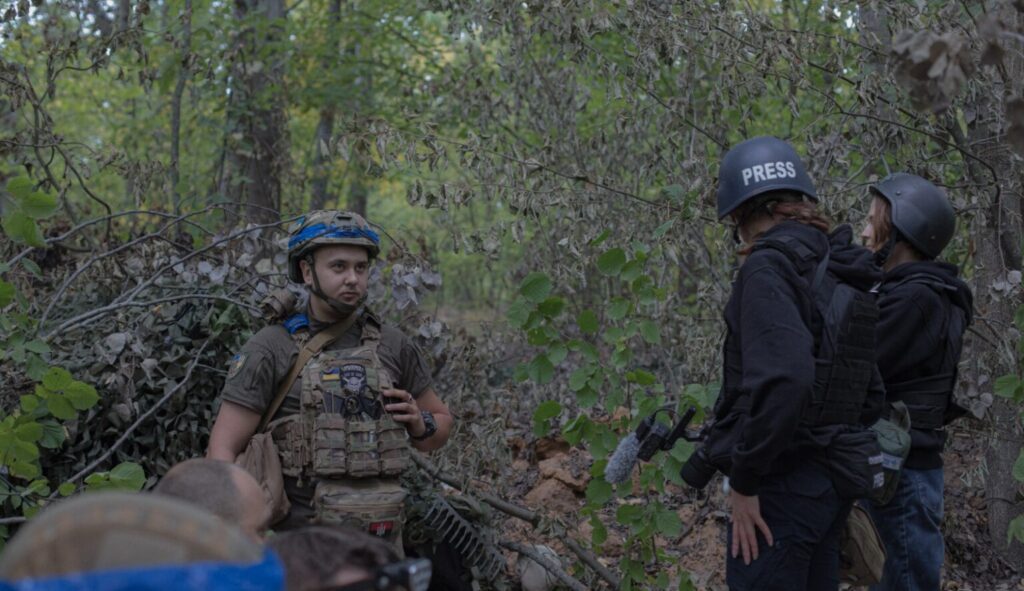
“During periods of intense shelling (in 2023–2024, when there could be three strikes a day), we switched to full crisis mode: everyone covered deployments, while part of the team stayed in the newsroom to process materials, prepare publications, and keep the news feed running…”
A particularly powerful episode that Polina “cannot erase from memory” happened on 23 January 2024: a missile hit a residential building, an entrance collapsed, and many people were killed. Severe frost, a search-and-rescue operation that lasted for days. And the image she keeps with her: a rescuer who couldn’t hold back and cried, leaning against a tree.
“When civilians cry, it’s heartbreaking. But when SESU rescuers or police officers cry — people who seem to be made of steel — it knocks the ground out from under your feet. Because it destroys the illusion that you can get used to this. Of course, you can learn to work. You can call shelling ‘routine,’ but internally it always remains a tragedy.”
Psychological safety for media workers requires the same kind of protocols as physical safety: rotation, the opportunity to rest, normalising seeking help, and recognising that being strong does not mean feeling nothing.
“Evidence for the Future” and a Message to Those Tired of the War
When asked about motivation, Polina answers without romanticising. She openly admits that images of destruction alone often fail to “break through” to Western audiences.
But media workers continue to do their job.
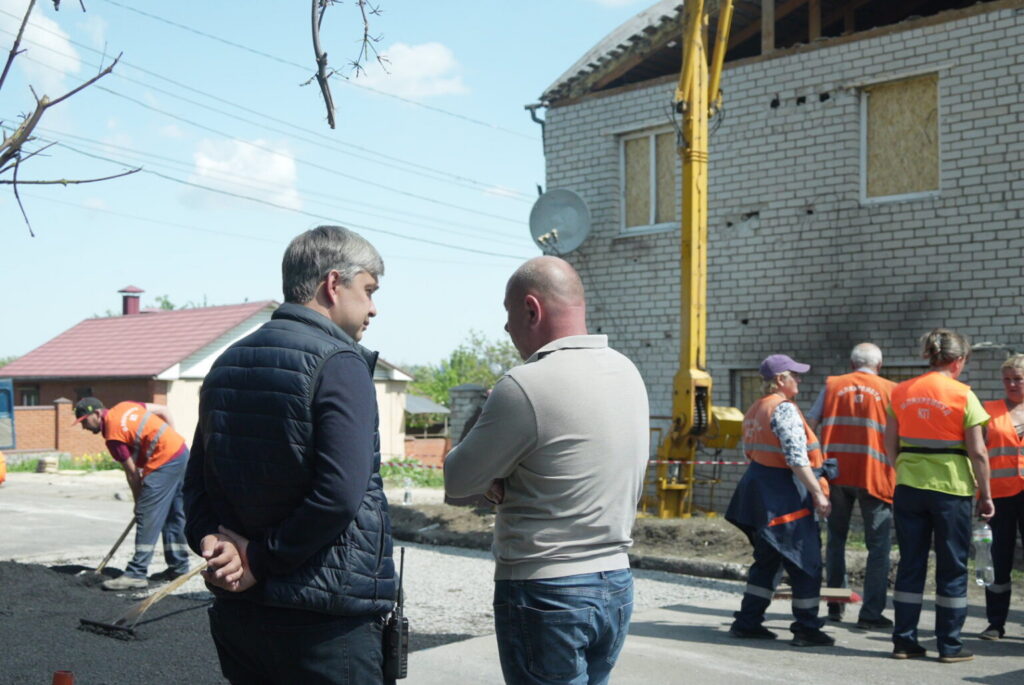
“First, to document a war crime, with the hope that the collected materials may become evidence in the future. Even if it sounds like an ‘idealistic dream,’ it is exactly such dreams that keep us in the profession. Second, it’s work ‘for our own’: to remind Ukrainian society that the war continues and that we cannot ‘get used to it’ to the point of stopping support for the army or ignoring reality just because ‘there are negotiations happening somewhere.’”
In addition to Ukrainian, Gwara Media has an English-language version, maintaining a bridge to an international audience.
“We are not only telling stories — we are preserving facts so that no one can later rewrite history. Our task is to leave testimony that will outlive the news cycle.”
The Biggest Change of the Past Year
The war changes safety standards so quickly that protocols that worked yesterday may be insufficient tomorrow — the biggest challenge for media workers today.
Although journalists currently do not go to positions because Russian drones control territory up to 10 km from the frontline, they constantly update their survival skills.
“When working in frontline towns and villages, we watch not only the sky — attacks may come from drones rather than artillery.”
Polina mentions the Tsukorok drone detector but notes that it is not always effective. Fibre-optic drones reduce the effectiveness of some detectors, which can no longer detect threats as they once did.
That is why the newsroom invests in training. Polina herself travelled to Kyiv for training in tactical medicine and counter-drone safety.
“And this is not a ‘bonus’ — it’s a necessity.”
Equipment and training are editorial resources on par with a camera. Journalistic work has become far more demanding and resource-intensive.
She gives an example: the newsroom planned a report with the police evacuation group White Angel. They went out three days in a row, trying to integrate into the group’s work, but weather conditions, drone threats, and the absence of evacuations prevented filming.
“What would have been one trip in peacetime becomes a series of attempts during war — each with its own risks and costs.”
That is why planning, risk assessment, and discipline are now core journalistic skills.
“And there is one more thing that can’t be written into a protocol, but without which nothing works: a newsroom culture where saying ‘Stop, it’s dangerous’ is normal — and where the journalist’s safe return matters as much as the story.”
Journalists’ Insurance: Why It Should Not Be Postponed
The Association of Independent Regional Press Publishers of Ukraine offers all media workers operating in dangerous areas the opportunity to obtain insurance to protect themselves and their loved ones. The project is part of the initiative of the International Insurance Fund for Journalists (IIFJ), implemented in partnership with Ukrainian and European organisations.
The terms of free insurance are outlined here.
You can apply here.
Media professionals working in the Kherson, Zaporizhzhia, Sumy, Mykolaiv, Donetsk, Luhansk, Odesa, Kharkiv, and Dnipropetrovsk regions, as well as in border areas of Kyiv and Chernihiv regions, are eligible to apply.
The project is implemented by the Association of Independent Regional Press Publishers of Ukraine (AIRPPU) together with partners. The initiative is part of the Voices of Ukraine program, coordinated by the European Centre for Press and Media Freedom (ECPMF). Voices of Ukraine is implemented within the Hannah Arendt Initiative and funded by the German Federal Foreign Office.